Contractual Hiring Trends: Geopolitics and Banking Rule Impacts
Source:Indian Express ↗
Why It Matters
This article is highly relevant for GS-3 Economy as it provides practical examples of how global events (geopolitics) and domestic monetary/regulatory policies (banking rules) directly impact employment generation, specifically the vulnerable contractual workforce.
Summary
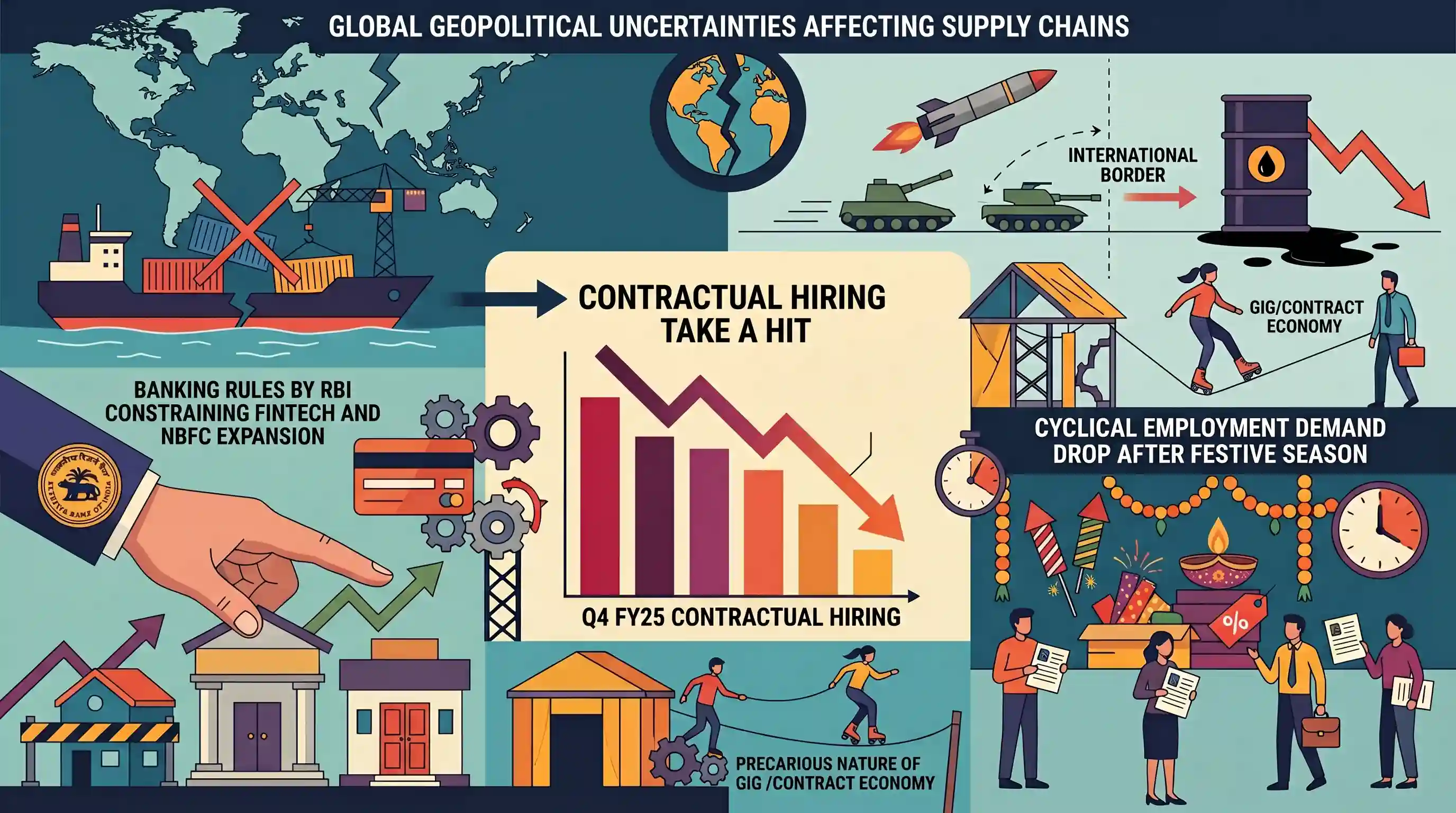
According to the Indian Staffing Federation, contractual hiring in India took a hit in the fourth quarter of FY25 (Q4FY25). This slowdown is primarily driven by a combination of global geopolitical uncertainties affecting supply chains, tighter banking rules implemented by the RBI that have constrained fintech and NBFC expansion, and the cyclical drop in employment demand following the end of the festive season. The trend highlights the precarious nature of the gig and contract economy, which remains highly sensitive to both domestic regulatory tightening and external macroeconomic shocks.
Key Points
- Contractual hiring in India has witnessed a noticeable slowdown in the fourth quarter of FY25, as reported by the Indian Staffing Federation.
- Global geopolitical uncertainties have negatively impacted export-oriented sectors and supply chains, causing employers to adopt a cautious approach toward temporary hiring.
- Stricter banking regulations, particularly the RBI's recent tightening on unsecured lending, have cooled down expansion and job creation within the fintech and NBFC sectors.
- The conclusion of the festive season has led to a cyclical drop in demand for gig and contract workers in retail, logistics, and e-commerce.
- The cumulative effect underscores the high vulnerability of India's informal and contractual workforce to both external macroeconomic shocks and internal regulatory shifts.
Important Terms
Indian Staffing Federation (ISF)

The apex industry body representing India's flexi-staffing and manpower outsourcing sector, facilitating formal employment for temporary and contract workers through triangular employment relationships.
UPSC context
Relevant for GS Paper III (Employment/Labor Reforms) and GS Paper II (Regulatory Governance and statutory consultations).
Reserve Bank of India (RBI)
India's central bank and regulatory body for the financial system; its recent tightening of digital lending and NBFC-fintech norms has impacted credit expansion and hiring.
UPSC context
Significant for GS Paper III (Indian Economy, Banking) and GS Paper II (Statutory/Regulatory Bodies).
Gig Economy
A labor market characterized by short-term contracts, freelance work, or platform-based tasks (e.g., Zomato, Uber) rather than traditional permanent employment.
UPSC context
Critical for GS Paper III (Employment, Inclusive Growth) and Paper I (Social issues/Work culture).
Informalisation of Workforce
The growing trend of shifting workers from formal to informal arrangements, often lacking job security, written contracts, and mandatory social security benefits.
UPSC context
Tests understanding of labor market vulnerabilities in GS Paper III (Growth, Development, and Employment).
Non-Banking Financial Companies (NBFCs)
Financial institutions providing banking-like services without a full banking license; they are crucial for credit delivery to underserved sectors but face stringent RBI compliance.
UPSC context
Core topic for GS Paper III regarding financial inclusion and resource mobilization.
Digital Lending Guidelines
RBI-mandated standards for app-based loans, requiring transparency, data protection, and direct fund transfers between regulated entities to protect consumers from predatory lending.
UPSC context
Relevant for GS Paper III (Economics/Fintech) and Paper II (Government Policies for various sectors).
Prelims Trap
Fixed-term contract workers are entirely excluded from statutory benefits like ESI and Provident Fund under Indian labour laws.
Under the 2018 rules, fixed-term workers are entitled to statutory benefits (ESI, PF, wages) proportionately equal to permanent workers, despite having no termination notice.
Static Concepts Connected
How does the RBI use risk weights to curb unsecured lending?
- Risk weights: The percentage of capital a bank must set aside against a loan. Higher weights mean banks hold more capital, making the loan costlier to disburse.
- Credit cooling: By raising risk weights on unsecured consumer loans and NBFC credit to 125%, the RBI directly restrains excessive lending and downstream corporate expansion.
How are gig workers protected under the Code on Social Security, 2020?
- Legal recognition: The Code explicitly defines 'gig' and 'platform' workers, legally distinguishing them from traditional employer-employee relationships for the first time in India.
- Dedicated fund: It mandates a dedicated Social Security Fund financed by a 1-2% levy on the aggregator's annual turnover, capped at 5% of worker payouts.
- National Board: Establishes a National Social Security Board specifically tasked with recommending and framing welfare schemes for unorganized, gig, and platform workers.
Cross-Topic Patterns
RBI regulations slowing informal job creation
Macro-prudential norms like increased risk weights limit NBFC credit. This cools fintech expansion, directly shrinking contractual hiring and showing how monetary tightening exacerbates workforce informalization vulnerabilities.
Geopolitics, exports, and fixed-term labor
Global supply chain disruptions hit India's export-manufacturing. Under the 2018 Fixed-Term Employment rules, these external macroeconomic shocks instantly translate into cyclical, notice-free layoffs for contract workers.

Expect a 2026 Prelims question linking RBI macro-prudential tools (risk weights) to downstream impacts on NBFCs and gig labor.
Linked PYQs · 3
Linked PYQs · 3
- 2016MainsGS3
How globalization has led to the reduction of employment in the formal sector of the Indian economy? Is increased informalization detrimental to the development of the country?
- 2025MainsGS3
What are the challenges before the Indian economy when the world is moving away from free trade and multilateralism to protectionism and bilateralism? How can these challenges be met?
- 2019PrelimsGS1
Consider the following statements : As per the Industrial Employment (Standing Orders) Central (Amendment) Rules, 2018 1. if rules for fixed-term employment are implemented, it becomes easier for the firms/companies to lay off workers 2. no notice of termination of employment shall be necessary in the case of temporary workman Which of the statements given above is/are correct?
