Child Pornography Legal Framework and Supreme Court Proceedings
Source:The Hindu ↗
આ શા માટે મહત્વનું છે
It highlights policy responses and legislative gaps regarding digital safety for children, balancing privacy, technology regulation, and child protection standards in India.
સારાંશ
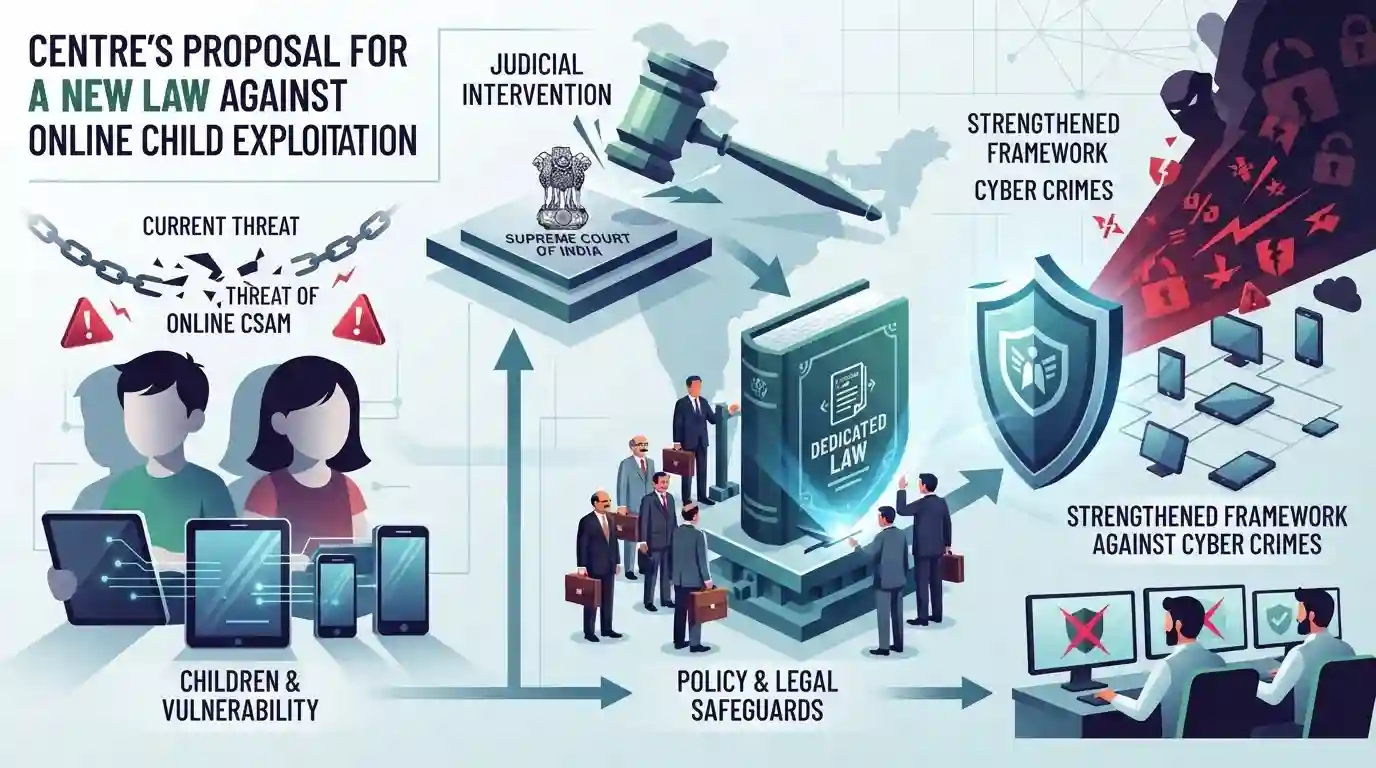
The Centre told the Supreme Court that it is contemplating enacting a dedicated law to address child pornography and child sexual abuse material (CSAM) to strengthen the legal framework against online crimes targeting children.
મુખ્ય મુદ્દા
- The Centre informed the Supreme Court that it is actively contemplating a specific law to deal with child pornography and child sexual abuse material (CSAM).
- Currently, such offences are primarily addressed through provisions of the POCSO Act and the Information Technology (IT) Act, but legal nuances regarding viewing, downloading, and possessing CSAM have required more comprehensive and explicit legislative intervention.
- The Supreme Court has been examining issues related to online child sexual abuse material and the obligations of tech intermediaries to prevent its circulation.
મહત્વપૂર્ણ શબ્દો
POCSO Act

India's primary legislation enacted in 2012 to protect children from sexual assault, harassment, and pornography, providing rigorous punitive measures and child-friendly judicial procedures.
UPSC context
UPSC GS Paper II (Vulnerable Sections - Children) and GS Paper III (Internal Security - Cyber Crimes); tests legal safeguards and child protection mechanisms.
Information Technology Act
A 2000 statute providing legal recognition for electronic transactions and penalizing cybercrimes, including Section 67B which specifically punishes the creation, browsing, or downloading of child sexual abuse material.
UPSC context
UPSC GS Paper III (Internal Security - Cyber Crimes & Prevention); tests regulatory frameworks for cyberspace and online offenses.
પ્રિલિમ્સ ટ્રેપ
Merely viewing or downloading child sexual abuse material without redistribution does not constitute a criminal offence under the POCSO Act.
Aspirants often assume downloading or viewing CSAM privately is not an offence under Indian law, missing the Supreme Court's explicit rulings under POCSO and the IT Act.
સંલગ્ન સ્થિર ખ્યાલો
What are the primary legal frameworks and judicial mandates addressing Child Sexual Abuse Material (CSAM) in India?
- POCSO Act 2012: POCSO Act criminalises sexual offences against children; courts have ruled that possessing, downloading, and viewing CSAM falls under its penal provisions.
- IT Act 2000: IT Act punishes publishing or transmitting obscene material involving children and mandates intermediaries to remove unlawful content promptly.
- Intermediary Liability: Safe Harbour Protection under Section 79 can be revoked if intermediaries fail to exercise due diligence in removing CSAM.
આંતર-વિષય પેટર્ન
CSAM + Intermediary Liability & Safe Harbour
Online child safety intersects with intermediary liability rules under IT Act Section 79, testing the balance between free speech, user privacy, and strict platform compliance.
Judicial Activism + Digital Forensics & Privacy
Judicial directives to establish centralized national hash databases for tracking CSAM link digital rights with domestic criminal investigation frameworks.

CSAM legal frameworks, intermediary safe-harbour exemptions, and POCSO/IT Act overlaps are prime for a multi-statement prelims question.
સંલગ્ન PYQ · 2
સંલગ્ન PYQ · 2
- 2025MainsGS2
The National Commission for Protection of Child Rights has to address the challenges faced by children in the digital era. Examine the existing policies and suggest measures the Commission can initiate to tackle the issue.
- 2020MainsGS3
Discuss different types of cyber crimes and measures required to be taken to fight the menace.
