Water Contamination and Amoebic Meningoencephalitis in Kerala
Source:The Hindu ↗
Why It Matters
Highlights the intersection of climate change (rising temperatures), inadequate sanitation infrastructure (septic tanks near wells), and public health crises (water-borne pathogens like brain-eating amoebas), a recurring theme in UPSC S&T and Environment sections.
Summary
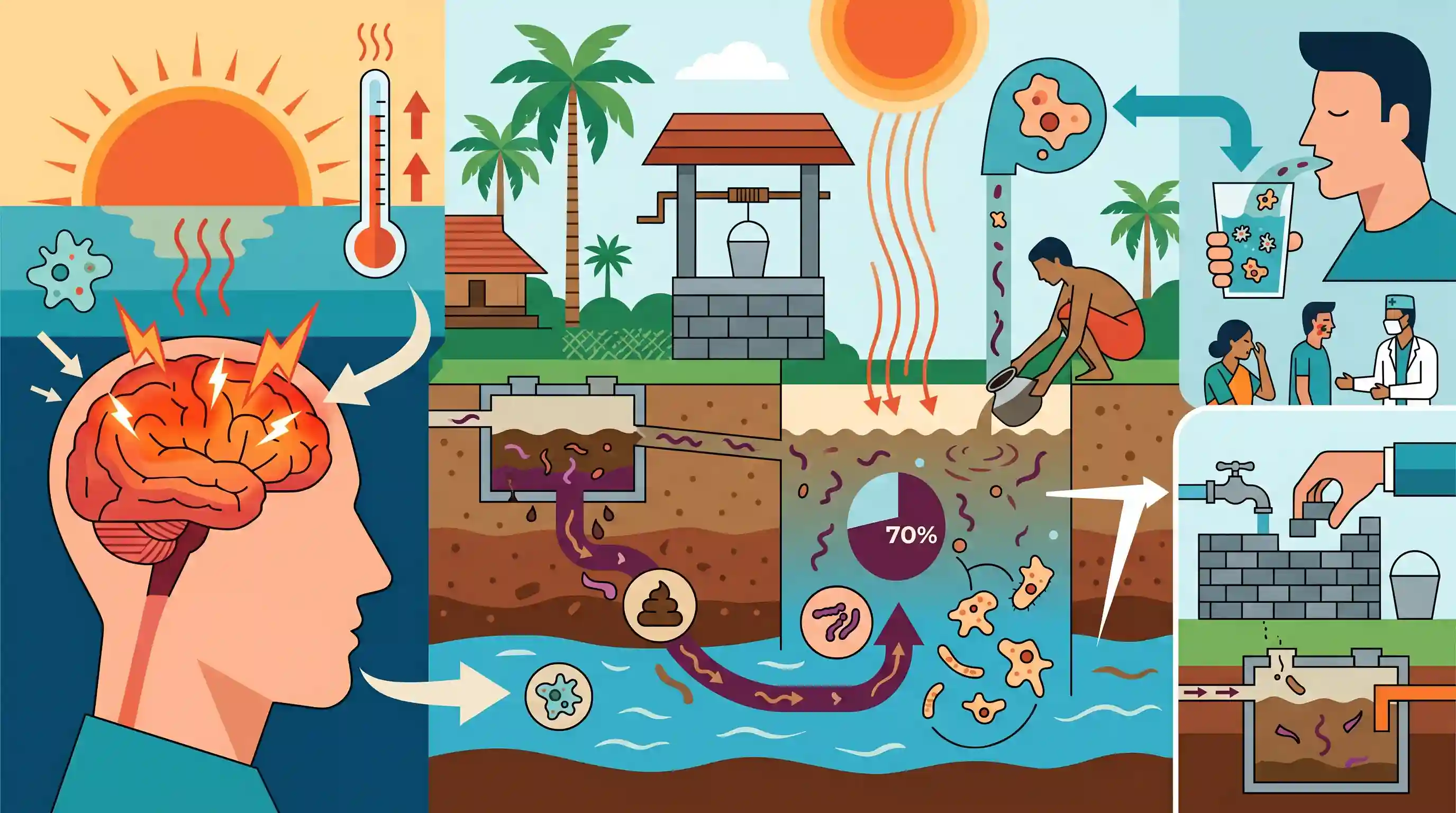
The surge in amoebic meningoencephalitis in Kerala is increasingly linked to the contamination of domestic water sources and environmental changes. Pathogens like Acanthamoeba and Naegleria fowleri are thriving due to rising ambient temperatures and poor water quality. Studies by the Centre for Water Resources Development and Management (CWRDM) indicate that over 70% of open wells in Kerala have high faecal contamination, exacerbated by the close proximity of poorly constructed septic tanks. Addressing these infrastructure and environmental issues is critical to preventing further outbreaks of water-borne brain infections.
Key Points
- Kerala has seen a surge in cases of amoebic meningoencephalitis, primarily driven by the contamination of domestic water sources such as open wells, ponds, and storage tanks.
- The infections are caused by free-living amoebae (FLA) including Acanthamoeba and Naegleria fowleri. Acanthamoeba typically causes a chronic condition called granulomatous amoebic encephalitis (GAE), whereas Naegleria fowleri causes acute infection.
- Environmental factors, specifically the rise in ambient temperatures, are facilitating the persistence and increased density of these pathogens in water bodies.
- Poor water quality is a major driver of the outbreak. Over 70% of open wells in Kerala are highly contaminated with faecal coliform or E. coli bacteria.
- A major contributing factor to groundwater pollution in the state is the proximity of poorly constructed septic tanks to drinking water wells, with studies showing 77% of wells have septic tanks within a 7.5-meter radius.
Important Terms
Primary Amoebic Meningoencephalitis (PAM)

A rare, typically fatal brain infection caused by the Naegleria fowleri amoeba. It results in severe inflammation and destruction of brain tissue after the pathogen enters through the nasal passages.
UPSC context
GS Paper III (Science & Technology - Health); important for understanding emerging infectious diseases and public health challenges in India.
Naegleria fowleri
Often called the "brain-eating amoeba," this single-celled organism thrives in warm freshwater. It infects humans via the nose during water activities, traveling to the brain via the olfactory nerve.
UPSC context
GS Paper III (Health); relevant for prelims (pathogen characteristics) and mains (impact of climate change on disease spread).
Centre for Water Resources Development and Management (CWRDM)
An autonomous R&D institution under the Government of Kerala that monitors water quality and resources. It recently highlighted that 70% of Kerala's open wells suffer from bacteriological contamination.
UPSC context
GS Paper II/III (Governance/Water Resources); tests knowledge of state-level institutions managing water safety and environmental health.
Indian Medical Association (IMA)
A national voluntary organization representing doctors of modern medicine in India. It works to improve public health, medical education, and the interests of the medical profession.
UPSC context
GS Paper II (Health Policy/Governance); relevant for discussions on medical ethics, health infrastructure, and professional bodies.
Faecal Coliform
Bacteria found in the intestines of warm-blooded animals; their presence in water sources indicates contamination by human or animal waste, signaling a high risk for water-borne diseases.
UPSC context
GS Paper III (Environment/Pollution); critical for questions on groundwater quality, sanitation standards, and Sustainable Development Goal 6 (Clean Water).
Prelims Trap
Naegleria fowleri infections are primarily caused by drinking contaminated groundwater.
While the pathogen lives in contaminated water, it cannot infect a person if swallowed. It must enter through the nose to reach the brain.
Static Concepts Connected
What are the primary indicators of water pollution in domestic sources?
- Coliform Bacteria: The presence of bacteria like E. coli acts as a primary indicator of faecal contamination from sewage or septic leakage.
- Biological Oxygen Demand: Measures the amount of dissolved oxygen needed by aerobic organisms to break down organic material. High BOD indicates severe organic pollution.
How do poorly managed septic tanks impact groundwater health?
- Pathogen Leaching: Unlined or poorly constructed tanks leak pathogens (like free-living amoebae and coliforms) directly into surrounding aquifers.
- Nitrate Contamination: Sewage leaching introduces high levels of nitrates into groundwater, which can cause Methemoglobinemia (Blue Baby Syndrome) in infants.
Cross-Topic Patterns
Climate Change and Pathogen Spread
Rising ambient temperatures increase the proliferation of thermophilic organisms like Naegleria fowleri in freshwater, linking global warming directly to new public health crises beyond traditional vector-borne diseases.
Urban Sanitation vs. Aquifer Health
Kerala's high water tables combined with reliance on decentralized, poorly constructed septic tanks highlight the complex trade-offs between local sanitation infrastructure and groundwater aquifer health.

Expect a Prelims question on Naegleria fowleri testing its specific transmission route (nasal, not drinking) and its climate-warming link.
Linked PYQs · 2
Linked PYQs · 2
- 2024MainsGS3
The world is facing an acute shortage of clean and safe freshwater. What are the alternative technologies which can solve this crisis? Briefly discuss any three such technologies citing their key merits and demerits.
- 2024MainsGS3
Industrial pollution of river water is a significant environmental issue in India. Discuss the various mitigation measures to deal with this problem and also the government's initiatives in this regard.
