Supreme Court Directs Rajasthan Action Plan for Luni River Pollution
Source:The Hindu ↗
Why It Matters
The Luni river and its tributaries form the most crucial drainage system in the arid and semi-arid regions of Western Rajasthan. Industrial pollution in this basin directly impacts agriculture, drinking water, and the fragile desert ecosystem. RPSC Prelims frequently tests candidates on Rajasthan's drainage network and environmental issues.
Summary
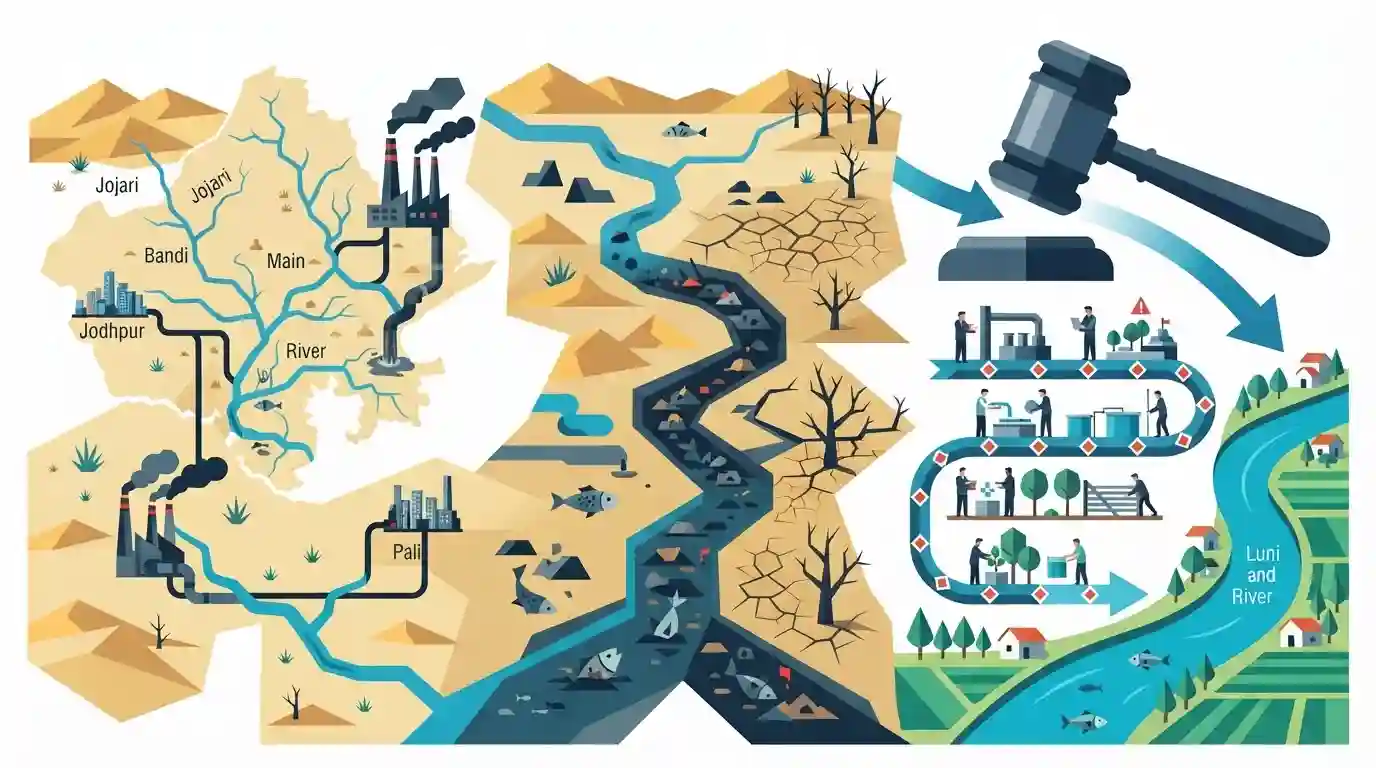
The Supreme Court of India has ordered the Rajasthan government to formulate a comprehensive 20-point resolution plan to combat the severe industrial pollution afflicting the Jojari, Bandi, and Luni rivers. Taking suo motu cognisance of the unchecked discharge of industrial waste, particularly from the industrial hubs of Jodhpur and Pali, the court highlighted the ecological threat to the Luni river basin, where these tributaries converge near Balotra. The intervention follows the creation of a high-level ecosystem oversight committee designed to identify and address the systemic causes of river contamination in the arid region.
Key Points
- The Supreme Court has directed the Rajasthan government to prepare a 20-point resolution plan to address the severe contamination of the Jojari, Bandi, and Luni rivers.
- The apex court took suo motu cognisance of the rampant discharge of industrial effluents into the Jojari river.
- The Bandi river, passing through the heavily industrialized town of Pali, and the Jojari river, passing through Jodhpur, are major tributaries of the Luni river.
- These polluted tributaries merge with the Luni river near Balotra, threatening the entire drainage basin in western Rajasthan.
- A high-level ecosystem oversight committee was constituted last year by the SC to investigate the fundamental causes of environmental degradation in these rivers.
Important Terms
Luni River

A major ephemeral river in western Rajasthan originating in the Aravalli Range. It flows southwest through the Thar Desert before terminating in the marshy salt flats of the Rann of Kutch, forming a key inland drainage system.
UPSC context
GS Paper I (Geography - Indian Drainage Systems). Tests knowledge of inland drainage networks, desert hydrology, and western Indian physiography.
Jojari River
A seasonal, right-bank tributary of the Luni River originating in Nagaur, Rajasthan. Known as "Maru Ganga," it has recently suffered severe ecological degradation due to unchecked industrial effluents and untreated municipal sewage from Jodhpur.
UPSC context
GS Paper I (Geography) & GS III (Environmental Pollution). Tests understanding of localized desert river hydrology and the impacts of industrial waste.
High-Level Ecosystem Oversight Committee
A court-appointed monitoring body chaired by a retired High Court Judge, established by the Supreme Court of India to inspect, coordinate, and oversee the restoration of Rajasthan’s highly polluted Jojari-Bandi-Luni river system.
UPSC context
GS Paper II (Judiciary) and GS Paper III (Environment). Tests knowledge of judicial oversight bodies and systemic solutions to environmental crises.
20-point resolution plan
A comprehensive roadmap suggested by the Supreme Court, requiring the Rajasthan Chief Secretary to coordinate multiple state departments to tackle industrial pollution, remove riverbed encroachments, and rejuvenate the Jojari, Bandi, and Luni rivers.
UPSC context
GS Paper II (Governance) & GS Paper III (Environmental Protection). Tests ability to evaluate policy solutions, administrative coordination, and river restoration models.
Suo Motu Cognisance
The legal power of Indian courts (under Articles 32 and 226) to initiate judicial proceedings on their own accord without a formal petition, frequently utilized to address urgent public interest and environmental issues.
UPSC context
GS Paper II (Polity & Constitution). Tests understanding of judicial activism, constitutional remedies, and the proactive role of the judiciary.
National Green Tribunal
A specialized statutory body established in 2010 under the National Green Tribunal Act, dedicated to the effective and expeditious disposal of cases relating to environmental protection, conservation of forests, and other natural resources.
UPSC context
GS Paper II (Statutory Bodies) and GS Paper III (Environment). Tests knowledge of environmental adjudication frameworks and fast-track ecological dispute resolution.
Prelims Trap
"All major tributaries of the Luni river, including the Jojari, originate in the Aravalli range."
The Jojari is unique because it is the only major tributary of the Luni that joins from the right bank and does NOT originate in the Aravallis.
Static Concepts Connected
What are the unique geographical characteristics of the Luni River system?
- Inland drainage: It originates in the Aravallis (Naga Hills) and forms an ephemeral system that does not reach the sea, instead dissipating into the Rann of Kutch.
- Right-bank anomaly: The Jojari river is its only major right-bank tributary and the only one that does not originate in the Aravalli hills.
- Salinity shift: The river contains fresh water up to Balotra, after which it turns increasingly brackish due to high salt content in the surface soils of the region.
What is the constitutional basis for the Supreme Court's suo motu environmental interventions?
- Article 21 expansion: The Court broadly interprets the Right to Life to inherently encompass the right to a clean environment, pollution-free water, and air.
- Public Trust Doctrine: The state acts as a trustee of natural resources like rivers and lakes, making it constitutionally obligated to proactively prevent ecological degradation.
Cross-Topic Patterns
Textile dyeing and groundwater toxicity
Pali and Balotra's synthetic textile hubs discharge acidic effluents, connecting arid-region drainage systems to environmental chemistry topics like heavy metal and azo dye groundwater pollution.
Inland drainage and salt marsh ecology
The Luni's ephemeral discharge eventually reaches the Rann of Kutch, linking upstream industrial river pollution directly to the degradation of a major downstream salt marsh ecosystem.

Expect a multi-statement geography question testing Luni's inland drainage, its non-Aravalli tributary (Jojari), and brackish transition.
Linked PYQs · 2
Linked PYQs · 2
- 2024RPSC_PRELIMSGS1
Which of the following is correct regarding Rajasthan Bharatpur – Rajasthan Berger? A. Luni Basin and Southwest Rajasthan Border are part of Rajasthan Berger. B. Ghagghar Plain covers mainly the North Rajasthan. C. Rajasthan Plain does have salty lakes and inland drainage. D. Bhilwara district is a part of all the above things of Rajasthan. Select the correct answer using the codes given below:
- 2023RPSC_PRELIMSGS1
NTU (NTU) is a unit of measurement for
