Waterborne Disease Outbreak in Ratlam District of Madhya Pradesh
Source:The Hindu ↗
Why It Matters
Highlights the intersection of public health infrastructure and community behavior, demonstrating how taste preferences can lead rural populations to reject safe piped water in favor of unsafe traditional sources, triggering local health emergencies.
Summary
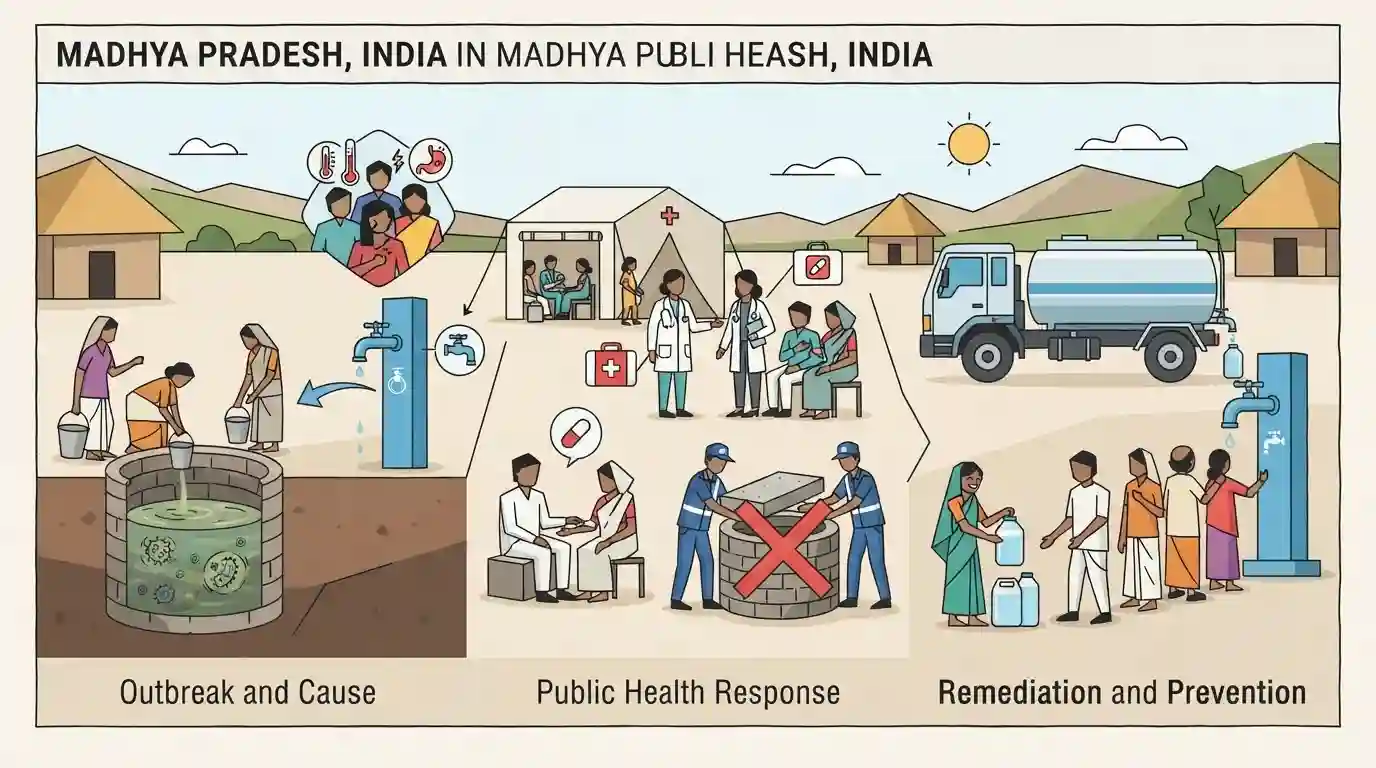
Over 80 villagers in Madhya Pradesh's Ratlam district fell ill with waterborne disease symptoms after consuming contaminated well water. The incident highlights behavioral challenges in rural health, as villagers preferred unsafe traditional well water over treated piped water due to taste preferences. Health teams have since treated the affected, sealed the well, and supplied safe drinking water.
Key Points
- Over 80 residents of Azampur Dodiya village in Ratlam district fell ill with vomiting, diarrhoea, and abdominal pain after drinking contaminated well water.
- 21 patients were admitted to the Piploda civil hospital and have since been discharged.
- Villagers bypassed the available government-provided piped water supply, preferring the well water due to finding the piped water 'bland' in taste.
- The local Health Department conducted a door-to-door survey, supplied safe drinking water via tankers, and sealed the contaminated well pending laboratory analysis.
Important Terms
Jal Jeevan Mission

A centrally sponsored scheme under the Ministry of Jal Shakti aiming to provide safe and adequate drinking water through Functional Household Tap Connections (FHTCs) to all rural households.
UPSC context
GS Paper II (Government Schemes) and GS Paper III (Water Resources); tests knowledge of rural infrastructure, water security, and public health governance.
Waterborne Diseases
Illnesses caused by pathogenic microorganisms—like bacteria, viruses, and parasites—transmitted through contaminated water, posing a major public health challenge in areas with inadequate sanitation.
UPSC context
GS Paper II (Social Sector/Health); tests awareness of public health challenges, epidemiological patterns, and the socio-economic impacts of poor sanitation.
Behavioral Change Communication (BCC)
A strategic, interactive process designed to promote and sustain positive, healthy behaviors in individuals and communities through targeted messaging, community engagement, and social mobilization.
UPSC context
GS Paper II (Governance and Health); tests ability to analyze socio-cultural obstacles in scheme implementation and design community-centric policy solutions.
Functional Household Tap Connection (FHTC)
A tap water connection provided directly to a household, guaranteeing regular delivery of at least 55 liters of safe, potable water per capita per day.
UPSC context
GS Paper II (Government Schemes) & GS Paper III (Infrastructure); tests technical targets and service delivery benchmarks of rural water supply policies.
Water Quality Monitoring
The regular, systematic testing of water bodies and drinking supply sources for physical, chemical, and biological contaminants to ensure safety standards and prevent public health crises.
UPSC context
GS Paper III (Environment & Infrastructure); tests knowledge of water resource management, technological interventions in sanitation, and preventive public health measures.
Public Health Governance
The administrative coordination of health policies, regulatory frameworks, public departments, and community actions to protect and improve public health, manage outbreaks, and ensure healthcare delivery.
UPSC context
GS Paper II (Issues relating to Health and Governance); tests understanding of administrative frameworks, institutional coordination, and policy delivery in social sectors.
Health Department
The administrative division of the government responsible for implementing healthcare policies, managing public health emergencies, monitoring disease outbreaks, and ensuring localized delivery of medical services.
UPSC context
GS Paper II (Governance and Health); tests understanding of administrative divisions, coordination in crisis management, and public service delivery at regional levels.
Prelims Trap
Deep groundwater aquifers are the primary source of acute microbial outbreaks, whereas shallow wells only face heavy metal toxicity.
It reverses the truth. Shallow water tables suffer from surface microbial runoff causing acute infections, while deep aquifers are vulnerable to long-term geogenic chemical leaching.
Static Concepts Connected
What is the institutional framework and decentralized governance of the Jal Jeevan Mission?
- Constitutional Status: Drinking water is a State subject, leaving planning, approval, and execution of supply schemes to state governments.
- Decentralized Execution: Gram Panchayat-led Paani Samitis (Village Water and Sanitation Committees) oversee operations and maintenance of local supply networks.
- Gender Mandate: At least 50% of Paani Samiti members must be women, with five women trained per village to use water testing kits.
How do microbial and geogenic water pollutants differ in their occurrence and health impacts?
- Microbial Pathogens: Infect shallow water tables causing acute diseases like cholera and typhoid; closely tied to open defecation and sanitation failures.
- Geogenic Contamination: Involves deep aquifer chemicals like arsenic, fluoride, and uranium, causing chronic conditions like fluorosis and blackfoot disease.
- Heavy Metals: Industrial effluents introduce toxic metals like cadmium (causing Itai-Itai) and lead, contaminating nearby groundwater systems.
Cross-Topic Patterns
Behavioral Economics and Rural Health
The transition to safe piped water requires overcoming behavioral biases and sensory preferences, emphasizing the need for social and behavior change communication in rural health governance.
Industrial Heavy Metal Runoff
Industrial runoff in hotspots like Ratlam links heavy metal pollution (e.g., Cadmium causing Itai-Itai disease) to environmental regulatory failures under the Water Act.

UPSC 2026 may test Jal Jeevan Mission 2.0 targets alongside the science of geogenic deep-aquifer pollutants vs shallow microbial contamination.
Linked PYQs · 3
Linked PYQs · 3
- 2022MPPSC_PRELIMSGS1
Which of the following districts has maximum forest area as a percentage of the geographical area?
- 2017MPPSC_PRELIMSGS1
Which of the following diseases is caused by protozoa?
- 2022MPPSC_PRELIMSGS1
Which pollution causes Itai-Itai disease in human beings?
