Industrial Groundwater Contamination and Public Health Risks in UP
Source:The Hindu ↗
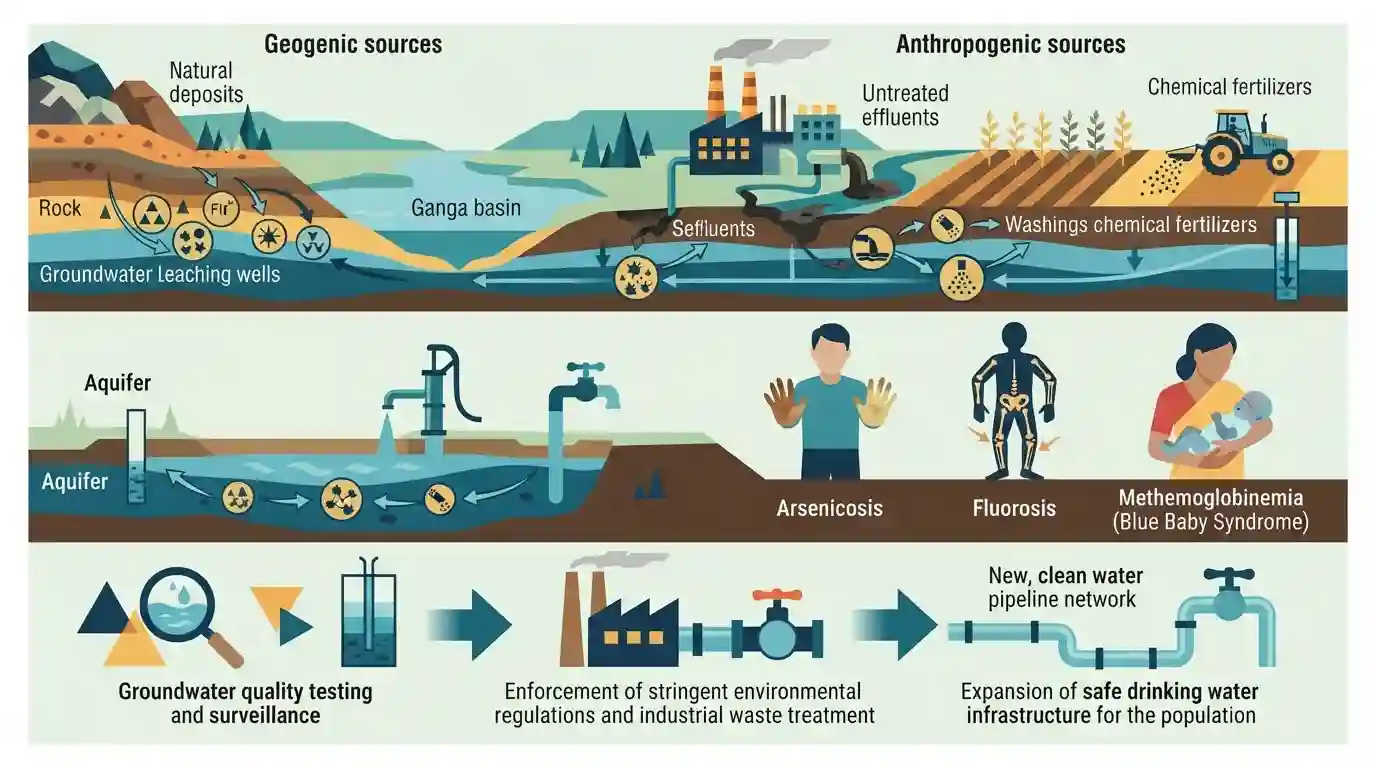
কেন এটি গুরুত্বপূর্ণ
Groundwater contamination by heavy metals (like chromium, arsenic, and uranium) is a recurring theme in UPSC exams. This specific case study of toxic yellow-green water highlights the intersection of industrial growth, environmental degradation, regulatory apathy, and public health, making it highly relevant for GS3 (Environment) and GS2 (Governance/Health).
সারসংক্ষেপ
The article highlights a severe public health and environmental crisis in Uttar Pradesh, where groundwater in industrial areas has become so contaminated that it glows yellow-green. This phenomenon is primarily driven by the unregulated discharge of toxic industrial effluents—particularly heavy metals like hexavalent chromium from tanneries and chemical units—into local aquifers. Residents relying on handpumps for drinking water are exposed to severe health hazards, including skin diseases and carcinogenic risks. The situation underscores systemic regulatory failures by pollution control boards to monitor Common Effluent Treatment Plants (CETPs) and penalize polluting industries. Addressing this issue requires urgent provision of safe piped water under the Jal Jeevan Mission, strict enforcement of environmental laws, and the implementation of aquifer remediation technologies.
মূল বিষয়
- Groundwater in certain industrial belts of Uttar Pradesh has turned toxic, appearing yellow-green due to unchecked discharge of industrial effluents, particularly hexavalent chromium from tanneries.
- Consumption and usage of this highly contaminated water from handpumps pose severe health risks, including skin lesions, gastrointestinal diseases, and cancer.
- The crisis highlights regulatory failures in monitoring Common Effluent Treatment Plants (CETPs) and enforcing the 'Polluter Pays' principle against violating industries.
- Urgent interventions are needed, including sealing contaminated handpumps, ensuring alternative safe drinking water supply (such as through the Jal Jeevan Mission), and bioremediation of aquifers.
গুরুত্বপূর্ণ শব্দ
Jal Jeevan Mission

A flagship centrally sponsored initiative of the Ministry of Jal Shakti aiming to provide safe, adequate Functional Household Tap Connections (FHTC) to all rural households in India.
UPSC context
GS Paper II (Governance) & GS Paper III (Water Resources); tests knowledge of rural drinking water schemes and public health.
Central Ground Water Board (CGWB)
India's apex scientific and technical organization under the Ministry of Jal Shakti, responsible for exploring, monitoring, assessing, and managing India's groundwater resources.
UPSC context
GS Paper III (Water Resources); tests understanding of aquifer mapping, groundwater quality monitoring, and depletion issues.
Water (Prevention and Control of Pollution) Act, 1974
India's foundational environmental law enacted to prevent and control water pollution, restore water wholesomeness, and establish Central and State Pollution Control Boards.
UPSC context
GS Paper III (Environmental Legislation); foundational for analyzing industrial effluent standards, consent regimes, and federal pollution control.
Central Pollution Control Board (CPCB)
A statutory body established under the Water Act, 1974, responsible for advising the central government, setting environmental quality standards, and coordinating state-level boards.
UPSC context
GS Paper II & III (Governance & Environment); tests environmental regulatory frameworks, pollution monitoring, and central-state coordination.
State Pollution Control Board (SPCB)
A state-level statutory authority established under the Water Act, 1974, responsible for regulating regional pollution, monitoring industrial compliance, and issuing effluent discharge consents.
UPSC context
GS Paper II & III (Federalism & Environmental Regulation); tests local compliance, decentralised pollution control, and industrial clearance.
Environment Protection Act, 1986
India's umbrella environmental legislation enacted under Article 253 following the Bhopal tragedy, empowering the Central Government to protect environmental quality and regulate hazardous substances.
UPSC context
GS Paper III (Environmental Protection & Legislation); tests core environmental governance, Environmental Impact Assessment, and center's rule-making powers.
National Green Tribunal (NGT)
A specialized, fast-track statutory judicial body established in 2010 to expedite the disposal of civil cases involving environmental protection, conservation, and legal rights.
UPSC context
GS Paper II & III (Judiciary & Environmental Justice); tests environmental dispute resolution, green jurisprudence, and active compliance enforcement.
প্রিলিমস ফাঁদ
Trivalent chromium and Hexavalent chromium are equally toxic, carcinogenic, and strictly prohibited from entering human metabolic pathways.
Trivalent chromium (Cr-III) is actually an essential dietary nutrient in trace amounts, whereas Hexavalent chromium (Cr-VI) is highly toxic, mobile, and classified as a Group 1 carcinogen.
সংযুক্ত স্থির ধারণা
What are the differences between Trivalent and Hexavalent Chromium in groundwater?
- Oxidation states: Trivalent chromium (Cr-III) is stable and less mobile; Hexavalent chromium (Cr-VI) is highly soluble, mobile, and toxic.
- Biological role: Cr-III is an essential micronutrient for human insulin and lipid metabolism; Cr-VI has no biological role and is mutagenic.
- Remediation: Bioremediation often involves reducing mobile Cr-VI to the less toxic and insoluble Cr-III using specific bacteria.
What is the Polluter Pays Principle under Indian environmental jurisprudence?
- Definition: Absolute liability holding the polluter liable for compensating victims and restoring environmental degradation.
- Judicial origin: Mainstreamed by the Supreme Court in the Vellore Citizens case (1996) as part of sustainable development.
- Statutory backing: Embedded implicitly within the National Green Tribunal Act, 2010, directing the tribunal to apply this principle.
আন্তঃবিষয় প্যাটার্ন
Water federalism vs. Central schemes
The gap between central drinking water targets (Jal Jeevan Mission) and state-level industrial regulation highlights how poor local enforcement directly sabotages national public health outcomes.
Export competitiveness vs Environmental compliance
Kanpur's leather export hub faces a trade-off: failing to internalize pollution costs violates environmental law and invites international ESG-based trade barriers.

Heavy metal groundwater contaminants (Chromium, Arsenic) and their bioremediation techniques are highly likely in multi-statement MCQs.
সংযুক্ত PYQ · 3
সংযুক্ত PYQ · 3
- 2013PrelimsGS1
Which of the following can be found as pollutants in the drinking water in some parts of India? 1. Arsenic 2. Sorbitol 3. Fluoride 4. Formaldehyde 5. Uranium Select the correct answer using the codes given below.
- 2024MainsGS3
Industrial pollution of river water is a significant environmental issue in India. Discuss the various mitigation measures to deal with this problem and also the government's initiatives in this regard.
- 2025MainsGS3
Mineral resources are fundamental to the country's economy and these are exploited by mining. Why is mining considered an environmental hazard? Explain the remedial measures required to reduce the environmental hazard due to mining.
