Groundwater Contamination in Uttar Pradesh and Public Health Crises
Source:thehindu ↗
Why It Matters
Groundwater serves as the primary source of drinking water and irrigation for the majority of Uttar Pradesh's population. Contamination directly threatens public health, agricultural safety, and demographic dividends, making it a pivotal issue for environmental governance and sustainable development in the state.
Summary
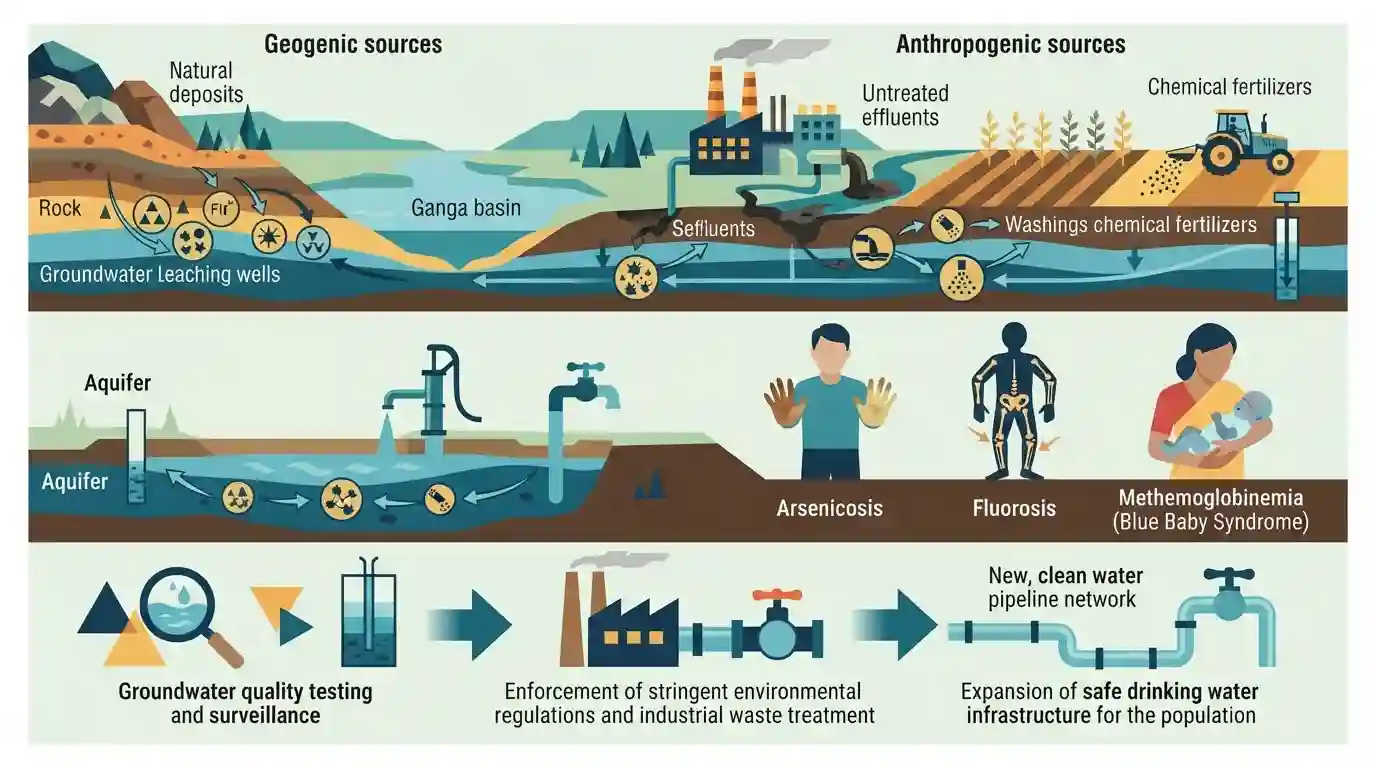
The article highlights a severe public health crisis in Uttar Pradesh driven by widespread groundwater contamination. Aquifers across various districts are polluted with hazardous levels of arsenic, fluoride, nitrates, and heavy metals. This contamination stems from a combination of geogenic factors—such as natural arsenic in the Ganga basin—and anthropogenic activities, including untreated industrial effluents from tanneries in Kanpur and Unnao, as well as agricultural fertilizer runoff. The polluted drinking water is linked to debilitating health conditions, including arsenicosis, fluorosis, and methemoglobinemia (Blue Baby Syndrome). The situation underscores an urgent need for the government to enforce stringent environmental regulations, monitor groundwater quality, and expand safe drinking water infrastructure to protect vulnerable populations.
Key Points
- Groundwater in multiple Uttar Pradesh districts shows dangerously high concentrations of toxic elements including arsenic, fluoride, nitrates, and heavy metals.
- Arsenic contamination is predominantly geogenic (natural) in the Ganga alluvial plains, heavily impacting districts like Ballia and Ghazipur and causing skin lesions and cancer (arsenicosis).
- Unregulated industrial discharges, notably chromium from tanneries in the Kanpur and Unnao belts, have severely polluted local aquifers.
- Excessive agricultural runoff rich in chemical fertilizers has elevated nitrate levels in groundwater, which can lead to methemoglobinemia (Blue Baby Syndrome) in infants.
- Addressing the crisis requires urgent policy interventions, including the provision of safe piped drinking water (via Jal Jeevan Mission), continuous aquifer monitoring, and strict regulation of industrial effluents.
Important Terms
Jal Jeevan Mission

A flagship Central Government initiative launched in 2019 to provide functional household tap connections to all rural households, ensuring 55 liters per capita per day of safe potable water and mitigating reliance on contaminated groundwater.
UPSC context
Important for GS Paper II (Governance) & GS Paper III (Water Resources) addressing rural water security and infrastructure.
Central Ground Water Board (CGWB)
A multidisciplinary scientific agency under the Ministry of Jal Shakti. It assesses, maps, and monitors India's groundwater resources, providing technical guidance to states on sustainable management and water quality regulation.
UPSC context
Tests GS Paper III (Environment) knowledge regarding national bodies tracking groundwater depletion and chemical contamination.
World Health Organization (WHO)
A specialized UN agency responsible for international public health. Its drinking-water quality guidelines form the authoritative benchmark for national regulations, setting safe maximum limits for hazardous contaminants like arsenic.
UPSC context
Relevant to GS Paper II (International Institutions) and Paper III (Environment) for setting baseline water pollution standards.
Methemoglobinemia (Blue Baby Syndrome)
A dangerous blood disorder occurring when infants ingest high levels of nitrate, often from contaminated groundwater. Nitrates reduce the blood's oxygen-carrying capacity, causing the infant's skin to turn blue.
UPSC context
Highly testable in GS Paper III (Environmental Pollution) and UPPSC Prelims regarding anthropogenic groundwater contaminants and diseases.
Arsenicosis
A chronic illness caused by long-term consumption of arsenic-contaminated groundwater. Common in the Ganga basin, it leads to severe skin lesions, neurological issues, and various forms of cancer.
UPSC context
Frequently asked in GS Paper III and UP-specific exams regarding geogenic pollution of aquifers in the Gangetic plains.
Fluorosis
A debilitating condition caused by excessive fluoride intake from groundwater. It initially causes dental mottling in children and can progress to severe skeletal fluorosis, characterized by stiff joints.
UPSC context
Essential for GS Paper III (Pollution/Health Hazards) covering the geogenic and industrial water contamination crisis in India.
Prelims Trap
"Arsenic contamination in eastern Uttar Pradesh groundwater is primarily caused by unregulated industrial effluents."
While industrial pollution is rampant in UP, arsenic contamination in the Ganga plains (Ballia, Ghazipur) is predominantly geogenic (natural), derived from Holocene alluvial sediments.
Static Concepts Connected
Which major diseases are caused by specific groundwater contaminants?
- Nitrates: Causes Methemoglobinemia or 'Blue Baby Syndrome' by severely reducing the oxygen-carrying capacity in infants' blood.
- Arsenic: Prolonged exposure leads to Arsenicosis, manifesting as skin lesions, keratosis, and 'black foot disease'.
- Fluoride: Excess intake causes dental and skeletal fluorosis, leading to crippling deformities of bones and joints.
- Hexavalent Chromium: Discharged by tanneries; it is highly carcinogenic and causes severe skin ulcers and respiratory distress.
What are the core provisions of the Jal Jeevan Mission (JJM)?
- Core Objective: Provide 55 litres of safe water per person per day to every rural household through Functional Household Tap Connections (FHTCs).
- Priority Focus: Special emphasis is placed on providing piped water to water-quality affected habitations (arsenic/fluoride endemic areas).
- Community Management: Pani Samitis (Village Water & Sanitation Committees) are mandated to plan, implement, and manage the village water supply systems.
Cross-Topic Patterns
Agriculture policy meets Environmental Health
Overuse of subsidized chemical fertilizers increases nitrate leaching into aquifers. This directly links UP's agricultural practices to the PM-PRANAM scheme's push for alternative, balanced fertilization.
UP Industrial Geography & Pollution
Tanneries concentrated in the Kanpur-Unnao belt represent a classic UP industrial geography topic. This is now frequently tested through the lens of chromium effluent regulation and Ganga pollution.

Match-the-following questions pairing pollutants (Arsenic/Nitrate) with UP districts (Ballia/Kanpur) or specific diseases are highly likely.
Linked PYQs · 3
Linked PYQs · 3
- 2021UPPSC_PRELIMSGS1
‘Blue baby syndrome’ is due to the presence of which of the following in the blood ?
- 2022UPPSC_PRELIMSGS1
Which country has natural arsenic water contamination ?
- 2016UPPSC_PRELIMSGS1
Indiscriminate use of fertilizers have led to
