Addressing the Consumption Conundrum in Indian Economy
Source:The Hindu ↗
Why It Matters
Highlights the macroeconomic interplay between fiscal policy (tax cuts, capital expenditure), aggregate demand, and structural labor market issues, which are critical for evaluating India's pathway to >8% GDP growth.
Summary
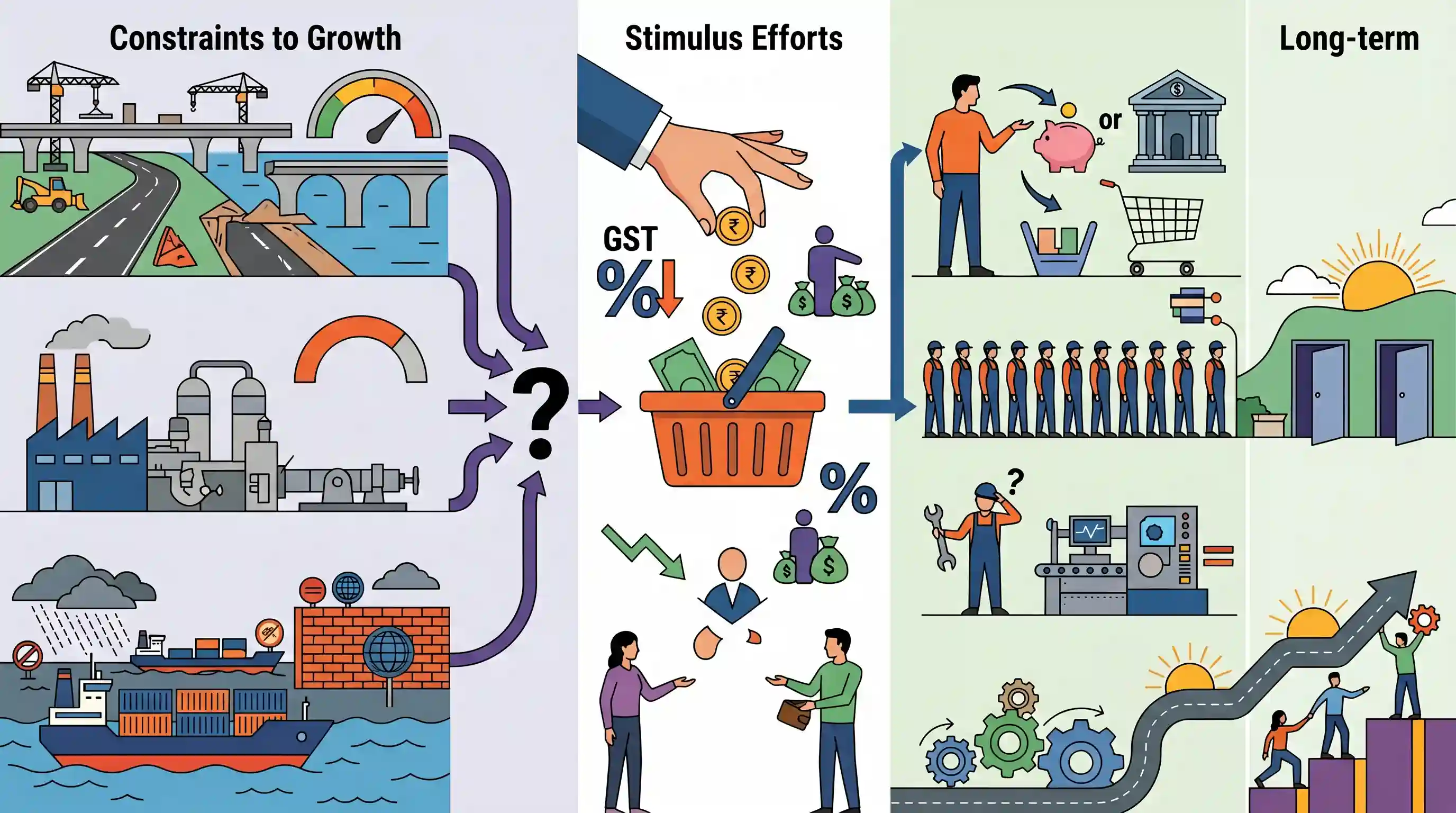
The editorial analyzes the 'consumption conundrum' facing the Indian economy, emphasizing that household spending must drive growth since private investment, government expenditure, and exports are facing constraints. While government infrastructure spending has been strong, its growth rate will slow due to competing priorities. Simultaneously, private investment lags because capacity utilization remains below 80%, and exports are hampered by global trade volatility and US tariffs. To counter this, the government is trying to stimulate domestic demand through recent GST rate cuts and income tax reductions in Budget 2025. However, this strategy faces hurdles: consumers tend to save additional income, and structural labor market challenges—specifically an oversupply of labor and a skill deficit—are preventing meaningful wage growth. Thus, overcoming consumption inertia requires sustained fiscal strategies.
Key Points
- The Indian economy relies heavily on household consumption as growth engines like net exports face global uncertainties and US tariffs, while the pace of government capital expenditure is expected to plateau.
- Private investment is currently insufficient to accelerate GDP growth beyond 6.5% to the target 8%, primarily due to industrial capacity utilization hovering below 80%.
- The government seeks to boost demand by reducing prices through recent GST rate rationalizations and by increasing disposable income via income-tax cuts in Budget 2025.
- Despite fiscal interventions, consumption growth is stymied by structural issues such as a propensity to save, an oversupply of labor, and a chronic skill deficit, all of which suppress wage growth.
Important Terms
Goods and Services Tax (GST)

A comprehensive indirect tax on goods and services. "Next-Gen" 2025 reforms simplified it into a two-slab structure (5% and 18%) to lower the tax burden and boost domestic consumption.
UPSC context
GS III: Economy; tests indirect tax reforms, federal fiscal relations, and the role of the GST Council in economic stabilization.
Union Budget 2025
India's annual financial plan for FY 2025-26. It introduced significant personal income tax relief (effectively making income up to ₹12.75 lakh tax-free) to stimulate household demand amid global headwinds.
UPSC context
GS III: Government Budgeting; critical for analyzing fiscal priorities, revenue-expenditure patterns, and demand-side stimulus policies.
Capacity Utilization
The extent to which an industry uses its installed productive potential. Economists suggest levels must reach 79-80% for sustained quarters to trigger new private sector capital investment.
UPSC context
GS III: Industrial Growth; essential for understanding the relationship between industrial demand, private investment, and economic expansion cycles.
Fiscal Policy
The use of government spending and tax policies to influence economic conditions. Recent strategy shifts emphasize tax cuts to spur private demand as government infrastructure spending faces fiscal constraints.
UPSC context
GS III: Indian Economy; tests ability to evaluate government strategies for managing growth, demand, and inflation through fiscal interventions.
FICCI
India's oldest and largest apex business organization (est. 1927). It serves as a non-government advocacy group that bridges the gap between industry stakeholders and government policy-makers.
UPSC context
GS III: Industrial Policy; relevant for understanding the role of industry bodies in shaping business-friendly policies and national economic growth.
Structural Labor Market Challenges
Deep-seated labor market issues, such as a mismatch between worker skills and industry needs, that prevent meaningful wage growth despite rising productivity, contributing to "consumption inertia."
UPSC context
GS III: Employment and Growth; critical for discussing the demographic dividend, human resource development, and the quality of employment.
Prelims Trap
"Government capital expenditure constitutes the largest component of India's aggregate demand."
Despite the recent surge in government capex, Private Final Consumption Expenditure (PFCE) consistently remains the largest absolute component (around 60%) of India's GDP.
Static Concepts Connected
What are the four core components of Aggregate Demand (GDP) in macroeconomics?
- Consumption (C): Private Final Consumption Expenditure (PFCE), which forms the largest chunk (approx. 55-60%) of India's GDP.
- Investment (I): Gross Fixed Capital Formation (GFCF) by private businesses and the government (capex).
- Govt Spending (G): Government Final Consumption Expenditure (GFCE), representing day-to-day administrative spending.
- Net Exports (NX): Total value of exports minus the total value of imports (X - M).
How does Capacity Utilization dictate the private investment (capex) cycle?
- Definition: The percentage of an enterprise's or nation's potential productive capacity that is actually being used.
- Capex Threshold: Fresh private capital investment typically stalls until existing capacity utilization crosses the 75-80% threshold.
- Multiplier Limit: Below this mark, demand interventions (like corporate tax cuts) often increase corporate savings rather than spurring new factory build-outs.
Cross-Topic Patterns
Demographic dividend vs. demand
Structural labor oversupply and chronic skill deficits suppress wage growth, linking macroeconomic consumption stagnation directly to social sector outcomes and demographic dividend debates.
FRBM targets limit Govt Capex
The anticipated plateauing of public capital expenditure reflects the inherent tension between sustaining counter-cyclical growth and adhering to FRBM fiscal deficit reduction targets.

Expect a 2026 prelims question testing the relative shares of GDP components (PFCE vs GFCF) and how capacity utilization impacts investment.
Linked PYQs · 5
Linked PYQs · 5
- 2020MainsGS3
Explain the meaning of investment in an economy in terms of capital formation. Discuss the factors to be considered while designing a concession agreement between a public entity and a private entity.
- 2017MainsGS3
Among several factors for India's potential growth, savings rate is the most effective one. Do you agree? What are the other factors available for growth potential?
- 2020MainsGS3
Explain the rationale behind the Goods and Services Tax (Compensation to States) Act of 2017. How has COVID-19 impacted the GST compensation fund and created new federal tensions?
- 2023MainsGS3
Most of the unemployment in India is structural in nature. Examine the methodology adopted to compute unemployment in the country and suggest improvements.
- 2024MainsGS3
Examine the pattern and trend of public expenditure on social services in the post-reforms period in India. To what extent this has been in consonance with achieving the objective of inclusive growth?
