Imported Inflation and Monetary Policy Dilemmas
Source:Indian Express ↗
Why It Matters
This article connects global geopolitical crises directly to domestic macroeconomic indicators. It is highly relevant for GS-3 (Economy and Energy Security) as it illustrates the concepts of imported inflation, the difference between direct and indirect pass-through of global prices, and the RBI's monetary policy dilemmas during external shocks.
Summary
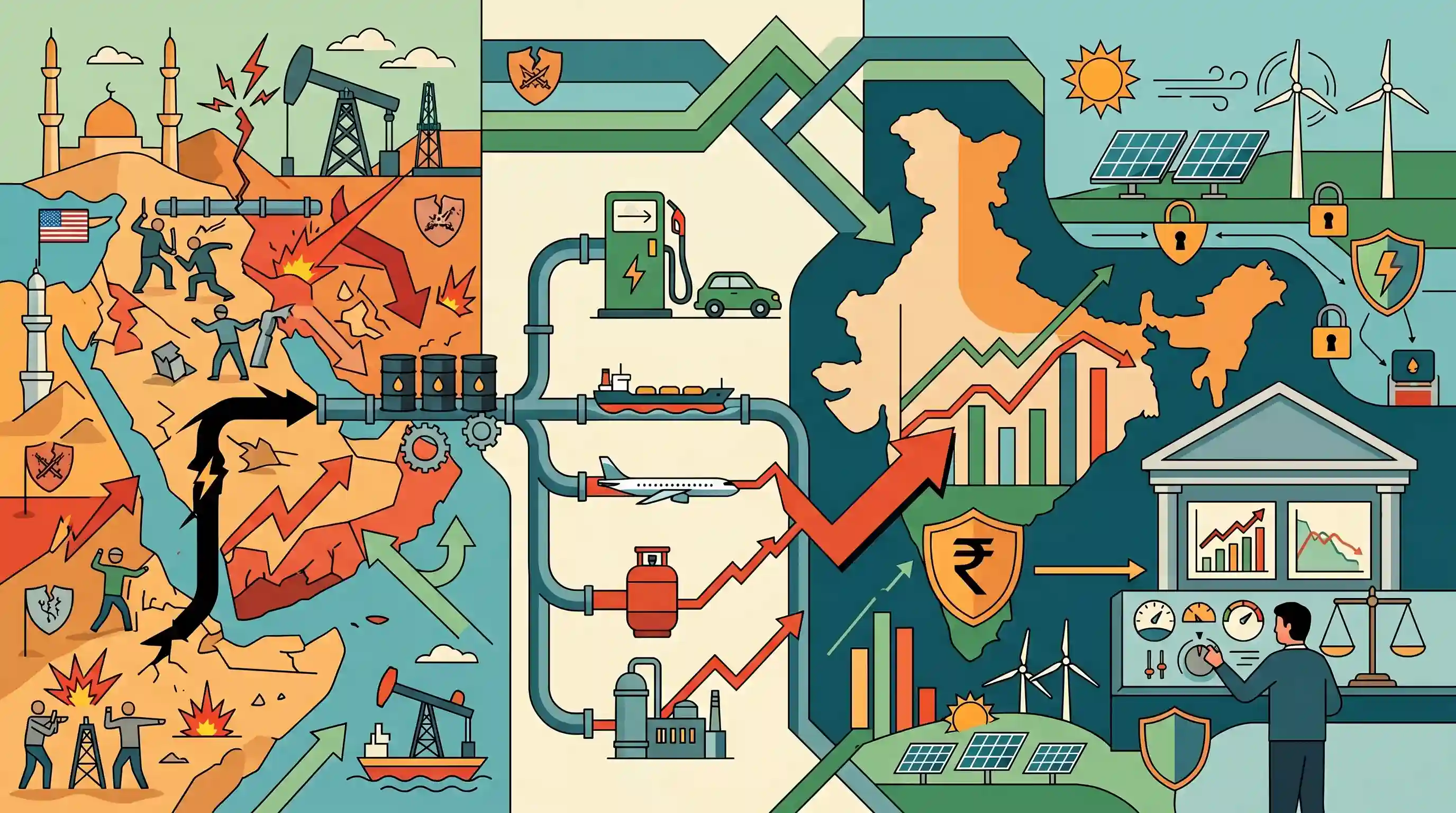
The escalating geopolitical conflict in West Asia, particularly the tensions involving the US, Israel, and Iran, is beginning to exert upward pressure on India's inflation trajectory. Retail inflation rose to 3.4% in March, with notable spikes in fuel and energy-related categories. Although direct pump prices remain unchanged, shielding consumers temporarily, the ripple effects are evident in aviation fuel, LPG, and petrochemicals. Amidst these external shocks and an anticipated slowdown in GDP growth, the RBI has opted to keep its benchmark repo rate unchanged. The situation highlights India's ongoing vulnerability to imported inflation and the critical need to secure its energy supply chains amidst West Asian instability.
Key Points
- India's retail inflation (CPI) edged up to 3.4% in March, largely driven by a sharp rise in the 'electricity, gas and other fuels' category reflecting global energy volatility.
- The ongoing geopolitical conflict involving the US, Israel, and Iran in West Asia is threatening global crude oil supplies, with prices expected to average $85-90 per barrel.
- While direct pass-through to petrol and diesel consumers is muted as OMCs hold pump prices steady, indirect inflation is visible through higher airfares, LPG prices, and petrochemical input costs.
- The Reserve Bank of India maintained the repo rate at 5.25%, balancing the management of imported inflation risks against a forecasted GDP growth moderation to 6.9%.
Important Terms
Retail Inflation (CPI)

The rate of price increase for a basket of consumer goods and services, measured in India by the Consumer Price Index (CPI) and released monthly by the National Statistical Office (NSO).
UPSC context
GS Paper III: Economy. Tests understanding of price stability, purchasing power, and the primary metric for RBI's inflation targeting.
Imported Inflation
A general price rise in a country caused by increased costs of imported goods, such as crude oil, or the depreciation of the local currency against foreign currencies.
UPSC context
GS Paper III: Economy. Crucial for analyzing external shocks and India's vulnerability to global commodity price volatility.
Repo Rate
The fixed interest rate at which the Reserve Bank of India (RBI) lends short-term funds to commercial banks, used as a primary tool to regulate liquidity and control inflation.
UPSC context
GS Paper III: Economy/Monetary Policy. Fundamental for questions on RBI's policy stance and interest rate transmission.
Energy Security
The uninterrupted availability of energy sources at an affordable price, encompassing short-term supply-demand balance and long-term investments aligned with economic development and environmental needs.
UPSC context
GS Paper III: Infrastructure/Energy. Tests strategic planning for India's high import dependence and diversification of energy sources.
Oil Marketing Companies (OMCs)
State-owned or private entities (such as IOC, BPCL, HPCL) involved in refining, distributing, and retailing petroleum products; they often shield consumers from global price volatility through managed pricing.
UPSC context
GS Paper III: Economy/Energy Sector. Relevant for fiscal deficit discussions (oil bonds/subsidies) and downstream infrastructure.
Geopolitics of West Asia
The study of how geographical factors and international relations influence political and economic power, currently evidenced by West Asian instability affecting global oil supplies and trade routes.
UPSC context
GS Paper II/III: International Relations and Economy. Tests impact of regional conflicts on India’s energy supply chains and maritime trade.
Prelims Trap
A sharp rise in global crude oil prices directly causes a larger and more immediate spike in CPI compared to WPI.
WPI actually reacts faster. Fuel & Power holds a 13.15% weightage in WPI, whereas Fuel & Light holds just 6.84% in CPI. Additionally, OMCs absorb initial retail shocks, delaying CPI impact.
Static Concepts Connected
How do CPI and WPI differ in capturing global crude oil shocks?
- Weightage difference: 'Fuel and Power' constitutes 13.15% of WPI, making it highly sensitive to global shocks. CPI's 'Fuel and Light' holds only 6.84%.
- Pass-through timing: WPI captures bulk import costs immediately. CPI impact is delayed because Oil Marketing Companies (OMCs) temporarily absorb shocks, keeping retail pump prices stable.
- Indirect vs Direct: While CPI's direct fuel component is lower, crude oil shocks eventually permeate CPI indirectly via rising transportation costs, airfares, and petrochemical input prices.
Why is imported inflation difficult to control using standard monetary policy tools?
- Supply-side nature: Imported inflation stems from external supply shocks (like geopolitics affecting oil), not from excess domestic demand that a central bank can easily cool down.
- Policy limitations: Hiking the repo rate increases domestic borrowing costs but cannot fix global supply chain disruptions or reduce global commodity prices.
- Growth trade-off: Using blunt interest rate hikes against external price shocks risks stifling domestic investment and moderating GDP growth without resolving the core inflation driver.
Cross-Topic Patterns
West Asia, CAD, and Rupee depreciation
High crude prices widen India's Current Account Deficit, leading to Rupee depreciation. A weaker Rupee makes all imports costlier, creating a vicious cycle of imported inflation beyond just the energy sector.
OMC absorption and fiscal burden
When Oil Marketing Companies hold pump prices steady during global spikes, it suppresses CPI temporarily but strains OMC balance sheets, effectively shifting the inflation burden to implicit fiscal costs.

Expect a 2026 multi-statement question interlinking RBI's FIT limits, imported inflation drivers, and WPI-CPI structural divergences.
Linked PYQs · 4
Linked PYQs · 4
- 2024MainsGS3
What are the causes of persistent high food inflation in India? Comment on the effectiveness of the monetary policy of the RBI to control this type of inflation.
- 2017MainsGS2
The question of India's Energy Security constitutes the most important part of India's economic progress. Analyze India's energy policy cooperation with West Asian countries.
- 2025MainsGS2
"Energy security constitutes the dominant kingpin of India's foreign policy, and is linked with India's overarching influence in Middle Eastern countries.” How would you integrate energy security with India's foreign policy trajectories in the coming years?
- 2020PrelimsGS1
Consider the following statements: 1. The weightage of food in Consumer Price Index (CPI) is higher than that in Wholesale Price Index (WPI). 2. The WPI does not capture changes in the prices of services, which CPI does. 3. Reserve Bank of India has now adopted WPI as its key measure of inflation and to decide on changing the key policy rates. Which of the statements given above is/are correct?
