March Retail Inflation Rises Amid West Asia War Pressures
Source:Indian Express ↗
Why It Matters
The article demonstrates the transmission mechanism of global geopolitical shocks to domestic inflation via energy imports, illustrating the vital interplay between international relations (GS2) and macroeconomic stability (GS3). It serves as a practical case study for understanding CPI/WPI dynamics and RBI monetary policy actions.
Summary
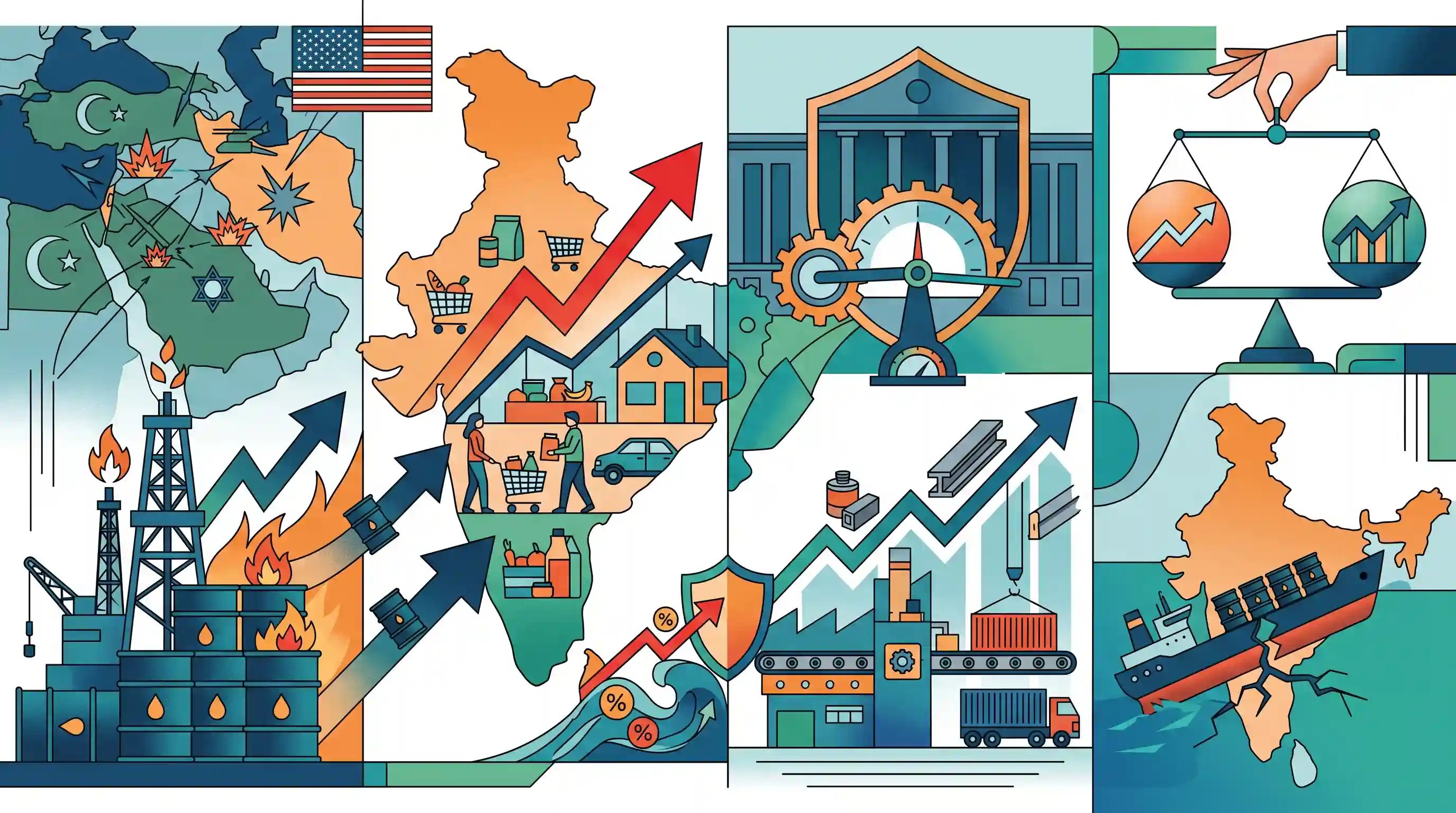
Retail inflation (CPI) in India rose to 3.4% in March 2026, largely driven by surging global crude oil prices stemming from geopolitical conflict in West Asia involving the US, Israel, and Iran. The Reserve Bank of India has maintained the repo rate at 5.25% to manage imported inflationary pressures, while keeping an eye on indirect pass-through effects to the broader economy, such as anticipated increases in the Wholesale Price Index (WPI). The situation highlights India's macroeconomic vulnerability to external energy shocks and underscores the delicate balance the RBI must strike between controlling inflation and sustaining economic growth.
Key Points
- India's Retail inflation (CPI) increased to 3.4% in March 2026, reversing a recent downward trend, driven primarily by external factors.
- Global crude oil prices spiked by over 60% in March due to escalating geopolitical conflict in West Asia involving the US, Israel, and Iran.
- Inflationary pressures are already visible in the 'electricity, gas, and other fuels' segment, notably in commercial LPG prices and aviation turbine fuel surcharges.
- Analysts expect indirect 'pass-through' effects to push up the Wholesale Price Index (WPI) in the coming months, raising costs across sectors.
- In response to geopolitical risks and failing peace talks in Islamabad, the RBI maintained the repo rate at 5.25%, balancing inflation control with a slight downward revision in GDP growth forecasts to 6.9%.
Important Terms
Reserve Bank of India (RBI)

India’s central bank, established in 1935, responsible for monetary policy, regulating the banking system, and maintaining financial stability. It chairs the Monetary Policy Committee to set interest rates.
UPSC context
GS Paper III (Economy). Fundamental for understanding monetary authorities, inflation targeting, and liquidity management tools like the repo rate.
Ministry of Statistics and Programme Implementation (MoSPI)
The central ministry responsible for national statistics and program monitoring. Its National Statistical Office (NSO) compiles and releases crucial economic indicators like CPI and IIP.
UPSC context
GS Paper III (Economic Development). Essential for identifying the institutional sources of India's official macroeconomic data and indices.
Consumer Price Index (CPI)
A retail-level inflation measure tracking price changes in a basket of goods and services purchased by households. It is the RBI’s primary tool for inflation targeting.
UPSC context
GS Paper III (Inflation). A core metric for evaluating the cost of living and the effectiveness of monetary policy.
Wholesale Price Index (WPI)
An index measuring price changes of goods sold in bulk at the wholesale level. Unlike CPI, it excludes services and is released by the Ministry of Commerce and Industry.
UPSC context
GS Paper III (Indian Economy). Tests the ability to distinguish between producer-side and consumer-side inflationary pressures.
Repo Rate
The interest rate at which the RBI lends short-term funds to commercial banks against government securities. It is the primary signal for interest rates in the economy.
UPSC context
GS Paper III (Monetary Policy). Key tool for controlling money supply, managing inflation, and stimulating economic growth.
Imported Inflation
A rise in domestic prices caused by the increased cost of imported essential commodities (like crude oil) or a depreciation of the domestic currency.
UPSC context
GS Paper III (External Sector). Vital for analyzing India’s vulnerability to global geopolitical shocks and energy security.
Prelims Trap
"Fuel and light components have a higher weightage in the Consumer Price Index (CPI) than in the Wholesale Price Index (WPI)."
It's the opposite. Fuel and power make up 13.15% of WPI, while 'fuel and light' is just 6.84% in CPI. WPI is far more sensitive to global crude shocks.
Static Concepts Connected
How does a global crude oil shock impact India's macroeconomic fundamentals?
- Imported Inflation: Higher global crude prices directly inflate the import bill, transmitting into domestic prices through increased transportation and production costs.
- Twin Deficits: Surging oil prices widen the Current Account Deficit and exert pressure on the fiscal deficit through potential fuel subsidy burdens or tax cuts.
- Rupee Depreciation: Increased demand for US dollars to fund an inflated oil import bill puts downward pressure on the Indian Rupee.
What distinguishes Headline Inflation from Core Inflation?
- Headline Inflation: Measures total inflation in an economy, including highly volatile commodities such as food and energy.
- Core Inflation: Excludes food and energy prices to capture the underlying, long-term trend of inflation driven by aggregate demand.
- Policy Anchor: The RBI officially targets CPI-Combined (Headline Inflation), even though it closely monitors Core Inflation to gauge indirect pass-through effects.
Cross-Topic Patterns
Chokepoints & Imported Inflation
Geopolitical conflicts in West Asia threaten transit through the Strait of Hormuz, linking International Relations directly with India's monetary policy and Current Account Deficit.
WPI-CPI Divergence
Oil shocks often cause WPI to spike before CPI due to its higher fuel weightage. UPSC frequently tests the compositional differences between these indices.

The mechanics of 'imported inflation' combined with CPI/WPI weightage differences forms a high-probability multi-statement Prelims question.
Linked PYQs · 4
Linked PYQs · 4
- 2020PrelimsGS1
Consider the following statements: 1. The weightage of food in Consumer Price Index (CPI) is higher than that in Wholesale Price Index (WPI). 2. The WPI does not capture changes in the prices of services, which CPI does. 3. Reserve Bank of India has now adopted WPI as its key measure of inflation and to decide on changing the key policy rates. Which of the statements given above is/are correct?
- 2022PrelimsGS1
With reference to the Indian economy, consider the following statements: 1. If the inflation is too high, Reserve Bank of India (RBI) is likely to buy government securities. 2. If the rupee is rapidly depreciating, RBI is likely to sell dollars in the market. 3. If interest rates in the USA or European Union were to fall, that is likely to induce RBI to buy dollars. Which of the statements given above are correct?
- 2025MainsGS2
"Energy security constitutes the dominant kingpin of India's foreign policy, and is linked with India's overarching influence in Middle Eastern countries.” How would you integrate energy security with India's foreign policy trajectories in the coming years?
- 2017MainsGS2
The question of India's Energy Security constitutes the most important part of India's economic progress. Analyze India's energy policy cooperation with West Asian countries.
