Consumer commission ruling on medical reimbursement for state retirees
Source:Indian Express ↗
Why It Matters
Demonstrates the crucial role of quasi-judicial bodies like Consumer Dispute Redressal Commissions in holding the executive accountable. It highlights the tension between outdated administrative rules (like the 1940 Medical Attendance Rules) and modern interpretations of the right to health and life during emergencies.
Summary
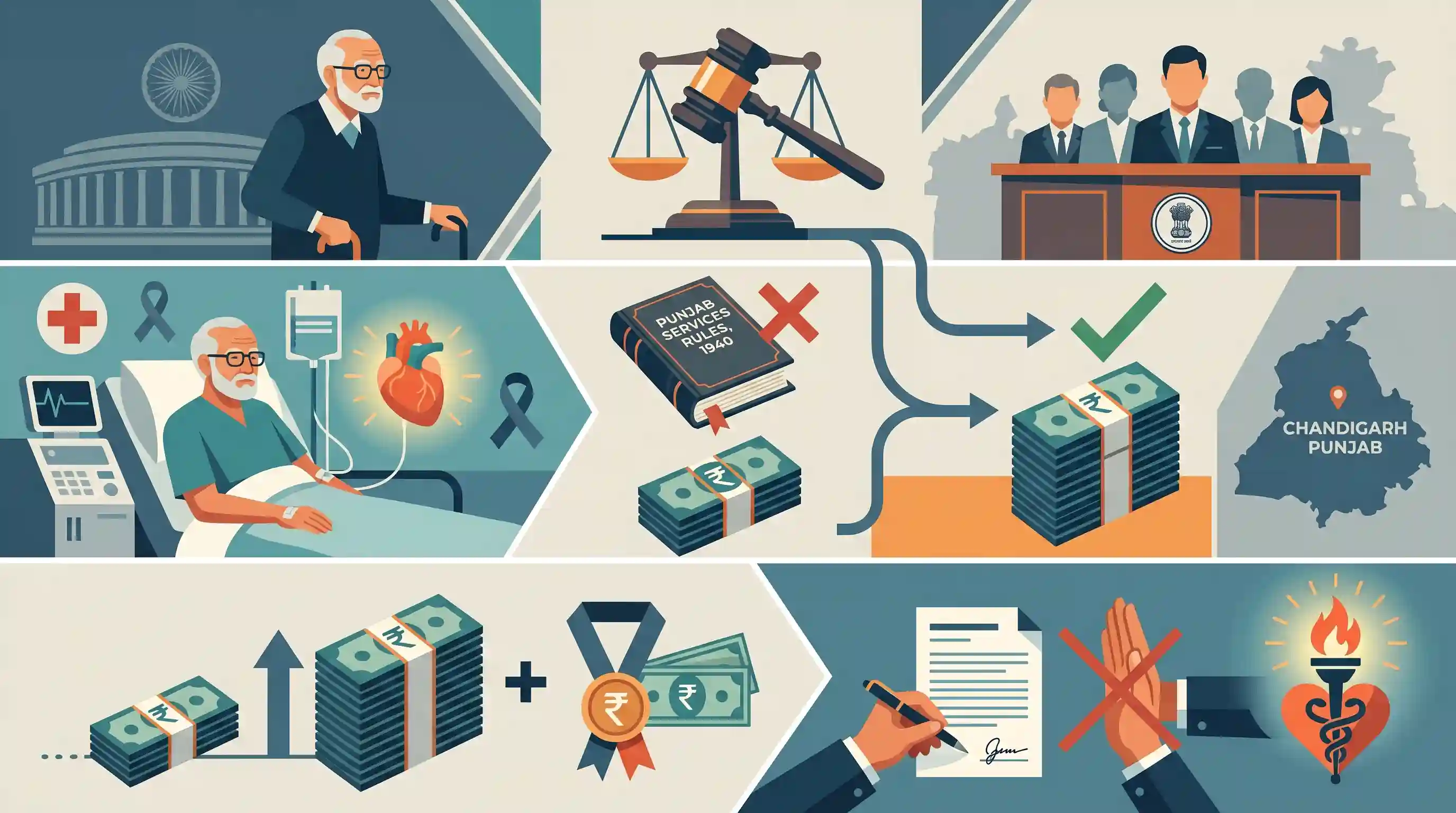
The District Consumer Disputes Redressal Commission in Chandigarh has ordered the Punjab government to pay the remaining Rs 2.90 lakh in medical reimbursement, along with Rs 20,000 in compensation, to a retired deputy district attorney treated for prostate cancer. The state government had previously reimbursed only a portion of the total expense, citing the Punjab Services (Medical Attendance) Rules, 1940. The commission ruled that providing partial reimbursement for a life-threatening emergency constitutes a "deficiency in service." Furthermore, it observed that an affidavit submitted by a patient during a medical crisis without informed consent regarding reimbursement limits cannot restrict their right to full coverage, thereby emphasizing the prioritization of the right to health over rigid administrative rules.
Key Points
- A retired Punjab government attorney spent Rs 5.48 lakh on emergency prostate cancer treatment at a private hospital, but the state reimbursed only Rs 2.58 lakh.
- The Punjab government justified the partial reimbursement by citing capped rates under the Punjab Services (Medical Attendance) Rules, 1940.
- The District Consumer Disputes Redressal Commission in Chandigarh ruled the partial reimbursement as arbitrary and constituting a "deficiency in service."
- The commission held that an affidavit signed during a medical emergency, without informed consent regarding restricted reimbursement, does not legally bind the patient to accept partial coverage.
- The ruling highlights that rigid administrative ceilings should not compromise a citizen's right to full medical reimbursement for life-threatening emergencies.
Important Terms
Consumer Protection Act

A comprehensive 2019 legislation replacing the 1986 version, establishing a three-tier quasi-judicial mechanism to protect consumer rights against 'deficiency in service,' unfair trade practices, and misleading advertisements.
UPSC context
GS Paper 2: Statutory and regulatory bodies; tests knowledge of consumer rights and grievance redressal mechanisms in India.
District Consumer Disputes Redressal Commission
The primary tier of India's three-tier consumer grievance redressal machinery, established in every district to handle consumer disputes involving claim values up to ₹50 lakh.
UPSC context
GS Paper 2: Governance and quasi-judicial bodies; tests understanding of the hierarchical judicial structure for public service accountability.
Punjab Services (Medical Attendance) Rules, 1940
A colonial-era statutory framework governing medical benefits for state employees. It defines the 'family' eligible for reimbursement and includes residuary powers for compassionate relaxation in emergencies.
UPSC context
GS Paper 2: Health and Governance; highlights issues with outdated administrative rules versus modern constitutional mandates like Article 21.
Director of Prosecution and Litigation
A state-level administrative and legal department that provides legal advice to the government and oversees civil and criminal litigation on behalf of the state.
UPSC context
GS Paper 2: Important aspects of governance; tests knowledge of the state executive's legal machinery and litigation management.
Deficiency in Service
A judicial finding under the Consumer Protection Act where a service provider fails to provide services with the required quality, nature, or manner as prescribed by law.
UPSC context
GS Paper 2: Governance; central to cases involving public health services and the accountability of state-run entities.
Right to Health
A judicially recognized fundamental right under Article 21 (Right to Life) of the Indian Constitution, obligating the State to provide adequate and timely medical facilities to citizens.
UPSC context
GS Paper 2: Constitution and Health; a critical interpretive facet of Article 21 often tested in fundamental rights contexts.
Prelims Trap
"The Right to Health is explicitly enumerated as a Fundamental Right under Part III."
The Right to Health is an inferred right read into Article 21 by the Supreme Court; it is not explicitly written in the Constitution's text.
Static Concepts Connected
What is the pecuniary jurisdiction of Consumer Disputes Redressal Commissions (post-2021)?
- District Commission: Hears complaints where the value of goods/services paid as consideration does not exceed ₹50 lakh.
- State Commission: Hears complaints where the value of consideration exceeds ₹50 lakh but does not exceed ₹2 crore.
- National Commission: Entertains complaints where the value of goods or services paid exceeds ₹2 crore.
How is the Right to Health protected under the Indian Constitution?
- Judicial Interpretation: Expanded Article 21 (Right to Life) to include the right to health and medical assistance.
- Paschim Banga Case: Supreme Court ruled that denial of timely medical treatment by government hospitals violates Article 21.
- DPSP (Article 47): Directs the State to raise the level of nutrition and the standard of living, and improve public health.
Cross-Topic Patterns
Consumer Courts & Article 21
Demonstrates how quasi-judicial bodies utilize fundamental rights (Article 21) to override outdated administrative constraints, blending statutory consumer law with constitutional guarantees.
Bioethics & Informed Consent
A strong GS4 example. Affidavits signed under the duress of a medical emergency lack 'voluntary' consent, highlighting the ethical limits of administrative contracts.

Expect a GS2 question examining how quasi-judicial bodies like Consumer Courts actively enforce Article 21 against outdated state rules.
Linked PYQs · 3
Linked PYQs · 3
- 2023MainsGS2
“The Constitution of India is a living instrument with capabilities of enormous dynamism. It is a constitution made for a progressive society.” Illustrate with special reference to the expanding horizons of the right to life and personal liberty.
- 2021MainsGS2
“Besides being a moral imperative of a Welfare State, primary health structure is a necessary precondition for sustainable development.” Analyze.
- 2025MainsGS2
Comment on the need of administrative tribunals as compared to the court system. Assess the impact of the recent tribunal reforms through rationalization of tribunals made in 2021.
