Inculcating constitutional values and improving legal accessibility
Source:The Hindu ↗
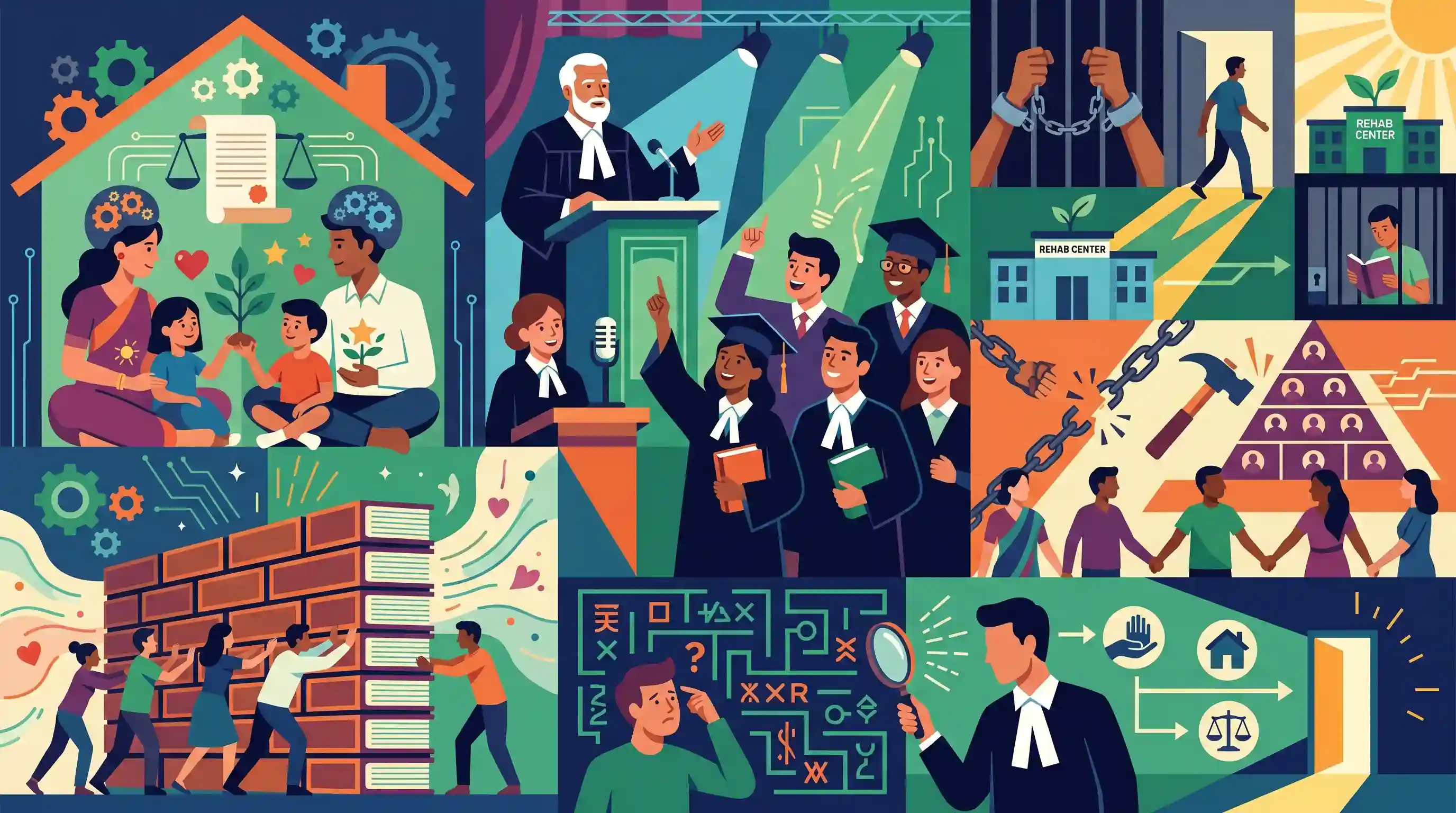
Why It Matters
Provides a profound perspective on how constitutional values interface with societal realities. It is highly relevant for GS-2 (Judicial Reforms, Constitutional Morality, Access to Justice) and GS-4 (Role of family and society in inculcating democratic/constitutional values).
Summary
Former Chief Justice of the Orissa High Court, S. Muralidhar, highlighted that constitutional morality and thinking must be nurtured at home, as formal laws alone struggle to reshape societal behaviors. Speaking at 'Justice Unplugged 2026', he praised the emerging generation of lawyers for their idealism, noting their active role in taking up pro bono causes such as prison reforms and challenging caste-based segregation (as seen in the Sukanya Shanta judgment). Furthermore, he emphasized the critical need for demystifying legal jargon to ensure that judgments and statutes are easily understandable to the common litigant, thereby improving the accessibility of justice.
Key Points
- Constitutional values cannot be solely enforced by statutory provisions; they must be inculcated through the social milieu, beginning at home.
- A new generation of lawyers, influenced by modern legal education, is actively pursuing public interest causes, including the decriminalisation of homosexuality and challenging caste segregation in prisons (e.g., the Sukanya Shanta judgment).
- Young lawyers are demonstrating significant idealism by undertaking pro bono initiatives, providing legal aid to marginalized prisoners, including those on death row.
- There is an urgent need to simplify complex legal language and judicial jargon to make justice more accessible and comprehensible for ordinary litigants.
Important Terms
Constitutional Morality

Adherence to core constitutional values like liberty, equality, and fraternity, prioritizing the Constitution's spirit and transformative vision over social or public morality.
UPSC context
GS II: Indian Constitution & Judiciary. Tests understanding of transformative constitutionalism and landmark judgments like Navtej Johar.
Sukanya Shantha v. Union of India
A landmark 2024 Supreme Court ruling that struck down caste-based labor division and segregation in prisons as violations of Articles 14, 15, 17, and 21.
UPSC context
GS II: Social Justice & Judiciary. Critical for questions on prison reforms and the abolition of untouchability.
Access to Justice
The fundamental principle ensuring all citizens can seek and obtain legal remedies through judicial institutions, regardless of economic, social, or procedural barriers.
UPSC context
GS II: Judiciary & Governance. Relates to Article 39A (Free Legal Aid) and judicial accessibility for marginalized groups.
Prison Reforms
Systematic institutional changes aimed at modernizing prisons, reducing overcrowding, and shifting the penal system from punitive confinement toward rehabilitation and human dignity.
UPSC context
GS II: Governance & Social Justice. Covers the Model Prisons Act 2023 and rights of undertrials in the criminal justice system.
Constitution of India
The supreme law of India establishing the framework for political principles, procedures, powers of government institutions, and fundamental rights of citizens.
UPSC context
GS II: Indian Polity. The foundational document for all governance, legislative, and judicial topics in the UPSC syllabus.
Prelims Trap
"The 'Right to Access to Justice' is explicitly enumerated as a Fundamental Right under Article 21 of the Constitution."
It is a derived fundamental right. The Supreme Court (Anita Kushwaha case) interpreted it as inherent to Articles 14 and 21, but it is not explicitly written in the constitutional text.
Static Concepts Connected
What is the doctrine of Constitutional Morality?
- Origins: Popularized by B.R. Ambedkar to emphasize that democratic constitutional forms require a cultivated, progressive public morality to function effectively.
- Core Principle: Prioritizes core constitutional values (dignity, liberty, equality) over majoritarian views, traditional norms, or popular morality.
- Key Rulings: Used prominently in Navtej Johar (decriminalizing homosexuality) and Sabarimala to strike down discriminatory social practices.
How do Fundamental Rights apply to prisoners in India?
- Basic Premise: Fundamental rights do not stop at prison gates. Prisoners retain rights under Articles 14, 15, 19, and 21, subject to reasonable restrictions of incarceration.
- Article 23: Prohibits forced labor. The SC has used this to strike down prison manuals that assign degrading menial work (like sweeping) strictly based on a prisoner's caste hierarchy.
- Sukanya Shanta Case: Landmark SC ruling that explicitly voided colonial-era state prison manuals for enforcing caste-based segregation and untouchability (Articles 15 & 17) within prison walls.
Cross-Topic Patterns
GS2 Polity meets GS4 Ethics
Links the legal doctrine of 'Constitutional Morality' (GS2) directly with the 'Role of family and society in inculcating values' (GS4), framing law not just as state action but as lived social ethics.
Prison reforms + Colonial continuities
Connects the Sukanya Shanta judgment on caste segregation in prisons to the broader theme of colonial-era criminal justice reforms (Bhartiya Nagarik Suraksha Sanhita transitions).

Expect a 2026 GS2 Mains question asking how 'Constitutional Morality' acts as a counterweight to traditional societal inequalities.
Linked PYQs · 3
Linked PYQs · 3
- 2021MainsGS2
‘Constitutional Morality’ is rooted in the Constitution itself and is founded on its essential facets. Explain the doctrine of ‘Constitutional Morality’ with the help of relevant judicial decisions.
- 2025MainsGS2
"Constitutional morality is the fulcrum which acts as an essential check upon the high functionaries and citizens alike...." In view of the above observation of the Supreme Court, explain the concept of constitutional morality and its application to ensure balance between judicial independence and judicial accountability in India.
- 2016MainsGS4
Our attitudes towards life, work, other people and society are generally shaped unconsciously by the family and the social surroundings in which we grow up. Some of these unconsciously acquired attitudes and values are often undesirable in the citizens of a modern democratic and egalitarian society. Discuss such undesirable values prevalent in today's educated Indians.
