Presidential Reference Explores Governor Assent Powers on Bills
Source:The Hindu ↗
Why It Matters
The recurrent conflict between State Governments and Governors over the withholding of assent to Bills is a critical contemporary constitutional issue. It touches upon core UPSC themes like federalism, Centre-State relations, the discretionary powers of the Governor, and the advisory jurisdiction of the Supreme Court, making it highly relevant for GS Paper 2 and Prelims Polity.
Summary
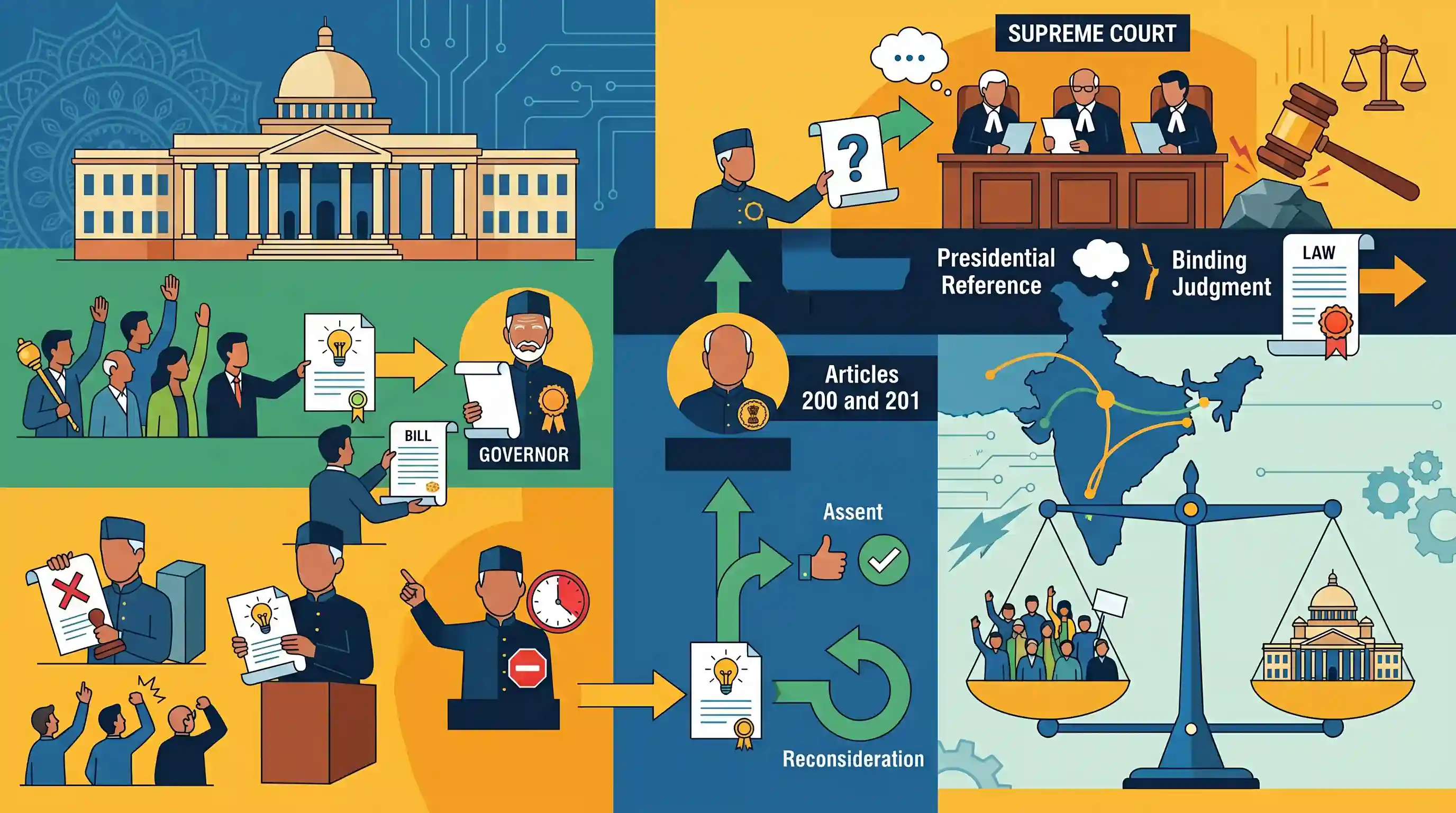
The article discusses the Supreme Court's hearings on a Presidential Reference concerning the powers of the Governor and the President in granting assent to Bills passed by State Assemblies. It highlights the constitutional provisions of Articles 200 and 201, underscoring that Governors cannot indefinitely withhold assent to thwart the legislative will of elected state governments. The piece contrasts the advisory nature of a Presidential Reference (Article 143) with binding Supreme Court judgments (Article 141), arguing that constitutional clarity is urgently needed to resolve the recurring friction between appointed Governors and elected state regimes, thereby protecting the federal structure.
Key Points
- Article 200 grants the Governor options regarding State Bills: give assent, withhold assent, return the Bill, or reserve it for Presidential consideration.
- Article 201 governs the procedure for Bills reserved for the President's assent.
- The Supreme Court has emphasized that Governors cannot indefinitely delay or sit on Bills, as this paralyzes democratic governance and undermines the elected state legislature.
- A Presidential Reference to the Supreme Court under Article 143 invokes its advisory jurisdiction, yielding an opinion rather than a binding judgment (as under Article 141).
- The recurring friction over gubernatorial delays poses a significant challenge to Indian federalism and Centre-State relations.
Important Terms
Article 200

Outlines the Governor's powers regarding Bills passed by the State Legislature, including granting assent, withholding it, returning it for reconsideration, or reserving it for the President's consideration.
UPSC context
GS Paper II (Polity); critical for Union-State relations, the Governor's discretionary powers, and the legislative process at the state level.
Article 201
Governs the procedure when a State Bill is reserved by the Governor for the President's consideration, allowing the President to grant/withhold assent or direct its return for reconsideration.
UPSC context
GS Paper II (Polity); tests understanding of the President's veto powers over state legislation and federal checks and balances.
Article 143
Empowers the President to seek the Supreme Court's advisory opinion on significant questions of law or fact of public importance; also known as a Presidential Reference.
UPSC context
GS Paper II (Judiciary); focuses on the Supreme Court's advisory jurisdiction and its role as a constitutional consultant to the Executive.
Article 141
Mandates that the law declared by the Supreme Court shall be binding on all courts within the territory of India, establishing the doctrine of binding precedent.
UPSC context
GS Paper II (Judiciary); essential for understanding judicial consistency, the rule of law, and the hierarchy of the Indian legal system.
Federal Structure
The basic framework of the Indian Constitution where power is divided between the Centre and States; frequently tested via Union-State friction points like gubernatorial delays.
UPSC context
GS Paper II (Federalism); a 'Basic Structure' element often tested through the lens of executive interference in state legislative autonomy.
State Legislatures
The law-making bodies at the state level (Legislative Assembly and Council) that represent the elected will of the people, whose legislation is subject to gubernatorial assent.
UPSC context
GS Paper II (Governance); pertains to the functions, powers, and challenges of state-level law-making in a parliamentary democracy.
Prelims Trap
The President is constitutionally bound to act upon the Supreme Court's advisory opinion rendered under Article 143.
The Supreme Court's opinion under Article 143 is purely advisory. The President is not legally bound to accept or act upon it.
Static Concepts Connected
What are the Governor's options when presented with a State Bill (Article 200)?
- Assent or Withhold: The Governor may grant or withhold assent, though indefinitely sitting on a Bill ('pocket veto') violates the constitutional mandate to act "as soon as possible".
- Return for Reconsideration: Can return non-Money Bills to the legislature. If the Bill is passed again, with or without amendments, the Governor must give assent.
- Reserve for President: May reserve the Bill for the President's consideration. This reservation is constitutionally mandatory if the Bill derogates the powers of the State High Court.
How does the Supreme Court's Advisory Jurisdiction (Article 143) function?
- Public Importance: The President can seek the Supreme Court's opinion on any question of law or fact of substantial public importance.
- Court's Discretion: The SC may decline to offer an opinion on general matters, but is constitutionally bound to give its opinion on pre-constitutional treaties and agreements.
- Non-Adjudicatory: The opinion is not a decree. It does not bind the President, nor does it automatically act as a binding precedent for lower courts under Article 141.
Cross-Topic Patterns
Gubernatorial Veto vs. Federal Commissions
Recurring friction over Article 200 invokes Sarkaria and Punchhi Commission recommendations, which stressed that Governors should not use discretionary powers to arbitrarily thwart the legislative will of elected state assemblies.
Article 201 and Absolute Presidential Veto
Once a Governor reserves a Bill under Article 201, their role ends. The President exercises an absolute veto, and unlike the US, Indian state legislatures cannot override a Presidential rejection.

Expect a multi-statement Prelims question contrasting Art 143 advisory opinions with Art 141 binding judgments and Governor veto powers.
Linked PYQs · 5
Linked PYQs · 5
- 2003PrelimsGS1
Under which Article of the Indian Constitution did the President make a reference to the Supreme Court to seek the Court’s opinion on the Constitutional validity of the Election Commission’s decision on deferring the Gujarat Assembly elections (in the year 2002)?
- 2023PrelimsGS1
Consider the following statements: 1. If the election of the President of India is declared void by the Supreme Court of India, all acts done by him/her in the performance of duties of his/her office of President before the date of decision become invalid. 2. Election for the post of the President of India can be postponed on the ground that some Legislative Assemblies have been dissolved and elections are yet to take place. 3. When a Bill is presented to the President of India, the Constitution prescribes time limits within which he/she has to declare his/her assent. How many of the above statements are correct?
- 2022MainsGS2
Discuss the essential conditions for exercise of the legislative powers by the Governor. Discuss the legality of re-promulgation of ordinances by the Governor without placing them before the Legislature.
- 2024MainsGS2
What changes has the Union Government recently introduced in the domain of Centre-State relations ? Suggest measures to be adopted to build the trust between the Centre and the States and for strengthening federalism.
- 2025PrelimsGS1
Consider the following statements : I. The Constitution of India explicitly mentions that in certain spheres the Governor of a State acts in his/her own discretion. II. The President of India can, of his/her own, reserve a bill passed by a State Legislature for his/her consideration without it being forwarded by the Governor of the State concerned. Which of the statements given above is/are correct?
