Womens Reservation Act Delimitation and Census Linkage
Source:Indian Express ↗
આ શા માટે મહત્વનું છે
The article addresses core constitutional themes of gender representation, federal balance, and electoral governance, making it highly relevant for UPSC Mains GS2 (Polity and Governance).
સારાંશ
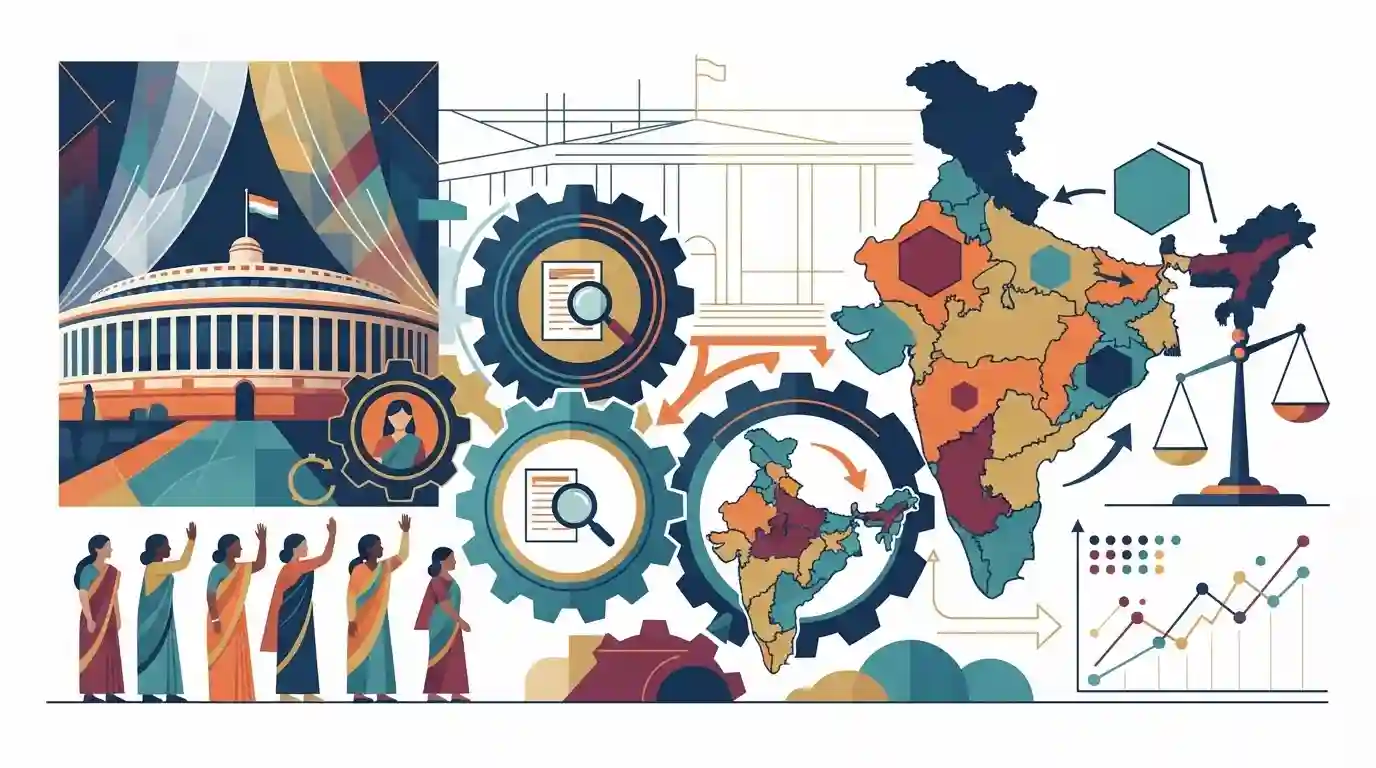
The article explores the intricate policy and constitutional linkages between the Nari Shakti Vandan Adhiniyam (Women's Reservation Act), the Census, and the delimitation exercise in India. It highlights how tying women's political representation to future delimitation and census timelines delays gender justice, while simultaneously raising federal concerns regarding population control and shifting parliamentary seat shares across states.
મુખ્ય મુદ્દા
- The operationalisation of the Nari Shakti Vandan Adhiniyam (Women's Reservation Act) is tied to the completion of the next Census and subsequent delimitation exercise.
- Delimitation based on shifting population shares can create tensions between states that promoted population control successfully and those with higher population growth.
- Delaying the Census and delimitation creates uncertainty over women's political empowerment and upsets the federal balance of parliamentary representation.
- There is an urgent need to balance gender justice objectives with equitable federal representation without penalizing states for demographic management.
મહત્વપૂર્ણ શબ્દો
Nari Shakti Vandan Adhiniyam (106th Constitutional Amendment Act)

A landmark constitutional amendment enacted in 2023 that mandates a 33% reservation for women in the Lok Sabha, State Legislative Assemblies, and the Delhi Assembly.
UPSC context
Important for GS Paper II (Polity - Amendments, Women Empowerment, and Gender Justice). Evaluates structural moves toward legislative parity.
Delimitation Act
The act of redrawing boundaries of parliamentary and assembly constituencies based on recent census data to ensure equal representation.
UPSC context
Important for GS Paper II (Indian Parliament, Federalism, and Representation of People). Tests implications of shifting regional seat shares.
Census Act
Legislation providing the legal framework for carrying out the decadal population census in India under the administrative control of the Registrar General and Census Commissioner.
UPSC context
Important for GS Paper I & II (Demographics, Governance, and Policy-making). Focuses on data reliability and administrative planning timelines.
Parliament
The supreme legislative body of India comprising the President, Lok Sabha (House of the People), and Rajya Sabha (Council of States).
UPSC context
Essential for GS Paper II (Structure, Functioning, Conduct of Business, and Powers of Parliament). Focuses on legislative procedures and law-making.
Supreme Court
The apex judicial court of India under the Constitution, responsible for constitutional interpretation and safeguarding fundamental rights.
UPSC context
Core for GS Paper II (Judiciary, Judicial Review, and Constitutional Remedies). Tests judicial oversight on legislative delays and rights.
Election Commission of India
An autonomous constitutional authority responsible for administering election processes in India across Parliament, State Legislatures, and the offices of the President and Vice-President.
UPSC context
Important for GS Paper II (Constitutional Bodies and Electoral Reforms). Focuses on free, fair, and inclusive democratic execution.
સંલગ્ન સ્થિર ખ્યાલો
What is the constitutional and statutory framework governing Delimitation and Census in India?
- Articles 82 & 170: Constitutional Mandate: Article 82 provides for readjustment of seat allocation after every Census; Article 170 does the same for state legislative assemblies.
- Statutory Body: Delimitation Commission: Appointed under the Delimitation Act enacted by Parliament after every Census; its orders have the force of law and cannot be challenged in any court.
- Seat Freezes: Constitutional Freezes: 42nd Amendment (1976) froze seat allocations till 2001; 84th Amendment (2001) extended this freeze until the first census after 2026 to encourage population control.
આંતર-વિષય પેટર્ન
Delimitation Freeze vs Finance Commission Demography
The freeze on delimitation bridges federal demography with gender justice, mirroring how financial devolution formulae (e.g., Finance Commission criteria) balance population control with needs-based resource distribution across states.

Expect a multi-statement Prelims question on Article 334A linking the 106th Amendment's operational trigger directly to post-2026 Census & delimitation.
સંલગ્ન PYQ · 2
સંલગ્ન PYQ · 2
- 2023MainsGS2
Explain the constitutional perspectives of Gender Justice with the help of relevant Constitutional Provisions and case laws.
- 2023MainsGS2
Discuss the contribution of civil society groups for women's effective and meaningful participation and representation in state legislatures in India.
