Constitutional Values Debate and Secularism versus Theocracy Discourse
Source:The Hindu ↗
Why It Matters
Debates surrounding the core ideals of the Constitution—secularism, socialism, and the basic structure doctrine—are central to UPSC's Polity syllabus. Understanding the ideological contestations between differing visions of the state (democratic republic vs theocracy) helps answer questions on constitutional morality, the foundational philosophy of the Constitution, and B.R. Ambedkar's emphasis on social and economic justice.
Summary
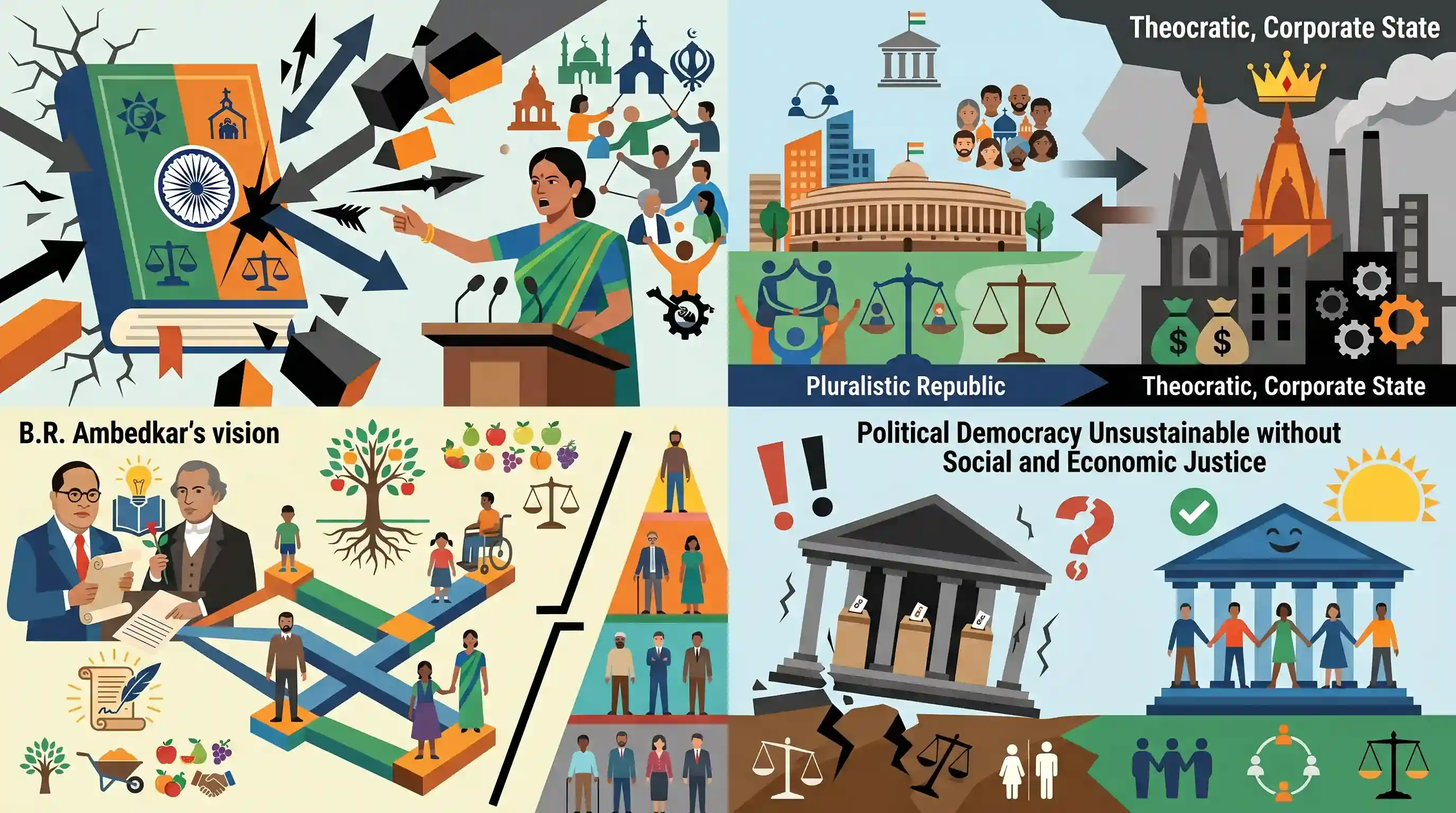
Addressing the 'Constitution and National Unity Convention', Congress leader Sonia Gandhi asserted that the Indian Constitution is "under siege" and accused the ruling BJP-RSS dispensation of orchestrating an "ideological coup" to replace the democratic republic with a theocratic, corporate state. She argued that the core constitutional principles of secularism and socialism are being systematically eroded by majoritarian forces. Invoking B.R. Ambedkar and Jawaharlal Nehru, Gandhi highlighted that the Constitution was designed as an instrument for social and economic equality, drawing a stark contrast between its egalitarian framework and the hierarchical ideology of the Manusmriti. She warned that political democracy is unsustainable without social and economic justice.
Key Points
- Sonia Gandhi accused the BJP and RSS of attempting an "ideological coup" to transform India from a democratic republic into a theocratic state.
- She argued that secularism and socialism are not foreign imports but foundational principles rooted in Indian civilization and the Constitution.
- The fundamental values of justice, liberty, equality, and fraternity are allegedly under threat from majoritarian and polarizing forces.
- A sharp contrast was drawn between the hierarchical ideology of the Manusmriti (associated with the RSS) and the egalitarian vision of B.R. Ambedkar.
- She emphasized Ambedkar\'s warning that political democracy cannot survive without accompanying social and economic democracy.
Important Terms
Constitution of India

The supreme legal document of India, defining government structures, powers, and duties, alongside fundamental rights. It serves as the foundation for the country's democratic and egalitarian governance.
UPSC context
GS II: Indian Constitution—historical underpinnings, evolution, features, and significant provisions. Tests understanding of the bedrock of Indian polity.
Basic Structure Doctrine
A judicial principle established in 1973 stating that Parliament's power to amend the Constitution under Article 368 cannot be used to destroy or alter its essential, "basic" features.
UPSC context
GS II: Significant provisions and basic structure. Tests the separation of powers and limits on parliamentary sovereignty.
Secularism
In India, this signifies "Sarva Dharma Sambhava" (equal respect for all religions). The state maintains neutrality and impartiality toward all faiths while reserving the power for social reform.
UPSC context
GS I: Social issues/Secularism; GS II: Preamble and Fundamental Rights. Essential for analyzing the nature of the Indian state.
Social Democracy
A vision championed by B.R. Ambedkar, asserting that political democracy (one man, one vote) is unsustainable unless rooted in social equality (one man, one value) and fraternity.
UPSC context
GS II: Social Justice and Ambedkar's contribution. Tests concepts of constitutional morality and egalitarianism in Indian society.
Manusmriti
An ancient Sanskrit legal text outlining social duties (Dharma) and laws. In modern political discourse, it is often cited as the antithesis to the egalitarian principles of the Indian Constitution.
UPSC context
GS I: Salient features of Indian Society. Tests understanding of historical social hierarchies vs. modern constitutional rights.
Socialism
Enshrined in the Preamble, it refers to "democratic socialism"—aiming to end poverty, ignorance, and inequality of opportunity through state-led welfare and social justice rather than total nationalization.
UPSC context
GS II: Preamble and Directive Principles. Tests understanding of the state’s role in economic justice and distributive fairness.
Prelims Trap
"Secularism and Socialism were explicit foundational terms enshrined in the original Constitution of 1950."
While inherent in the foundational philosophy of the Republic, these exact words were missing from the original Preamble until the 42nd Amendment (1976).
Static Concepts Connected
How does Indian Secularism differ from the Western model?
- Strict Separation vs.: The Western model demands a strict wall of separation between the State and religion, with neither interfering in the other's affairs.
- Principled Distance: The Indian State maintains a 'principled distance', allowing positive intervention in religious matters to ensure social reform (e.g., abolishing untouchability).
What is B.R. Ambedkar's concept of 'Social Democracy'?
- Trinity of Ideals: He argued that liberty, equality, and fraternity form an inseparable union; divorcing one from the others defeats the very purpose of democracy.
- One Man, One Value: Political equality (one man, one vote) will inevitably collapse unless backed by social and economic equality (one man, one value) in society.
Cross-Topic Patterns
Secularism + S.R. Bommai Judgment
Current political debates over a 'theocratic state' heavily draw upon the 1994 S.R. Bommai ruling, which explicitly established secularism as an unamendable part of the Basic Structure.
Constitutionalism + Limited Government
The rhetoric warning against 'majoritarian forces' directly links to the UPSC's repeated focus (2020, 2021) on Constitutionalism fundamentally meaning a 'limited government' that restricts arbitrary state power.

Prelims 2026 will likely feature statement-based questions contrasting Ambedkar's 'social democracy' against purely political democracy.
Linked PYQs · 5
Linked PYQs · 5
- 2024MainsGS2
Discuss India as a secular state and compare with the secular principles of the US constitution.
- 2020PrelimsGS1
A constitutional government by definition is a
- 2021PrelimsGS1
Constitutional government means
- 2020PrelimsGS1
Consider the following statements: 1. The Constitution of India defines its 'basic structure' in terms of federalism, secularism, fundamental rights and democracy. 2. The Constitution of India provides for 'judicial review' to safeguard the citizens' liberties and to preserve the ideals on which the Constitution is based. Which of the statements given above is/are correct?
- 2021PrelimsGS1
What was the exact constitutional status of India on 26th January, 1950?
