Constitutional supremacy and basic structure doctrine parameters
Source:The Hindu ↗
Why It Matters
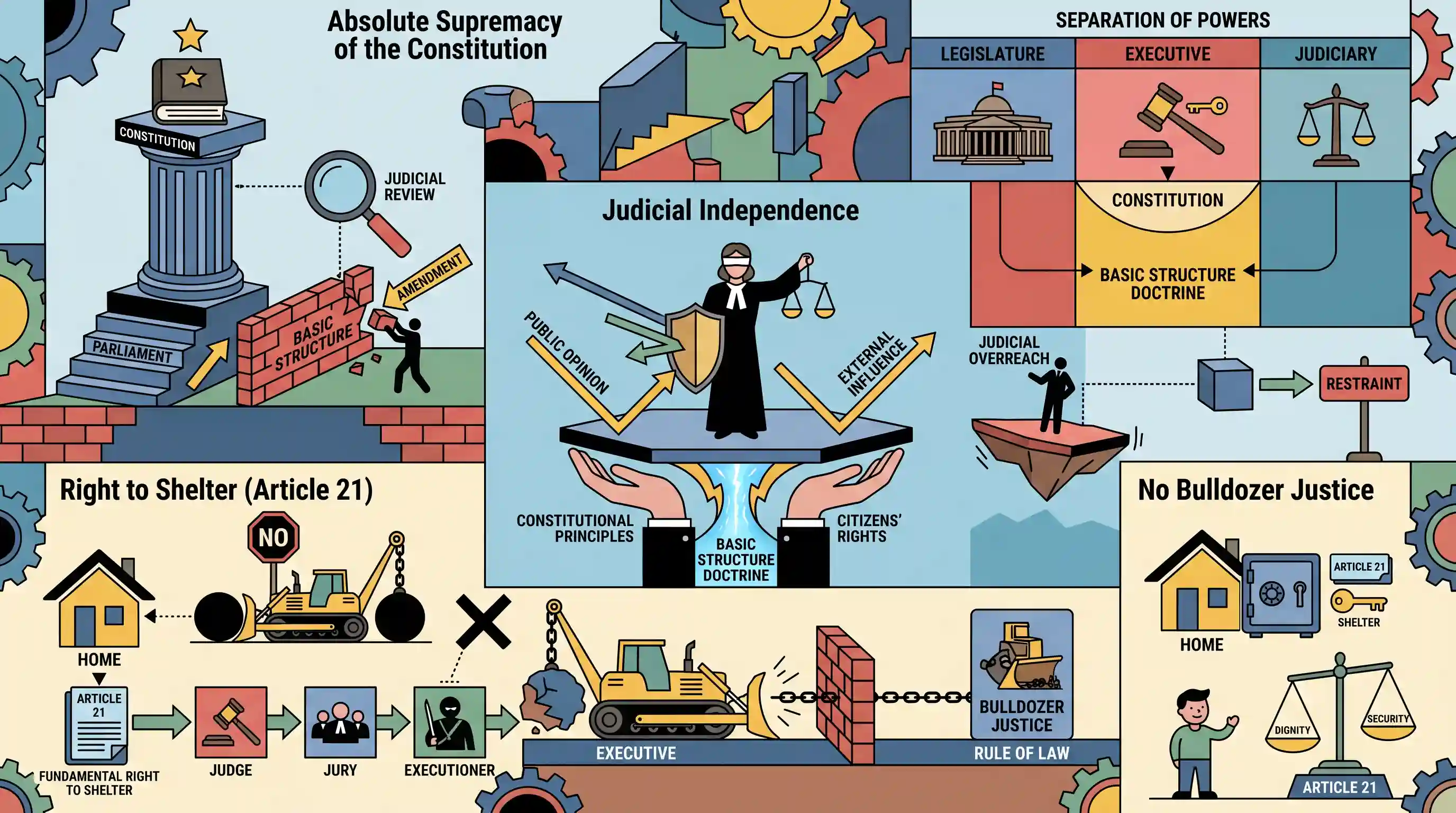
The debate between Parliamentary sovereignty and Constitutional supremacy is a fundamental concept in Indian polity. The CJI's remarks provide crucial insights into the judiciary's self-perception regarding its independence, the basic structure doctrine, and the expansive interpretation of fundamental rights like the right to shelter.
Summary
Chief Justice of India B.R. Gavai asserted the absolute supremacy of the Constitution over Parliament, highlighting the 'Basic Structure' doctrine which limits legislative amending powers. Speaking on judicial independence, he remarked that judges must act as independent custodians of citizens' rights and constitutional principles, free from the influence of public opinion. He also reiterated his stance against 'bulldozer justice', affirming the fundamental right to shelter.
Key Points
- Chief Justice of India B.R. Gavai affirmed that the Constitution, not Parliament, is the supreme authority in India, governing all three wings of democracy.
- He highlighted the 'Basic Structure' doctrine, which dictates that while Parliament has amending powers, it cannot alter the Constitution's core framework.
- Gavai emphasized that true judicial independence involves acting as custodians of constitutional values and citizens' rights, rather than merely passing anti-government orders or bowing to public opinion.
- He also referenced his ruling against 'bulldozer justice', underscoring that the right to shelter is a paramount fundamental right.
Important Terms
Basic Structure Doctrine

A judicial principle established in the Kesavananda Bharati case (1973) stating that Parliament's power to amend the Constitution does not include the power to alter its core features.
UPSC context
GS Paper 2: Significant for topics on Constitutional Amendments, Judicial Review, and the balance of power between Parliament and the Judiciary.
Judicial Independence
The principle that the Judiciary must function autonomously and impartially, free from the influence or control of the Executive or Legislative branches of government.
UPSC context
GS Paper 2: Vital for questions on 'Separation of Powers' and the 'Basic Structure' of the Indian Constitution.
Separation of Powers
A governance model where the functions of the Legislative, Executive, and Judicial branches are distinct, ensuring checks and balances to prevent any single branch from becoming dominant.
UPSC context
GS Paper 2: Frequently tested under 'Separation of Powers between various organs, dispute redressal mechanisms and institutions.'
Right to Shelter
A judicial interpretation of Article 21 (Right to Life) asserting that a dignified existence requires a safe place to live; it prohibits arbitrary evictions without due process.
UPSC context
GS Paper 2: Relevant to Fundamental Rights and judicial activism; often discussed in the context of urban displacement and social justice.
Constitutional Supremacy
The principle that the Constitution is the highest law of the land, and every state action or legislation must conform to its provisions.
UPSC context
GS Paper 2: Fundamental to the study of the Indian Polity, contrasting with Parliamentary Sovereignty found in other democracies like the UK.
Bulldozer Justice
A colloquial term for state-led demolitions of properties of accused individuals; the Supreme Court ruled this unconstitutional for violating due process and the rule of law.
UPSC context
Current Affairs/GS Paper 2: Important for contemporary issues involving Executive overreach and the protection of civil liberties.
Prelims Trap
The Basic Structure doctrine, explicitly defined under Article 368, restricts Parliament's amending powers.
The term 'Basic Structure' is nowhere mentioned in the constitutional text. It is entirely a judicial innovation formulated in the 1973 Kesavananda Bharati judgment.
Static Concepts Connected
How does Indian Constitutional Supremacy differ from British Parliamentary Sovereignty?
- Amending Power: The UK Parliament has absolute power; the Indian Parliament's amending power is restricted by the Basic Structure doctrine.
- Judicial Review: Indian courts can strike down laws violating fundamental rights; UK courts traditionally lack this power of judicial review over primary legislation.
What key implied rights have been read into Article 21 by the Supreme Court?
- Right to Shelter: Recognized in the Chameli Singh case; the state cannot arbitrarily deprive citizens of shelter, serving as a check against summary 'bulldozer' demolitions.
- Due Process: Introduced via the Maneka Gandhi case; executive actions must be just, fair, and reasonable, moving beyond mere procedural compliance.
Cross-Topic Patterns
Bulldozer Justice & Rule of Law
Executive-led punitive demolitions often bypass the 'procedure established by law', linking municipal building regulations directly with Article 21 fundamental rights violations.
Judicial Independence & NJAC
The SC's insistence on judges as independent custodians mirrors the exact rationale used to strike down the 99th Constitutional Amendment (NJAC) in 2015.

Expect a 2026 Prelims multi-statement question mixing Article 21 implied rights (shelter) with Basic Structure limits on Article 368.
Linked PYQs · 5
Linked PYQs · 5
- 2025MainsGS2
Indian Constitution has conferred the amending power on the ordinary legislative institutions with a few procedural hurdles. In view of this statement, examine the procedural and substantive limitations on the amending power of the Parliament to change the Constitution.
- 2019MainsGS2
“Parliament's power to amend the Constitution is a limited power and it cannot be enlarged into absolute power." In the light of this statement explain whether Parliament under Article 368 of the Constitution can destroy the Basic Structure of the Constitution by expanding its amending power?
- 2020PrelimsGS1
Consider the following statements: 1. The Constitution of India defines its 'basic structure' in terms of federalism, secularism, fundamental rights and democracy. 2. The Constitution of India provides for 'judicial review' to safeguard the citizens' liberties and to preserve the ideals on which the Constitution is based. Which of the statements given above is/are correct?
- 2023MainsGS2
“Constitutionally guaranteed judicial independence is a prerequisite of democracy.” Comment.
- 2025MainsGS2
"Constitutional morality is the fulcrum which acts as an essential check upon the high functionaries and citizens alike...." In view of the above observation of the Supreme Court, explain the concept of constitutional morality and its application to ensure balance between judicial independence and judicial accountability in India.
