Evolution of Parliament and Constitutional Amendments in India
Source:Indian Express ↗
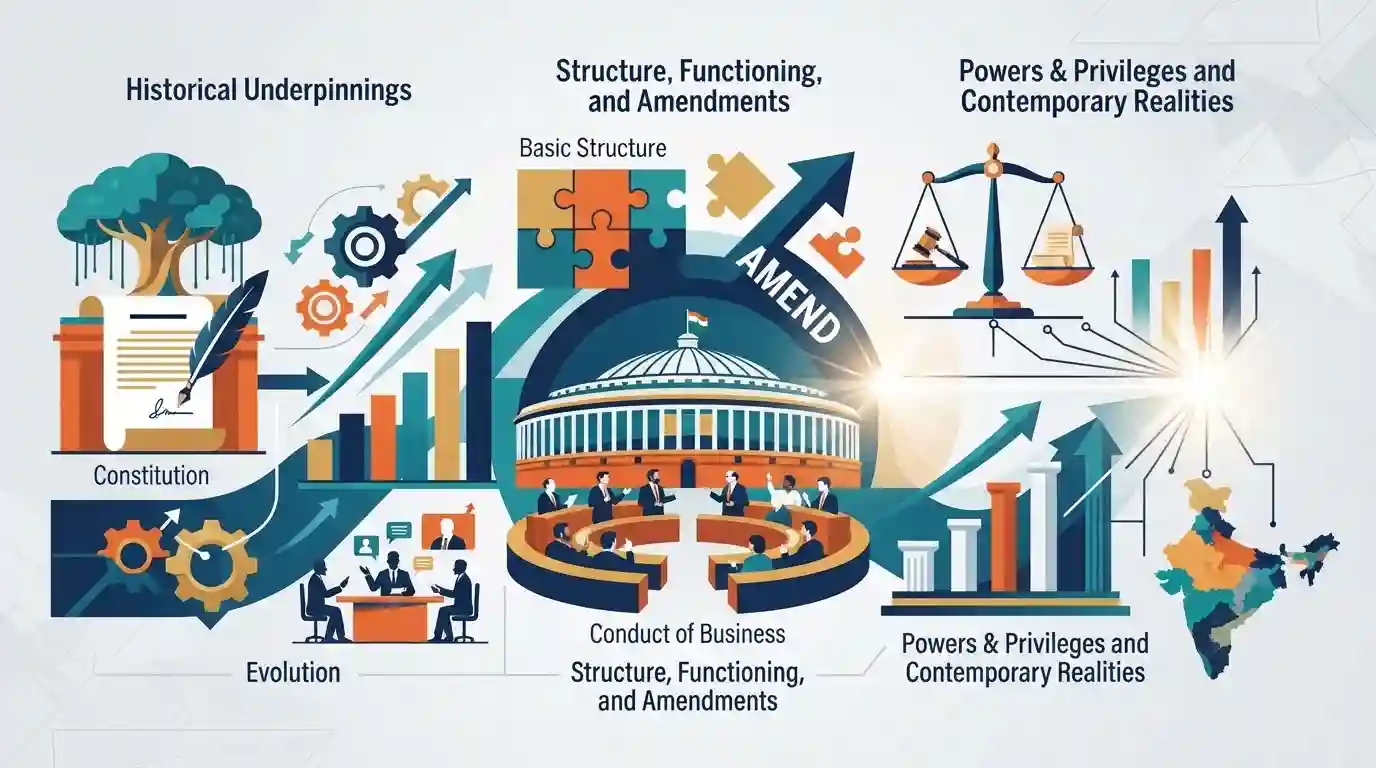
Why It Matters
Understanding how constitutional numbers and parliamentary structures have transformed over time provides crucial insights into the evolving nature of Indian democracy, federal representation, and legislative powers under Article 368.
Summary
The article examines how the numbers, structure, and representation within the Indian Parliament have evolved through constitutional amendments and historical shifts, highlighting the continuous adaptation of India's foundational legal document to contemporary political realities.
Key Points
- The Indian Constitution has undergone numerous amendments since its adoption, reflecting the changing socio-political and economic dynamics of the country.
- Parliamentary structures, numbers, and representation principles have evolved significantly, impacting federal balance and legislative efficiency.
- The amending power of Parliament, while broad, is subject to judicial review and the basic structure doctrine.
- Changes in parliamentary numbers and composition raise critical questions regarding political representation, federal equity, and governance.
Important Terms
Constitution of India

The supreme law of India, containing the framework, fundamental political principles, structure, procedures, powers, and duties of government institutions, along with the fundamental rights and directive principles.
UPSC context
GS Paper II (Indian Constitution - Historical Underpinnings, Evolution, Features, Amendments, Basic Structure). Essential core topic for prelims and mains polity questions.
Article 368
The article in Part XX of the Constitution of India that prescribes the power of Parliament to amend the Constitution and the procedure to be followed.
UPSC context
GS Paper II (Amendments and Basic Structure). Tests knowledge of legislative powers, federal balance, and judicial review doctrines.
Parliament of India
India's supreme legislative body, consisting of the President and the two Houses: the Rajya Sabha (Council of States) and the Lok Sabha (House of the People).
UPSC context
GS Paper II (Parliament and State Legislatures - Structure, Functioning, Conduct of Business, Powers & Privileges). Highly recurrent in both Prelims and Mains.
Constituent Assembly
A body of representatives elected indirectly by the Provincial Legislative Assemblies that met between 1946 and 1950 to draft and adopt the Constitution of India.
UPSC context
GS Paper II (Historical Underpinnings and Evolution). Tests understanding of India's constitutional history, debates, and founding principles.
Prelims Trap
Parliament's amending power under Article 368 is absolute and extends to all parts of the Constitution without judicial exception.
Aspirants often assume Article 368 provides an unlimited constituent power to Parliament. In reality, procedural requirements and the substantive limits of the Basic Structure Doctrine apply.
Static Concepts Connected
What are the procedural and substantive limits on the amending power under Article 368?
- Constituent Power: Constituent power lies in a distinct category, differentiating ordinary legislation from constitutional amendments under Article 368.
- Basic Structure: Supreme Court established in Kesavananda Bharati (1973) that core features like federalism, judicial review, and democracy cannot be destroyed.
- Procedure & Ratification: Requires a special majority (absolute majority of total membership plus two-thirds present and voting) and state ratification for federal provisions.
Cross-Topic Patterns
Parliamentary Representation vs Fiscal Federalism
Constitutional amendments affecting parliamentary representation directly interact with the Finance Commission's devolution criteria, creating a federal tension between population size and fiscal performance.
Delimitation and Social Justice Mandates
The delimitation exercise tied to parliamentary numbers directly impacts Scheduled Castes/Scheduled Tribes reservation seats, bridging electoral geography with social justice mandates.

Delimitation + Article 368 + Basic Structure Doctrine will likely be tested via a multi-statement conceptual question.
Linked PYQs · 4
Linked PYQs · 4
- 2025MainsGS2
Indian Constitution has conferred the amending power on the ordinary legislative institutions with a few procedural hurdles. In view of this statement, examine the procedural and substantive limitations on the amending power of the Parliament to change the Constitution.
- 2019MainsGS2
“Parliament's power to amend the Constitution is a limited power and it cannot be enlarged into absolute power." In the light of this statement explain whether Parliament under Article 368 of the Constitution can destroy the Basic Structure of the Constitution by expanding its amending power?
- 2023MainsGS2
Compare and contrast the British and Indian approaches to Parliamentary sovereignty.
- 2024MainsGS2
What changes has the Union Government recently introduced in the domain of Centre-State relations ? Suggest measures to be adopted to build the trust between the Centre and the States and for strengthening federalism.
