Constitutional Challenges and Autonomy of State Institutions
Source:The Hindu ↗
Why It Matters
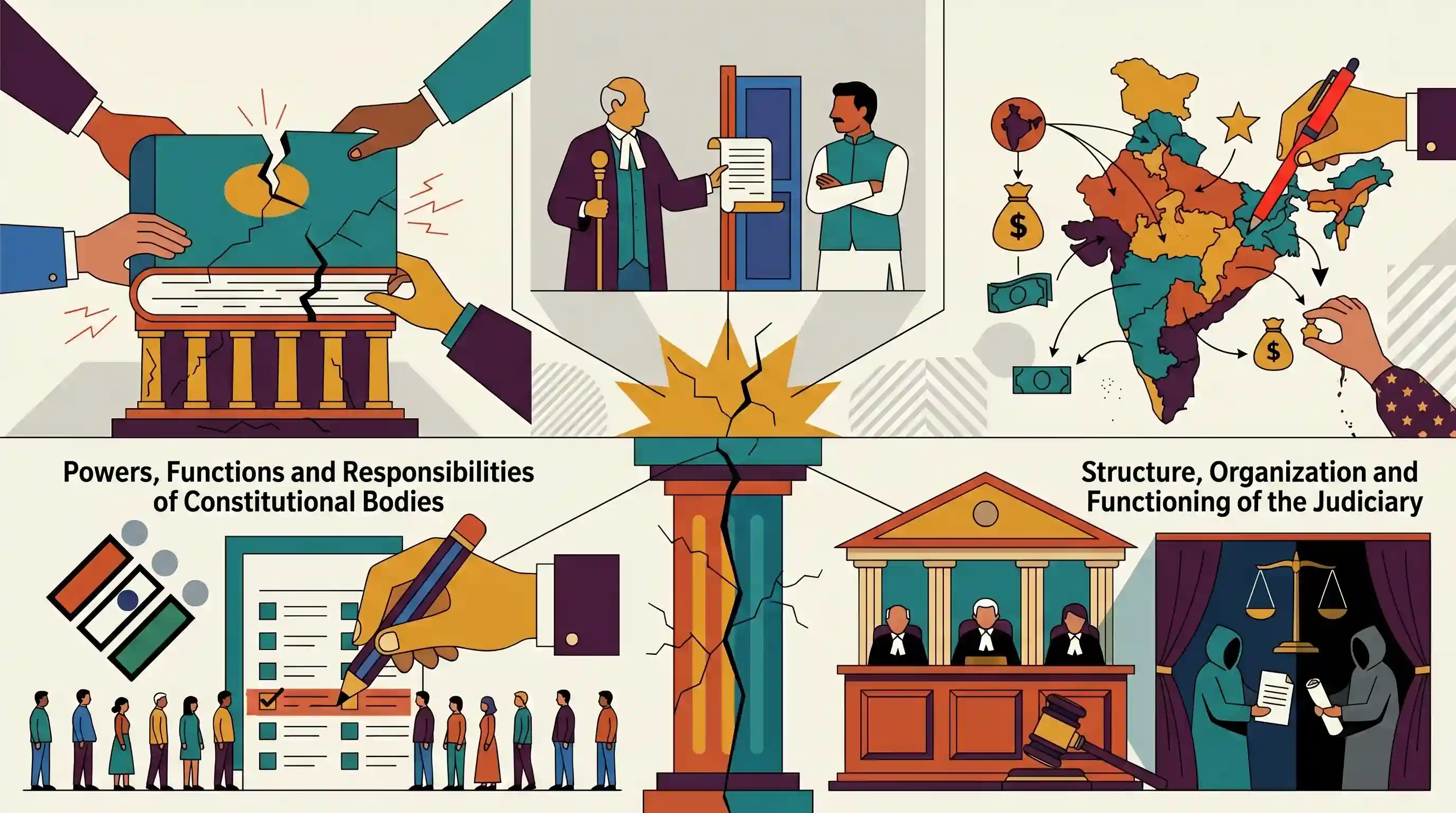
This article captures a critical, high-level analysis of multiple interconnected constitutional issues in India today. It serves as a valuable resource for answering questions on the erosion of institutional autonomy, the changing nature of federalism, electoral overreach, and the ongoing debates over judicial independence and accountability.
Summary
Former Supreme Court Judge B. Sudershan Reddy has expressed profound concerns regarding the challenges facing the Constitution of India, attributing them partly to the actions of autonomous institutions like the judiciary and the Election Commission of India (ECI). He pointed out potential overreaches, such as the ECI's Special Intensive Revision (SIR) of electoral rolls and the lack of transparency in judicial appointments and transfers. He also highlighted a major constitutional vulnerability regarding the lack of an impeachment process for state Governors, which becomes critical when Governors refuse to cooperate with elected state governments. Furthermore, he warned of the deep federal and financial implications of the impending delimitation exercise.
Key Points
- A former Supreme Court Judge warned that India's constitutional principles face significant challenges from autonomous institutions, including the judiciary itself.
- He raised concerns over controversial judicial verdicts and doubts surrounding the transparency of judicial appointments and transfers.
- The absence of an impeachment provision for Governors, akin to the President or Vice-President, represents a constitutional vulnerability, particularly amidst instances of Governors skipping legislative addresses.
- The Election Commission's Special Intensive Revision (SIR) of electoral rolls has been criticized for potentially overstepping its mandate to ensure free and fair elections, targeting non-citizens and migrants instead.
- The upcoming delimitation of constituencies poses serious financial and political repercussions, potentially straining India's federal structure.
Important Terms
Constitution of India

The supreme law of India, establishing the framework for government, fundamental rights, and the duties of institutions. It serves as a check on power.
UPSC context
Core of GS Paper II (Polity). Tests understanding of constitutionalism, basic structure, and institutional checks and balances.
Election Commission of India (ECI)
A constitutional body (Article 324) responsible for administering election processes in India. It possesses a 'reservoir of power' to ensure free and fair polls.
UPSC context
GS Paper II (Constitutional Bodies). Crucial for topics on electoral reforms, institutional autonomy, and democratic integrity.
Special Intensive Revision (SIR)
A comprehensive, house-to-house verification drive by the ECI to update and correct electoral rolls, often preceding major elections to remove duplicates and ineligible entries.
UPSC context
GS Paper II (Elections). Relevant for questions on electoral roll accuracy, digital reforms, and potential voter disenfranchisement.
Collegium System
A system where the Chief Justice of India and four senior-most SC judges recommend judicial appointments and transfers; it is not mentioned in the original Constitution.
UPSC context
GS Paper II (Judiciary). Tests knowledge of judicial independence vs. transparency, and the evolution of the 'Three Judges Cases'.
Governor of India
The constitutional head of a state, appointed by the President. They hold office during the 'pleasure of the President' without a constitutional impeachment process.
UPSC context
GS Paper II (Federalism/Constitutional Posts). Central to debates on Centre-State relations and the discretionary powers of gubernatorial offices.
Delimitation Exercise
The process of redrawing boundaries of Lok Sabha and State Assembly constituencies based on population (Article 82) to ensure equitable representation.
UPSC context
GS Paper II (Federalism). High relevance for the upcoming 2026 cycle, inter-state representation disparities, and women’s reservation.
Pleasure Doctrine
A principle under Article 156(1) where certain officials, like Governors, can be removed by the President at any time without assigning specific cause.
UPSC context
GS Paper II (Polity). Important for understanding the security of tenure for constitutional posts and its impact on federal balance.
Prelims Trap
The Constitution outlines an impeachment process for removing a State Governor on grounds of constitutional violation.
False. The Constitution provides NO formal impeachment process for Governors. Under Article 156, they hold office purely during the "pleasure of the President."
Static Concepts Connected
How is a State Governor removed from office?
- Pleasure Doctrine: Under Article 156(1), the Governor holds office during the pleasure of the President, meaning they can be removed at any time.
- No Impeachment: Unlike the President or Supreme Court Judges, the Constitution outlines no specific grounds, procedure, or formal impeachment mechanism for a Governor's removal.
- Judicial Check: The Supreme Court ruled in the B.P. Singhal case (2010) that the President's pleasure cannot be exercised arbitrarily, capriciously, or for purely political reasons.
What governs the delimitation of parliamentary constituencies?
- Article 82: Empowers Parliament to enact a Delimitation Act after every Census to readjust the allocation of seats and territorial boundaries.
- 84th Amendment Act: Froze the total number of Lok Sabha seats based on the 1971 census until the relevant figures for the first census post-2026 are published.
- Absolute Authority: Orders of the Delimitation Commission have the force of law and cannot be challenged in any court of law (Article 329).
Cross-Topic Patterns
Delimitation + Financial Devolution
The 2026 seat freeze expiration connects to Finance Commission debates. Southern states fear a double-penalty: losing both parliamentary weight and central tax share due to effective demographic management.
ECI Mandate vs Citizenship Enforcement
ECI's electoral roll revisions (SIR) risk bleeding into citizenship verification, creating syllabus overlaps between Article 324, RPA 1950 mechanisms, and the executive's domain under the Citizenship Act.
Governor's Address & Constitutional Morality
Governors skipping or altering their mandatory legislative addresses connects constitutional morality with federal friction, frequently tested alongside discretionary powers and floor-test controversies.

Expect a 2026 multi-statement Prelims question mixing Article 156 (Governor removal), Article 176 (customary address), and B.P. Singhal.
Linked PYQs · 4
Linked PYQs · 4
- 2025MainsGS2
Discuss the evolution of collegium system in India. Critically examine the advantages and disadvantages of the system of appointment of the Judges of the Supreme Court of India and that of the USA.
- 2023MainsGS2
“Constitutionally guaranteed judicial independence is a prerequisite of democracy.” Comment.
- 2022MainsGS2
Discuss the role of the Election Commission of India in the light of the evolution of the Model Code of Conduct.
- 2022MainsGS2
Discuss the essential conditions for exercise of the legislative powers by the Governor. Discuss the legality of re-promulgation of ordinances by the Governor without placing them before the Legislature.
