Constitution Day Celebrations and Regional Language Editions
Source:The Hindu ↗
Why It Matters
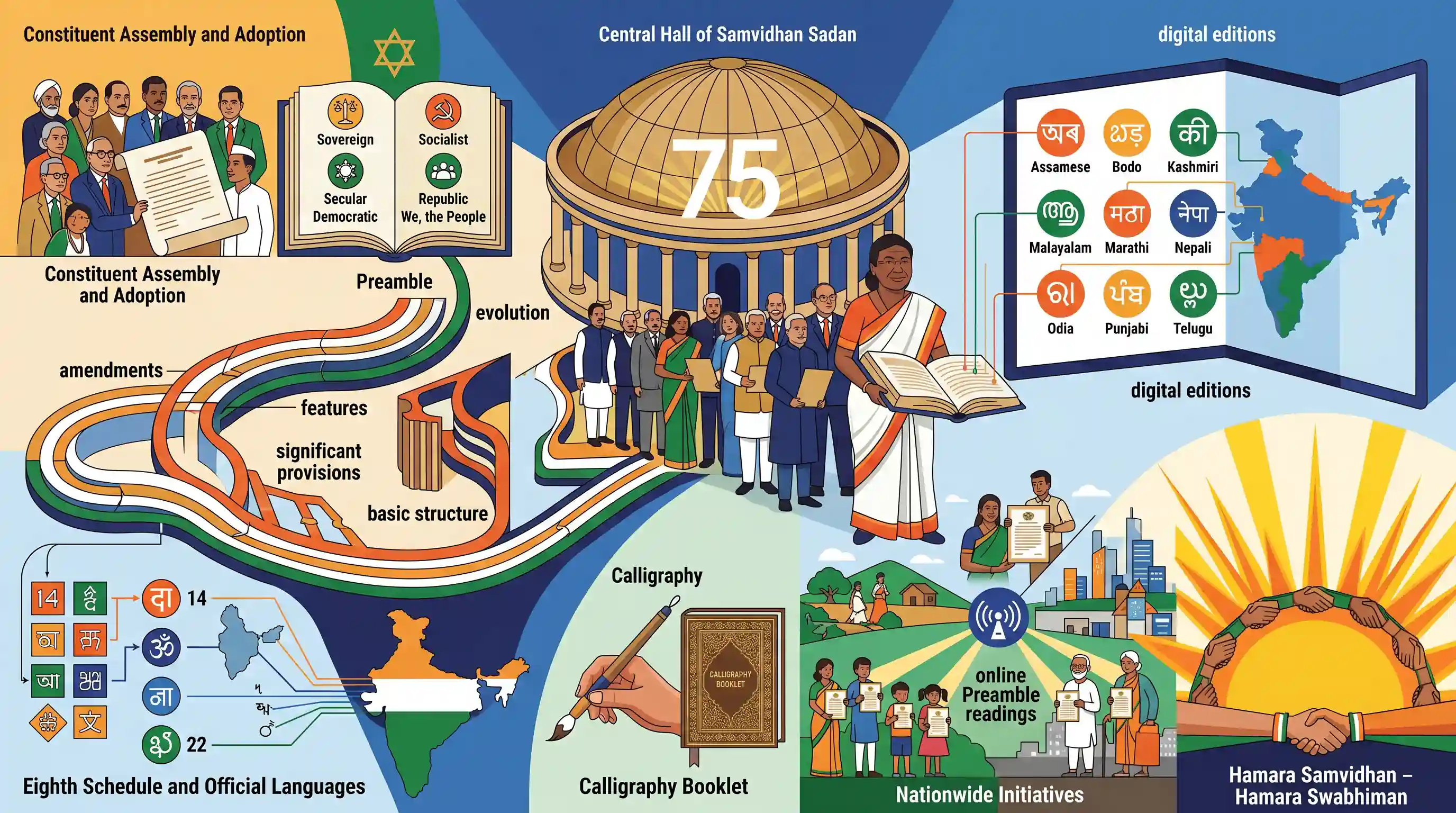
Constitution Day highlights the foundational principles of Indian democracy, the legacy of the Constituent Assembly, and the importance of the Preamble. The translation of the Constitution into regional languages underscores the linguistic diversity mapped out in the Eighth Schedule.
Summary
President Droupadi Murmu will lead the 75th Constitution Day (Samvidhan Diwas) celebrations on November 26 at the Central Hall of Samvidhan Sadan. As part of the events, digital editions of the Constitution in nine regional languages, prepared by the Legislative Department, will be unveiled to promote constitutional accessibility. Additionally, a booklet showcasing the calligraphy of the original Constitution will be launched, alongside nationwide initiatives like online Preamble readings and the 'Hamara Samvidhan – Hamara Swabhiman' campaign.
Key Points
- President Droupadi Murmu will lead Constitution Day (Samvidhan Diwas) celebrations on November 26 at the Central Hall of Samvidhan Sadan to mark 75 years of the adoption of the Constitution.
- The Constitution of India will be digitally launched in nine regional languages: Malayalam, Marathi, Nepali, Punjabi, Bodo, Kashmiri, Telugu, Odia, and Assamese.
- A commemorative booklet on the calligraphy of the original Constitution will be released.
- Citizens are encouraged to participate in a mass online reading of the Preamble and the 'Hamara Samvidhan – Hamara Swabhiman' campaign.
Important Terms
Constitution Day (Samvidhan Diwas)

Observed annually on November 26, it commemorates the adoption of the Constitution of India in 1949. Designated in 2015, it promotes constitutional values and honors Dr. B.R. Ambedkar's legacy.
UPSC context
GS II (Polity). Significant for questions on historical milestones, constitutional adoption, and the role of the Constituent Assembly.
Samvidhan Sadan
The official name for India's old Parliament building, designated in September 2023. It historically housed the Constituent Assembly during the drafting of the Constitution from 1946 to 1950.
UPSC context
GS I (Heritage) & GS II (Parliament). Relevant for understanding institutional history and recent structural changes in Indian governance.
Legislative Department
A department under the Ministry of Law and Justice responsible for drafting principal legislation and handling constitutional matters, election laws, and the publication of the Constitution.
UPSC context
GS II (Structure of Government). Tests knowledge of the executive machinery involved in the legislative process and law drafting.
Preamble to the Constitution
The introductory statement of the Constitution that outlines its core philosophy, objectives (Justice, Liberty, Equality, Fraternity), and the nature of the Indian State as a Sovereign Socialist Secular Democratic Republic.
UPSC context
GS II (Basic Structure). Essential for understanding the fundamental principles and judicial interpretations of the Constitution's preamble.
Hamara Samvidhan – Hamara Swabhiman
A nationwide constitutional literacy initiative (2024-25) by the Ministry of Law and Justice. It aims to empower citizens by fostering pride in constitutional rights and promoting legal awareness at the grassroots.
UPSC context
GS II (Governance/Social Justice). Tests awareness of government schemes like DISHA aimed at citizen empowerment and constitutional literacy.
Eighth Schedule
A constitutional list recognizing the official languages of India. The release of digital editions of the Constitution in regional languages highlights the schedule's role in promoting linguistic diversity.
UPSC context
GS II (Polity/Federalism). Relevant for topics regarding language policy, official status, and the protection of regional cultural identities.
Prelims Trap
"Constitution Day has been officially celebrated annually since the adoption of the document in 1949."
Constitution Day was declared in 2015 to mark Dr. B.R. Ambedkar's 125th birth anniversary. Prior to 2015, November 26 was observed as National Law Day.
Static Concepts Connected
How were languages incrementally added to the Eighth Schedule after 1950?
- 21st Amendment (1967): Added Sindhi as the 15th official language.
- 71st Amendment (1992): Included Konkani, Manipuri, and Nepali.
- 92nd Amendment (2003): Added Bodo, Dogri, Maithili, and Santhali, raising the total number of recognized languages to 22.
- 96th Amendment (2011): Replaced the spelling of 'Oriya' with 'Odia'.
Who were the key figures involved in physically crafting the original Constitution?
- Prem Behari Raizada: The master calligrapher who handwritten the original English manuscript of the Constitution in a flowing italic style.
- Nandalal Bose: Led the artists from Shantiniketan (including Beohar Rammanohar Sinha) in illuminating and decorating the document's pages.
- Vasant Krishnan Vaidya: Served as the principal calligrapher for the original Hindi version of the Constitution.
Cross-Topic Patterns
Access to Justice via DISHA
The 'Hamara Samvidhan – Hamara Swabhiman' campaign operates under DISHA, linking constitutional literacy (Polity) with targeted grassroots legal empowerment and e-governance initiatives (Governance).
Bengal School of Art in Polity
Illuminating the original Constitution connects the Constituent Assembly's work to Nandalal Bose and the Bengal School of Art, making it a cross-disciplinary target blending Polity with Modern Indian Art.

Expect a 2026 multi-statement Prelims question mixing 8th Schedule amendments (71st/92nd) with original Constitution crafting facts.
Linked PYQs · 5
Linked PYQs · 5
- 2023MainsGS2
“The Constitution of India is a living instrument with capabilities of enormous dynamism. It is a constitution made for a progressive society.” Illustrate with special reference to the expanding horizons of the right to life and personal liberty.
- 2021MainsGS2
‘Constitutional Morality’ is rooted in the Constitution itself and is founded on its essential facets. Explain the doctrine of ‘Constitutional Morality’ with the help of relevant judicial decisions.
- 2023PrelimsGS1
Consider the following statements in respect of the Constitution Day: Statement-I: The Constitution Day is celebrated on 26th November every year to promote constitutional values among citizens. Statement-II: On 26th November, 1949, the Constituent Assembly of India set up a Drafting Committee under the Chairmanship of Dr. B. R. Ambedkar to prepare a Draft Constitution of India. Which one of the following is correct in respect of the above statements?
- 2020PrelimsGS1
The Preamble to the Constitution of India is
- 2017PrelimsGS1
The mind of the makers of the Constitution of India is reflected in which of the following?
