Subordinate Judiciary Bar Quota Eligibility and Article 233
Source:The Hindu ↗
Why It Matters
The Supreme Court's interpretation of Article 233(2) will directly impact the recruitment rules for the subordinate judiciary and the career advancement of judicial officers. The structure, appointment mechanisms, and constitutional provisions governing lower courts are vital topics for UPSC GS2 (Polity) and Prelims.
Summary
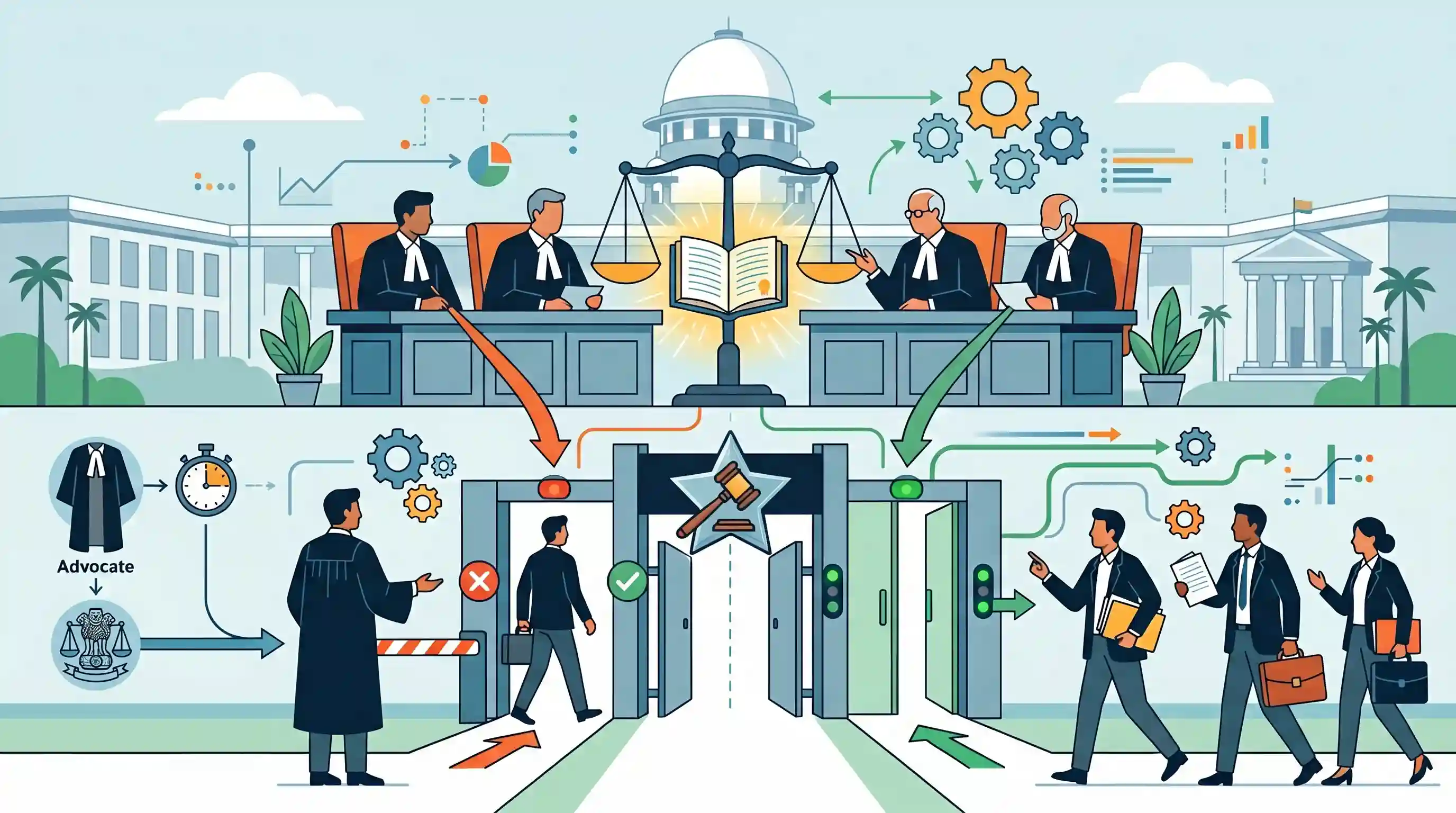
A five-judge Constitution Bench of the Supreme Court will examine whether serving judicial officers with seven years of prior experience as advocates are eligible for District Judge appointments under the Bar quota. The case hinges on the interpretation of Article 233(2) of the Constitution and stems from a Kerala High Court decision that disqualified serving Munsiffs from the Bar quota, ruling that candidates must be actively practicing advocates at the time of appointment.
Key Points
- A 5-judge Supreme Court Constitution Bench will interpret Article 233(2) regarding the eligibility of serving judicial officers for District Judge appointments under the Bar quota.
- The central issue is whether judicial officers with seven years of prior experience as practicing advocates can compete for District Judge vacancies reserved for the Bar.
- Article 233(2) mandates that candidates not already in Union or State service must have been an advocate or pleader for at least seven years to be appointed as a District Judge.
- The reference follows a 2021 Supreme Court stay on a Kerala High Court ruling, which disqualified sitting Munsiffs from the Bar quota because they were not practicing advocates at the time of appointment.
Important Terms
Article 233(2) of the Constitution

Constitutional provision specifying that individuals not already in union or state service are eligible for District Judge appointment only if they have practiced as an advocate for at least seven years.
UPSC context
GS II - Judiciary. Tests knowledge of constitutional eligibility criteria for judicial appointments and the "in-service" vs. "Bar quota" debate.
Constitution Bench
A Supreme Court bench comprising at least five judges, mandated by Article 145(3) for cases involving substantial questions of law regarding constitutional interpretation or to resolve conflicting judgments.
UPSC context
GS II - Judiciary. Essential for understanding the Supreme Court's procedural mechanics and its role as the final interpreter of the Constitution.
District Judge
The highest judicial official in a district, exercising original and appellate jurisdiction over civil and criminal matters and appointed by the Governor in consultation with the State's High Court.
UPSC context
GS II - Judiciary. Tests understanding of the hierarchy and administrative structure of the Indian judicial system at the local level.
Subordinate Judiciary
The system of courts operating below the High Courts, governed by Articles 233 to 237, which forms the primary tier of justice delivery at the local level.
UPSC context
GS II - Judiciary. Relevant for questions on the vertical structure of Indian courts and the relationship between High Courts and lower courts.
Munsiff
A judicial officer of the lowest rank in the civil court hierarchy in certain states, typically presiding over cases with limited pecuniary (monetary) jurisdiction.
UPSC context
GS II - Judiciary. Demonstrates familiarity with specific designations and career entry points within subordinate judicial services across different Indian states.
Bar Quota
The reserved percentage of District Judge vacancies filled through direct recruitment from practicing advocates, distinct from posts filled via the promotion of serving judicial officers.
UPSC context
GS II - Judiciary/Appointments. Relevant to the legal debate over recruitment streams and eligibility criteria for higher judicial services.
Prelims Trap
"Administrative control over the subordinate judiciary, including posting and promotion, is vested in the State Governor."
Under Article 235, the administrative control over district and subordinate courts is exclusively vested in the High Court, though the Governor formally appoints District Judges.
Static Concepts Connected
How are District Judges appointed and controlled under the Constitution?
- Appointing Authority: The Governor of the State appoints, posts, and promotes District Judges in consultation with the respective High Court under Article 233.
- Direct Recruitment: A candidate must not already be in Union/State service, must have at least seven years of experience as an advocate or pleader, and be recommended by the High Court.
- Administrative Control: Under Article 235, the control over district and subordinate courts, including postings, promotions, and leave, is vested entirely in the High Court.
What positions are included under the term 'District Judge' in the Constitution?
- Civil Jurisdiction: Under Article 236, it includes judges of a city civil court, additional district judges, joint district judges, and assistant district judges.
- Criminal/Special Courts: The definition extends to chief judges of small cause courts, chief presidency magistrates, sessions judges, and additional or assistant sessions judges.
Cross-Topic Patterns
AIJS vs State Judicial Services
The debate over interpreting Article 233 ties into the broader push for an All India Judicial Service (Article 312), which seeks to centralize district judge recruitment away from state-level processes.
Independence of Subordinate Judiciary
Article 235 explicitly vests control of district courts with the High Court, reinforcing the Directive Principle (Article 50) of separating the judiciary from the executive at the grassroots level.

Subordinate court appointments (Art 233) and HC control (Art 235) will likely be tested as a multi-statement Prelims question in 2026.
Linked PYQs · 3
Linked PYQs · 3
- 2021PrelimsGS1
With reference to Indian judiciary, consider the following statements : 1. Any retired judge of the Supreme Court of India can be called back to sit and act as a Supreme Court judge by the Chief Justice of India with prior permission of the President of India. 2. A High Court in India has the power to review its own judgement as the Supreme Court does. Which of the statements given above is/are correct?
- 2023MainsGS2
“Constitutionally guaranteed judicial independence is a prerequisite of democracy.” Comment.
- 2025MainsGS2
Discuss the evolution of collegium system in India. Critically examine the advantages and disadvantages of the system of appointment of the Judges of the Supreme Court of India and that of the USA.
