Constitution 131st Amendment Bill and Chandigarh Legislative Status
Source:Indian Express ↗
Why It Matters
It provides a contemporary case study on how constitutional amendments are used to alter the governance structures of Union Territories (via Article 239A/368) and highlights the federal frictions that can arise when the Union acts on territories that are subject to historical inter-state disputes.
Summary
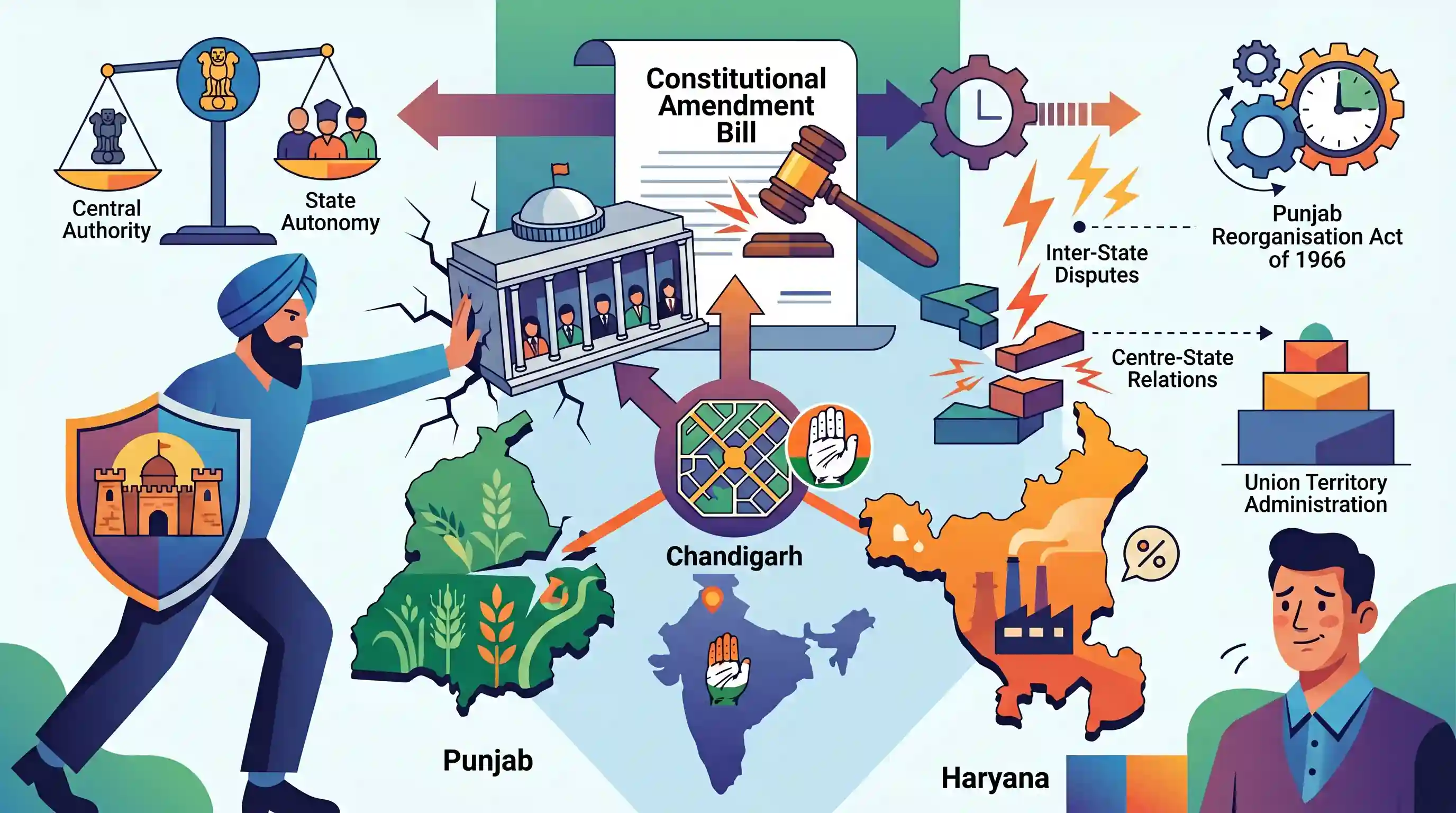
The Constitution (131st Amendment) Bill 2025 seeks to change the administrative status of Chandigarh by proposing the creation of a Legislative Assembly for the Union Territory. Punjab has strongly opposed this move, arguing that granting Chandigarh its own legislature permanently establishes it as a separate entity, thereby diluting Punjab's long-standing historical claim to the city as its exclusive capital. The row highlights the intricacies of Union Territory administration under the Constitution, the legacy of the Punjab Reorganisation Act of 1966, and the ongoing complexities in Centre-State and inter-state relations regarding shared capitals.
Key Points
- The Constitution (131st Amendment) Bill 2025 proposes to grant a Legislative Assembly to the Union Territory of Chandigarh, fundamentally altering its current administrative setup.
- Chandigarh currently operates as a Union Territory without a legislature and serves as the shared capital of both Punjab and Haryana.
- Punjab opposes the amendment because creating a distinct legislative assembly for Chandigarh would cement its independent status and undermine Punjab's historical demand for the city's exclusive transfer to the state.
- The development brings focus to the constitutional provisions governing Union Territories (Article 239A) and the broader challenges of Centre-State relations and unresolved territorial disputes.
Important Terms
Constitution (131st Amendment) Bill 2025

A proposed legislative change aimed at bringing the Union Territory of Chandigarh under Article 240 of the Constitution to streamline its law-making process via Presidential regulation.
UPSC context
GS Paper 2: Indian Constitution and its amendments; tests understanding of legislative proposals affecting federal structures.
Punjab Reorganisation Act 1966
The legislation that carved Haryana out of Punjab in 1966 and established Chandigarh as a Union Territory serving as a shared capital for both states.
UPSC context
GS Paper 2: Reorganisation of states; essential for understanding historical territorial disputes and federal evolution.
Article 240
A constitutional provision empowering the President of India to make regulations for certain Union Territories for their peace, progress, and good government.
UPSC context
GS Paper 2: Executive powers of the President and governance of Union Territories.
Union Territory Administration
The administrative framework through which the Central Government governs UTs, often through an appointed Administrator or Lieutenant Governor under Articles 239–241.
UPSC context
GS Paper 2: Structure, organization, and functioning of the Executive.
Federalism
A political system where power is divided between a central authority and constituent units; in India, this includes complex Centre-State and inter-state relations.
UPSC context
GS Paper 2: Issues and challenges pertaining to the federal structure; tests knowledge of cooperative and competitive federalism.
Inter-State Disputes
Conflicts between state governments, such as the Punjab-Haryana row over Chandigarh, often involving land, water, or capital city claims.
UPSC context
GS Paper 2: Statutory, regulatory and various quasi-judicial bodies and federal friction points.
Prelims Trap
Creating a legislative assembly for a Union Territory always requires a Constitutional Amendment under Article 368.
Under Article 239A, Parliament can create a legislature for certain UTs via ordinary law, which explicitly states it shall NOT be deemed an Article 368 amendment.
Static Concepts Connected
How does the Constitution differentiate between UT administrative frameworks?
- Article 239: UTs are administered directly by the President through an appointed Administrator (such as a Lieutenant Governor or Chief Commissioner).
- Article 239A: Allows Parliament to create a Legislature and/or Council of Ministers for certain UTs (like Puducherry) via ordinary law.
- Article 239AA: Provides special, constitutionally codified status to Delhi, explicitly establishing a Legislative Assembly and detailing its powers.
How did Chandigarh become a shared capital Union Territory?
- Shah Commission: The JC Shah Commission (1966) recommended the linguistic reorganization and division of the composite state of Punjab.
- Punjab Reorganisation Act: The 1966 Act created Haryana, transferred hilly areas to Himachal Pradesh, and made Chandigarh a shared provisional capital UT.
- Ex-officio Administrator: Uniquely, since 1984, the Governor of Punjab concurrently serves as the ex-officio Administrator of Chandigarh.
Cross-Topic Patterns
Delhi vs. Chandigarh Administrative Models
While Delhi's powers are constitutionally entrenched via Art 239AA (69th Amendment), Chandigarh's proposed assembly mirrors the Puducherry model (Art 239A), adding complexity to federal friction over shared capitals.
Zonal Councils and Territorial Disputes
Unresolved territorial claims over Chandigarh between Punjab and Haryana highlight the role and limitations of statutory dispute resolution bodies like the Northern Zonal Council.

Expect a Prelims question comparing Art 239A (ordinary law) vs Art 239AA (Delhi) and the Article 368 UT amendment process.
Linked PYQs · 3
Linked PYQs · 3
- 2024MainsGS2
What changes has the Union Government recently introduced in the domain of Centre-State relations ? Suggest measures to be adopted to build the trust between the Centre and the States and for strengthening federalism.
- 2024PrelimsGS1
As per Article 368 of the Constitution of India, the Parliament may amend any provision of the Constitution by way of : 1. Addition 2. Variation 3. Repeal Select the correct answer using the code given below:
- 2019MainsGS2
From the resolution of contentious issues regarding distribution of legislative powers by the courts, 'Principle of Federal Supremacy' and 'Harmonious Construction' have emerged. Explain.
