Honnavar port project and ecological fragility of Western Ghats
Source:Indian Express ↗
Why It Matters
This issue serves as a critical case study for the 'Development vs. Environment' debate in GS3 and Essays. It provides contemporary examples of the ecological fragility of the Western Ghats, the practical challenges of enforcing Environmental Impact Assessments (EIAs), and the threats to specific endemic/vulnerable species (Lion-tailed macaques, Olive Ridley turtles).
Summary
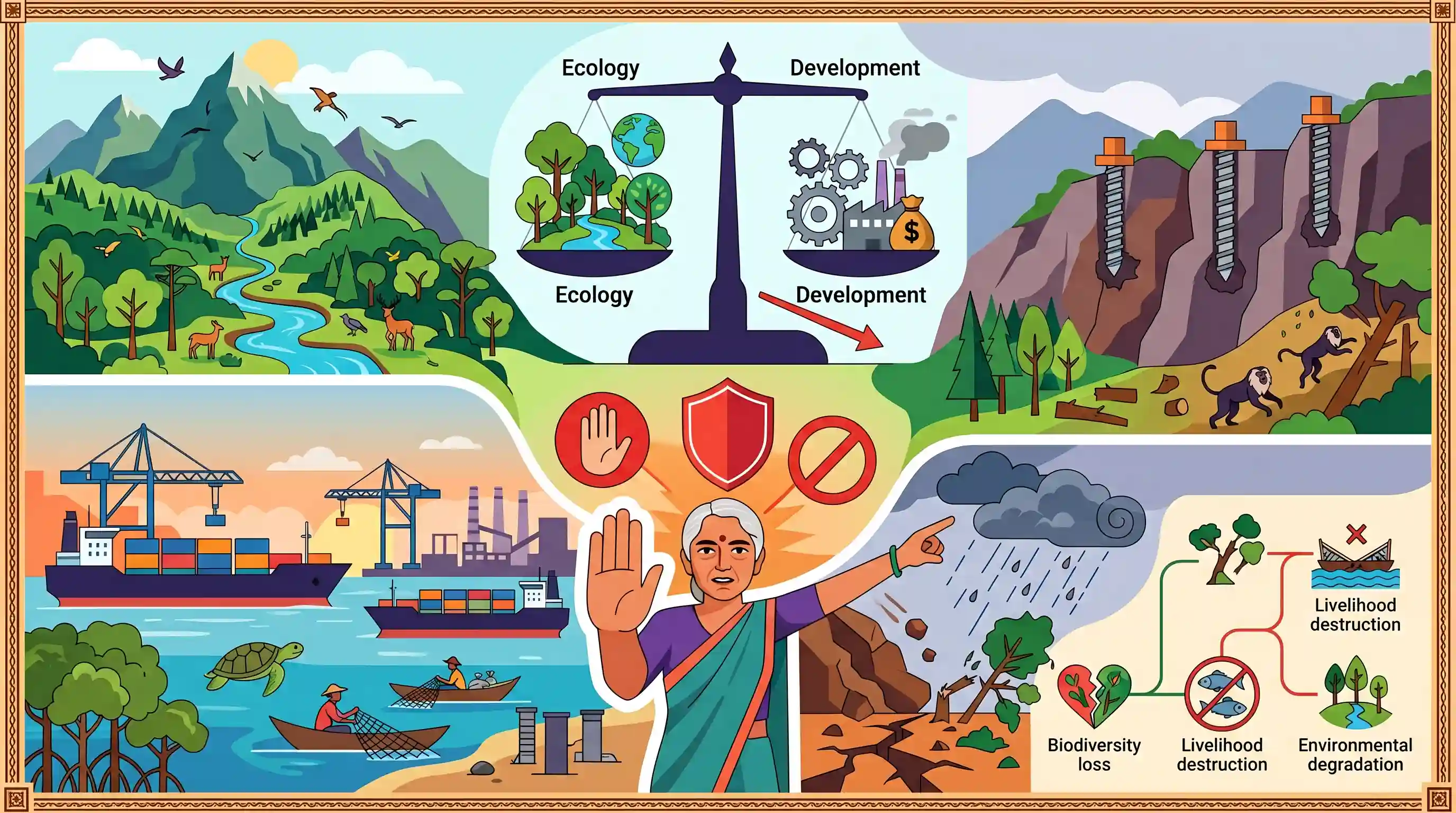
Social activist Medha Patkar has strongly cautioned the Karnataka government against proceeding with large-scale development projects like the Honnavar port and the Sharavathi pumped storage project in the ecologically sensitive Western Ghats. She highlighted that these projects threaten crucial biodiversity, including Olive Ridley turtles and lion-tailed macaques, while also destroying mangroves and the livelihoods of local fisherfolk. Patkar emphasized the need to respect the region's 'carrying capacity' and warned that relentless drilling and deforestation could trigger catastrophic environmental disasters similar to those witnessed in the Himalayan states.
Key Points
- The proposed Honnavar port project in Karnataka threatens local estuaries, mangroves, traditional fishing communities, and the nesting sites of endangered Olive Ridley turtles.
- The Sharavathi pumped storage project necessitates the felling of over 16,000 trees, threatening the habitat of endemic species like the lion-tailed macaque.
- Social activist Medha Patkar warned that constant drilling and construction could lead to severe ecological disasters in the Western Ghats, similar to recent calamities in Uttarakhand and Himachal Pradesh.
- Activists allege that environmental clearances for these projects were obtained using misleading information, such as falsely claiming the absence of turtles in the region.
Important Terms
Environmental Impact Assessment (EIA)

A legal process to evaluate the potential environmental, social, and economic consequences of a proposed project before approval, aimed at ensuring sustainable development and mitigating negative impacts.
UPSC context
GS3 (Environment/Infrastructure); tests knowledge of regulatory tools, 2006/2020 notifications, and the balance between development and ecology.
Coastal Regulation Zone (CRZ)
Regulated coastal areas within 500m of the High Tide Line, classified into zones (CRZ I-IV) to protect fragile marine ecosystems and livelihoods under the Environment (Protection) Act, 1986.
UPSC context
GS3 (Environment/Disaster Management); tests understanding of coastal governance, blue economy, and environmental protection laws.
Carrying Capacity
The maximum population size or level of human activity an ecosystem can sustain indefinitely without resource depletion or environmental degradation.
UPSC context
GS3 (Environment/Ecology); key for questions on regional planning, urbanization, and sustainable resource management.
Pumped Storage Project (PSP)
A hydroelectric energy storage system that pumps water from a lower to an upper reservoir during low demand and releases it for power generation during peak demand.
UPSC context
GS3 (Energy/Environment); relevant for India's renewable energy transition and the trade-offs involving biodiversity in the Western Ghats.
Lion-tailed Macaque
An endangered primate endemic to the Western Ghats; its presence in project sites necessitates strict wildlife clearances and habitat protection measures under the Wildlife (Protection) Act, 1972.
UPSC context
GS3 (Biodiversity); frequently tested in questions on endemic species, Western Ghats conservation, and eco-sensitive zones.
Olive Ridley Turtle
The smallest and most abundant sea turtle species, protected under Schedule I of the WPA 1972; their nesting sites in coastal areas are critical factors in environmental clearance processes.
UPSC context
GS3 (Biodiversity/Environment); essential for Prelims/Mains regarding coastal wildlife protection and arribada nesting.
Prelims Trap
Olive Ridley turtles nest exclusively along the eastern coast of India.
While famous for mass nesting (arribadas) in Odisha, Olive Ridleys also have critical sporadic nesting sites along India's western coast (Karnataka, Maharashtra, Goa).
Static Concepts Connected
What is the conservation status and habitat of the Lion-tailed Macaque?
- Conservation Status: Endangered (IUCN), Schedule I (Wildlife Protection Act, 1972), and Appendix I (CITES).
- Habitat: Endemic to the tropical evergreen rainforests of the Western Ghats, restricted to Karnataka, Kerala, and Tamil Nadu.
- Vulnerability: They are highly arboreal (tree-dwelling) and extremely sensitive to canopy fragmentation caused by infrastructure and pumped storage projects.
What are the defining characteristics of west-flowing peninsular rivers like Sharavathi?
- Estuaries over Deltas: Due to steep gradients and fast flow into the Arabian Sea, they form estuaries (like the Honnavar estuary) rather than large deltas.
- Hydropower Potential: Their steep descent through the Western Ghats makes them highly suitable for hydropower generation and pumped storage projects.
- Origin and Flow: They originate in the Western Ghats and are entirely rain-fed, lacking the glacial meltwater of Himalayan rivers.
Cross-Topic Patterns
Carrying Capacity: Himalayas vs Western Ghats
Disasters in Joshimath and Sikkim mirror infrastructural overload in the Western Ghats. Both highlight the urgent need for regional carrying capacity studies before sanctioning mega-projects in ecologically fragile zones.
EIA Data Integrity & CRZ Dilution
Activists frequently cite flawed baseline data in EIAs (e.g., hiding turtle nesting sites) to bypass stringent Coastal Regulation Zone (CRZ) protections for port and coastal infrastructure.

Expect a multi-statement question linking Western Ghats endemic fauna (Lion-tailed Macaque) with specific west-flowing rivers (Sharavathi).
Linked PYQs · 4
Linked PYQs · 4
- 2023PrelimsGS1
Consider the following fauna: 1. Lion-tailed Macaque 2. Malabar Civet 3. Sambar Deer How many of the above are generally nocturnal or most active after sunset?
- 2002PrelimsGS1
The sea coast of which one of the following states has become famous as a nesting place for the giant Olive Ridley turtles from South America?
- 2014MainsGS3
Environmental Impact Assessment studies are increasingly undertaken before a project is cleared by the Government. Discuss the environmental impacts of coal-fired thermal plants located at coal pitheads.
- 2019MainsGS3
Define the concept of carrying capacity of an ecosystem as relevant to an environment. Explain how understanding this concept is vital while planning for sustainable development of a region.
