ISRO Space Technology Advancements and International Collaborations
Source:The Hindu ↗
Why It Matters
UPSC frequently tests knowledge on ISRO's achievements, international space collaborations (like NISAR), and the transition towards manned missions (Gaganyaan). This article provides concrete examples of ISRO's growing technical authority and its emphasis on academic collaboration to build indigenous capabilities.
Summary
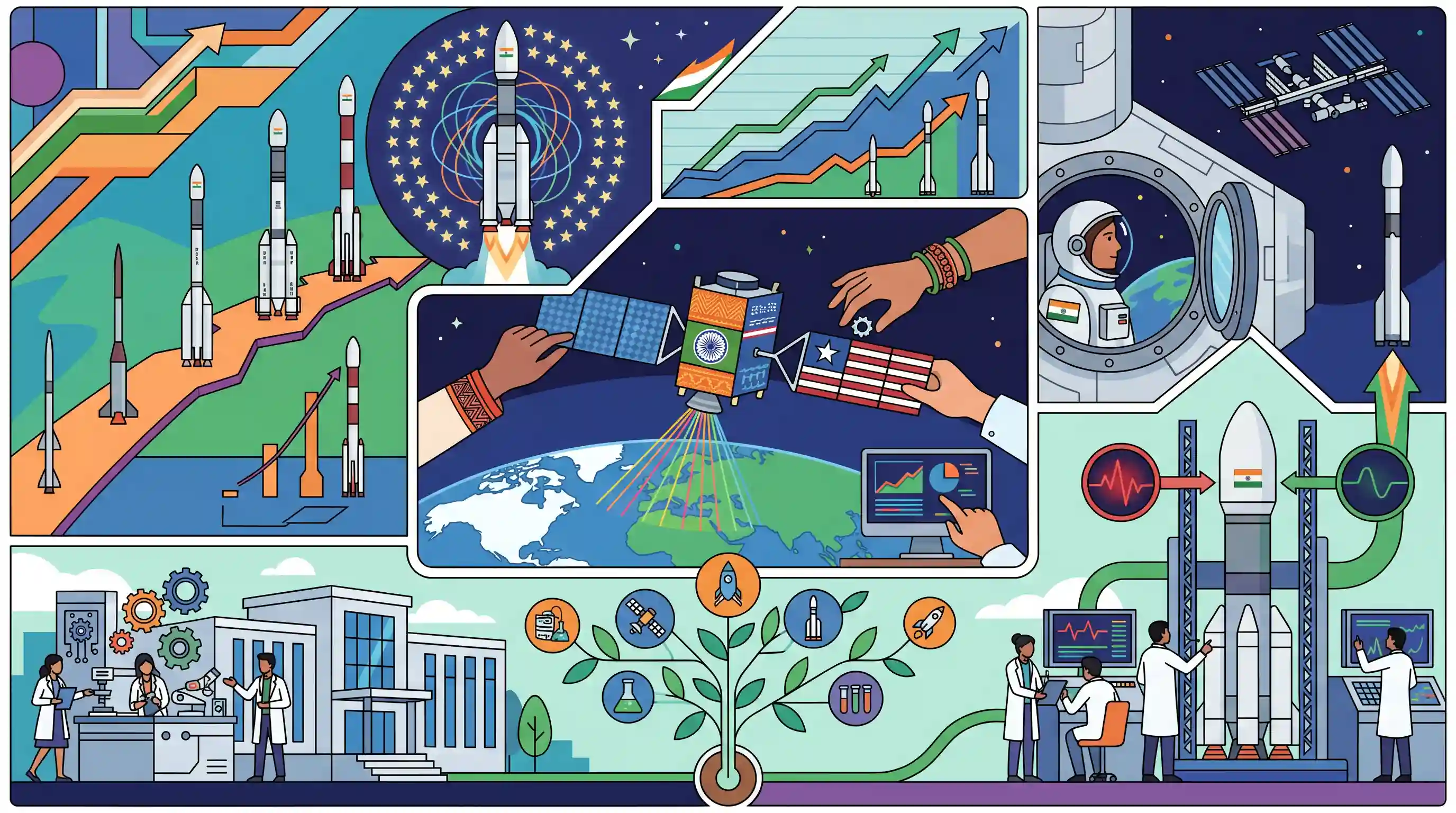
In a recent convocation address at NIT-Tiruchi, ISRO officials underscored India's consistent and remarkable growth in space technology. Key milestones include the launch of India's 100th space vehicle and the upcoming NASA-ISRO Synthetic Aperture Radar (NISAR) mission, which reflects India's robust international stature. Furthermore, Indian astronaut Shubhanshu Shukla's journey to the International Space Station (ISS) demonstrates ISRO's stringent safety standards and technical expertise, as Indian specialists successfully validated anomaly corrections on the Falcon rocket. ISRO is also strengthening its research ecosystem through academic collaborations like the Space Technology Incubation Centre at NIT-T.
Key Points
- The upcoming NASA-ISRO Synthetic Aperture Radar (NISAR) mission highlights India's equal standing in major international space collaborations.
- An Indian astronaut, Shubhanshu Shukla, is slated to visit the International Space Station (ISS), with ISRO demonstrating high technical standards by helping identify and resolve an anomaly in the Falcon launch vehicle.
- India recently achieved a major milestone by successfully launching its 100th space vehicle.
- ISRO is actively fostering academic partnerships to drive innovation, such as the Space Technology Incubation Centre established at NIT Tiruchi.
Important Terms
NASA-ISRO Synthetic Aperture Radar (NISAR)

A joint Earth-observation mission by NASA and ISRO using dual-band Synthetic Aperture Radar (L and S bands) to map global land and ice surfaces to monitor environmental changes and disasters.
UPSC context
GS-III (Science & Tech); tests knowledge of international space collaborations and remote sensing applications.
Gaganyaan
India’s flagship human spaceflight program aiming to demonstrate indigenous capability by sending a three-member crew to a 400 km Low Earth Orbit for three days.
UPSC context
GS-III (Science & Tech); essential for understanding India's milestones in indigenous space exploration and human safety standards.
Space Technology Incubation Centre (S-TIC)
An ISRO initiative to bridge academia and industry by establishing research hubs in technical institutions to foster space-tech startups and indigenous product development.
UPSC context
GS-III (Indigenization of Technology); relevant for policies linking research institutions with the commercial space sector.
Liquid Propulsion Systems Centre (LPSC)
The lead ISRO center responsible for the design, development, and realization of liquid and cryogenic propulsion stages for India’s launch vehicles and satellites.
UPSC context
GS-III (Science & Tech); focus on critical infrastructure and propulsion technology for space missions.
Axiom-4 Mission
A collaborative mission between NASA, Axiom Space, and ISRO to the International Space Station, notable for carrying Indian astronaut Shubhanshu Shukla as a mission pilot.
UPSC context
GS-III (Achievements of Indians in S&T); signifies deepening India-US space ties and precursor training for Gaganyaan.
Prelims Trap
Shubhanshu Shukla is visiting the ISS as part of India's indigenous Gaganyaan mission.
Shukla's ISS visit is under the Axiom-4 (Ax-4) mission with NASA/Axiom Space. It serves as capacity-building precursor training, not the actual indigenous Gaganyaan launch.
Static Concepts Connected
What is Synthetic Aperture Radar (SAR) and how does it differ from optical remote sensing?
- Active Sensor: SAR emits its own microwave pulses to illuminate the target, unlike optical sensors that rely on reflected sunlight.
- All-weather Capability: Because microwaves penetrate clouds and darkness, SAR can capture high-resolution images day or night, in any weather condition.
- Specialized Applications: SAR is highly effective for measuring surface deformation, ice sheet dynamics, and forest biomass, which optical sensors struggle to quantify deeply.
What is the Gaganyaan Mission and its core orbital parameters?
- Mission Objective: To demonstrate indigenous human spaceflight capability by sending a crew of three to a Low Earth Orbit (LEO).
- Orbital Parameters: The crew module will orbit at an altitude of approximately 400 km for a 3-day mission before returning safely to Earth.
- Launch Vehicle: It utilizes the Human-rated LVM3 (HLVM3), which has been reconfigured with robust crew escape and life support systems.
Cross-Topic Patterns
Space Tech + Climate Change Modeling
NISAR's dual-band radar links space tech directly to GS3 Environment, mapping groundwater stress, glacier retreat, and carbon cycles via global biomass estimation.
Commercialization of Human Spaceflight
The Ax-4 mission with Axiom Space highlights commercial spaceflight. This mirrors India's domestic policy shift via IN-SPACe and NSIL to privatize space operations.

Expect a multi-statement question contrasting Gaganyaan's LEO parameters with the ISS Ax-4 mission, combined with NISAR's SAR capabilities.
Linked PYQs · 3
Linked PYQs · 3
- 2016MainsGS3
Discuss India's achievements in the field of Space Science and Technology. How the application of this technology has helped India in its socio-economic development?
- 2017MainsGS3
India has achieved remarkable successes in unmanned space missions including the Chandrayaan and Mars Orbitter Mission, but has not ventured into manned space missions. What are the main obstacles to launching a manned space mission, both in terms of technology and logistics? Examine critically.
- 2023MainsGS3
What is the main task of India's third moon mission which could not be achieved in its earlier mission? List the countries that have achieved this task. Introduce the subsystems in the spacecraft launched and explain the role of the Virtual Launch Control Centre' at the Vikram Sarabhai Space Centre which contributed to the successful launch from Sriharikota.
