West Asia Conflict Poses Downside Risks to India GDP Growth
Source:Indian Express ↗
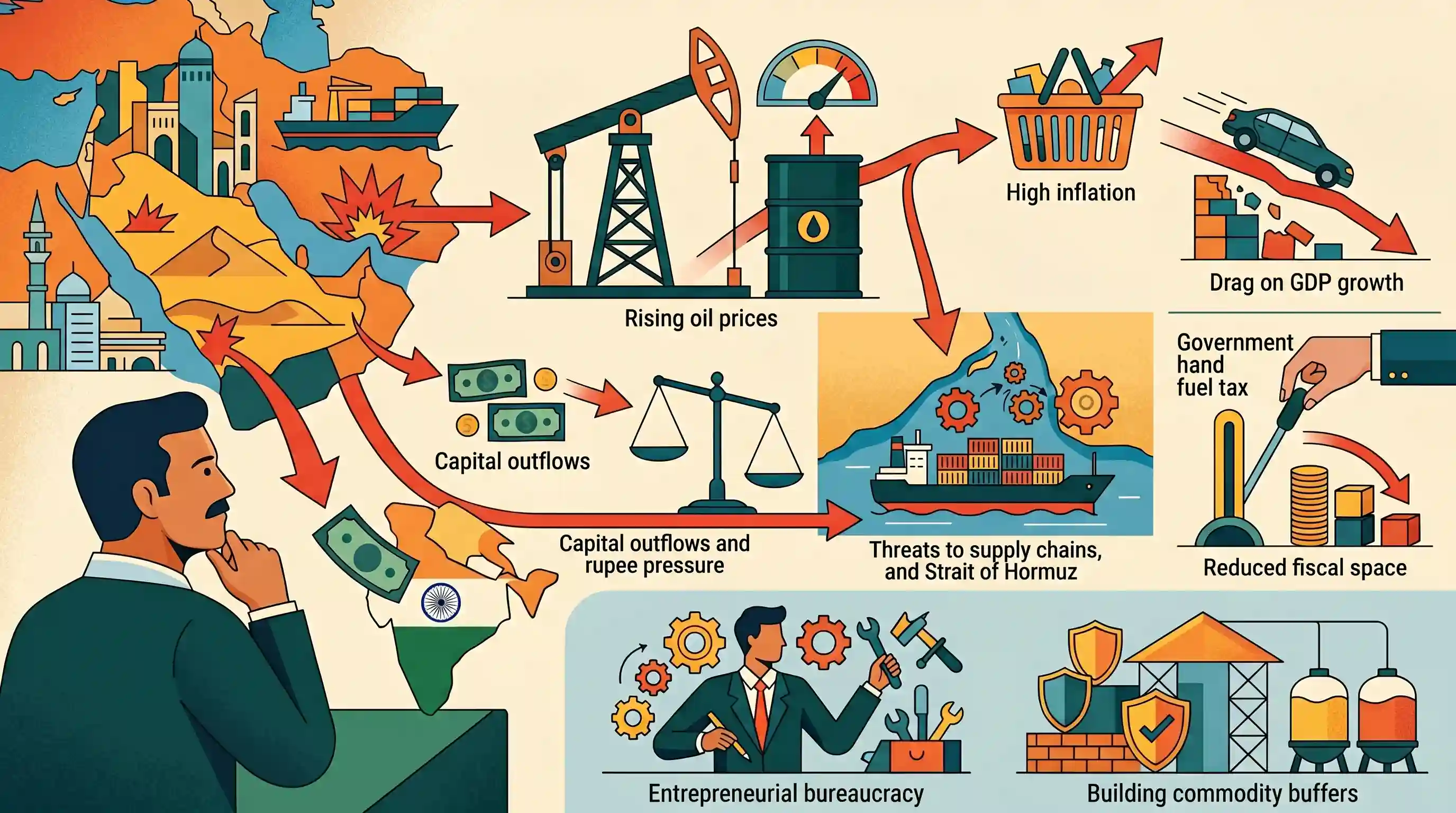
Why It Matters
The article provides an excellent real-world case study for Mains GS3 (Economy) and GS2 (International Relations), explicitly linking geopolitical events (West Asia conflict, Strait of Hormuz) to domestic macroeconomic consequences (imported inflation, GDP downgrades, FPI exits, and fiscal deficit pressures). It offers direct data points for answers on India's energy vulnerability and potential GDP determinants.
Summary
Chief Economic Advisor V Anantha Nageswaran has cautioned that the ongoing conflict in West Asia poses severe downside risks to India's FY27 GDP growth forecast of 7-7.4%. A sustained rise in crude oil prices to $130 per barrel could push retail inflation to 5.5% and drag growth down to 6.4%. The conflict has already resulted in record foreign capital outflows of $13.3 billion, putting extreme pressure on the rupee. Compounding these macroeconomic vulnerabilities are threats to energy security and supply chains, particularly the potential closure of the Strait of Hormuz. To alleviate the financial strain on Oil Marketing Companies (OMCs), the government reduced the Special Additional Excise Duty (SAED) on fuels, which constricts available fiscal space. Nageswaran emphasized the strategic need for building long-term commodity buffers and cultivating an entrepreneurial approach within the bureaucracy to better navigate external shocks.
Key Points
- Chief Economic Advisor V Anantha Nageswaran warned of significant downside risks to India's FY27 GDP growth forecast (7-7.4%) due to the escalating West Asia conflict.
- If global crude oil prices remain elevated at $130/bbl, India's GDP growth could slow to 6.4% and retail inflation could rise to 5.5%, severely impacting macroeconomic stability.
- The crisis triggered a record exit of $13.3 billion in foreign capital in April-May, driving the rupee to new lows.
- Potential closure of the Strait of Hormuz poses severe risks to India's supply chains, logistics, and energy security.
- To support Oil Marketing Companies (OMCs), the government cut the Special Additional Excise Duty (SAED) on fuel by Rs 10, constraining fiscal space and highlighting the need for long-term commodity buffers.
Important Terms
Special Additional Excise Duty (SAED)

A tax imposed on domestic production or exports in addition to basic excise duty. It is frequently utilized as a 'windfall tax' to capture supernormal profits during global energy crises.
UPSC context
GS-III (Economy/Taxation); tests knowledge of resource mobilization and government interventions during price volatility.
Strait of Hormuz
A critical maritime chokepoint between the Persian Gulf and Gulf of Oman. It handles ~20% of global oil shipments and roughly 40% of India's crude imports.
UPSC context
GS-I (Geography) and GS-II (International Relations); critical for energy security and maritime trade routes.
Oil Marketing Companies (OMCs)
Downstream petroleum entities (e.g., IOCL, BPCL, HPCL) responsible for refining, distributing, and retailing fuel. They bridge global oil markets and domestic consumers.
UPSC context
GS-III (Energy/Infrastructure); concerns the financial health of PSUs and domestic energy pricing mechanisms.
Foreign Portfolio Investment (FPI)
Investment by non-residents in Indian financial assets like stocks and bonds. Often called 'hot money' due to its sensitivity to global market sentiments and interest rates.
UPSC context
GS-III (Economy); significant for external sector stability, capital account management, and rupee volatility.
Fiscal Space
The budgetary room available for a government to increase spending or provide stimulus without jeopardizing fiscal sustainability, debt repayment capacity, or macroeconomic stability.
UPSC context
GS-III (Indian Economy/Budgeting); tests understanding of deficit management and the capacity for counter-cyclical spending.
Energy Security
The uninterrupted availability of energy sources at affordable prices. It involves securing supply chains, diversifying imports, and building strategic reserves to mitigate external shocks.
UPSC context
GS-III (Infrastructure/Energy); vital as India imports ~85% of its crude oil requirements.
Prelims Trap
Reducing Special Additional Excise Duty (SAED) on fuels expands the government's fiscal space.
Reducing SAED means the government collects less tax revenue from energy producers. This constricts (reduces) the fiscal space available for other capital or welfare expenditures.
Static Concepts Connected
How do high crude prices and capital outflows impact India's macro-economy?
- Imported Inflation: High global oil prices increase domestic fuel costs, creating a cascading effect on transport, logistics, and wholesale prices.
- Capital Flight: Geopolitical uncertainty drives Foreign Portfolio Investors (FPIs) to dump Indian assets for safe havens, depreciating the rupee.
- Twin Deficit Risk: Higher import bills widen the Current Account Deficit, while government tax cuts on fuel widen the Fiscal Deficit.
What is the geographic and strategic importance of the Strait of Hormuz?
- Location: It is a narrow maritime chokepoint connecting the Persian Gulf to the Gulf of Oman and the Arabian Sea.
- Trade Hub: It transits nearly 20% of global oil supply and handles a massive share of India's crude imports from the Middle East.
- Vulnerability: Closure by Iran would instantly disrupt global supply chains, severely threatening India's energy security and logistics.
Cross-Topic Patterns
Oil shocks & Fiscal Deficit
Geopolitical oil spikes force the government to cut taxes to shield consumers, linking international IR crises directly to India's fiscal deficit and FRBM target management.
FPI flight & Forex Reserves
West Asian tensions trigger FPI flight to safe-haven assets, forcing the RBI to deplete forex reserves to manage rupee volatility under a managed float system.

Expect a multi-statement 2026 question linking West Asian chokepoints (Hormuz) directly to imported inflation and FPI capital flight.
Linked PYQs · 5
Linked PYQs · 5
- 2025MainsGS2
"Energy security constitutes the dominant kingpin of India's foreign policy, and is linked with India's overarching influence in Middle Eastern countries.” How would you integrate energy security with India's foreign policy trajectories in the coming years?
- 2017MainsGS2
The question of India's Energy Security constitutes the most important part of India's economic progress. Analyze India's energy policy cooperation with West Asian countries.
- 2020MainsGS3
Define potential GDP and explain its determinants. What are the factors that have been inhibiting India from realizing its potential GDP?
- 2024MainsGS3
What are the causes of persistent high food inflation in India? Comment on the effectiveness of the monetary policy of the RBI to control this type of inflation.
- 2018MainsGS3
How would the recent phenomena of protectionism and currency manipulations in world trade affect macroeconomic stability of India?
