Supreme Court Directs Review of Ground Realities on Statehood Pleas
Source:The Hindu ↗
Why It Matters
It explores the tension between constitutional mandates (federalism and statehood) and internal security imperatives (terrorism), making it highly relevant for questions on Centre-State relations, the Basic Structure doctrine, and the ongoing political normalization of Jammu and Kashmir.
Summary
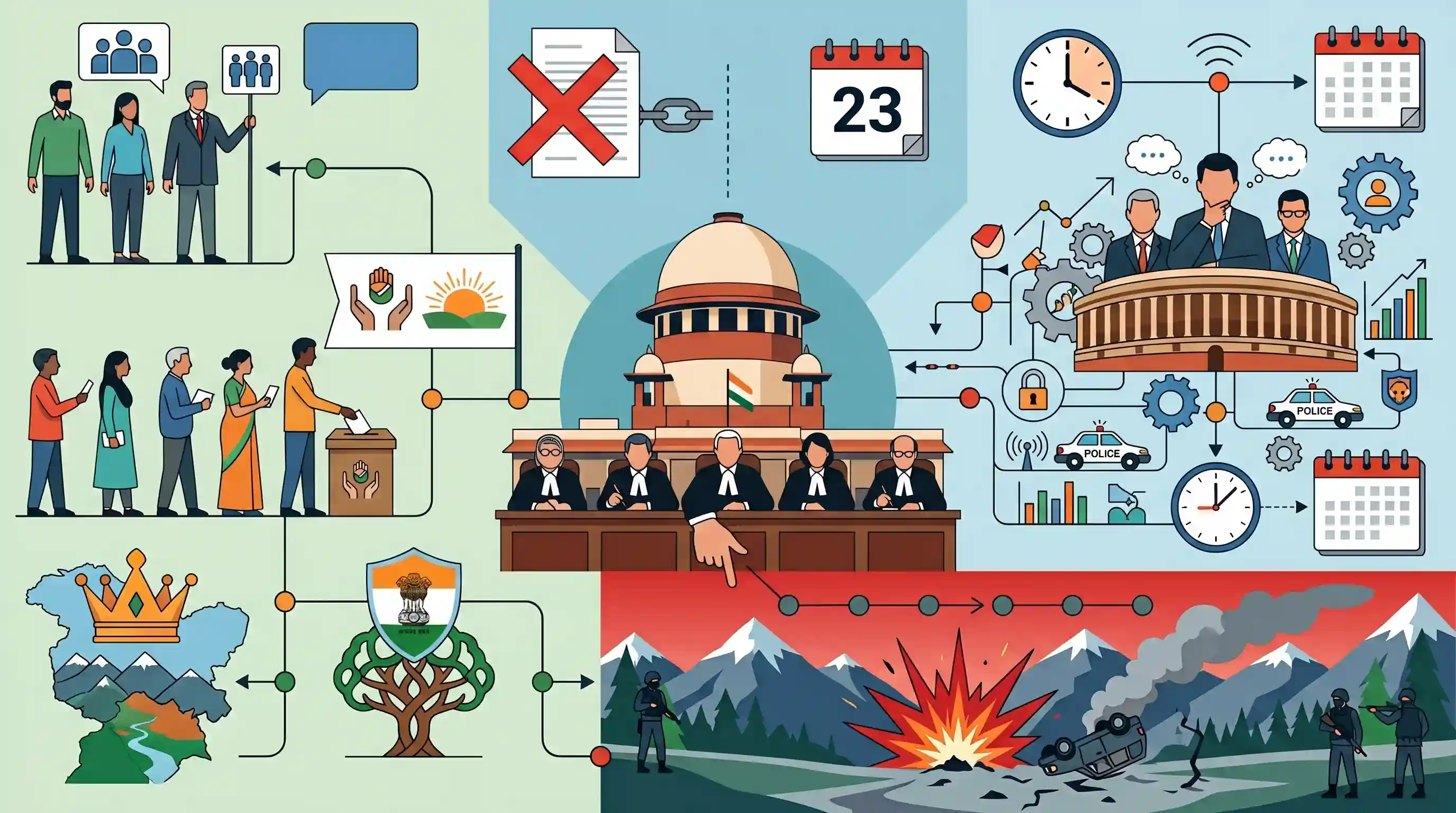
The Supreme Court has asked petitioners seeking the immediate restoration of Jammu and Kashmir's statehood to remain mindful of "ground realities," highlighting the recent Pahalgam terror attack. While the petitioners argued that peaceful Assembly polls negate any security-related delays and that denying statehood violates the constitutional principle of federalism, the Centre maintained that various considerations are necessary before restoring statehood. The court has sought a response from the Centre, revisiting the context of the 2023 judgment that upheld the abrogation of Article 370 on the assurance that statehood would be restored "at the earliest."
Key Points
- The Supreme Court heard petitions seeking the prompt restoration of statehood to Jammu and Kashmir, issuing a notice to the Centre and scheduling the next hearing in eight weeks.
- CJI B.R. Gavai advised petitioners to consider current ground realities, specifically referencing the recent Pahalgam terror attack, when demanding immediate statehood.
- Petitioners argued that the successful and peaceful conduct of Assembly elections proves there are no security impediments to restoring statehood.
- The plea contended that the continued denial of statehood violates the principle of federalism, which is an integral part of the Constitution's Basic Structure.
- The article recalls the 2023 Supreme Court Constitution Bench judgment that unanimously upheld the abrogation of Article 370 while noting the Centre's assurance to restore statehood at the earliest.
Important Terms
Article 370

A constitutional provision (now largely abrogated) that granted special autonomous status to Jammu and Kashmir, allowing it to have its own constitution and distinct laws.
UPSC context
GS Paper II: Constitution and Polity. Relevant for questions on J&K's integration, special provisions, and the 2023 Supreme Court verdict.
Basic Structure Doctrine
A judicial principle established in the Kesavananda Bharati case (1973) stating that Parliament cannot amend certain fundamental features of the Constitution, such as federalism.
UPSC context
GS Paper II: Judiciary and Constitutional Amendments. Tests understanding of judicial review and limitations on legislative power.
Federalism
A constitutional system dividing power between a central authority and constituent units (states). In India, it is considered part of the Basic Structure.
UPSC context
GS Paper II: Centre-State Relations. Tests the balance of power and impact of converting states into Union Territories.
J&K Reorganisation Act, 2019
Legislation that bifurcated the state of Jammu and Kashmir into two Union Territories: Jammu & Kashmir (with a legislature) and Ladakh (without a legislature).
UPSC context
GS Paper II: Reorganization of States. Important for understanding the legal framework behind the current status of J&K.
Union Territory
An administrative unit in India governed directly by the Union Government. J&K's current UT status is being challenged in favor of statehood restoration.
UPSC context
GS Paper II: Federal Structure. Relevant for distinctions between State and UT powers and the role of the Lieutenant Governor.
Pahalgam Terror Attack (2025)
A major 2025 militant incident targeting tourists, cited by the Supreme Court as a "ground reality" influencing the timing of statehood restoration.
UPSC context
GS Paper III: Internal Security. Used to illustrate the security challenges hampering political normalization in sensitive regions.
Prelims Trap
"The Supreme Court in 2023 ruled that Parliament cannot permanently convert a State into a Union Territory under Article 3."
The SC explicitly left this legal question open in its 2023 verdict, relying instead on the Centre's assurance that J&K's statehood would eventually be restored.
Static Concepts Connected
What are Parliament's powers under Article 3 regarding States?
- Power to Alter: Parliament can form new states, or alter areas, boundaries, and names of existing states using a simple majority in both Houses.
- State Legislature Views: The President must refer the bill to the concerned State Legislature for its views, though these views are not binding on Parliament.
- Downgrading to UT: J&K was downgraded in 2019. The constitutional validity of permanently converting a full State into a UT remains undecided by the Supreme Court.
How does the Basic Structure doctrine protect Federalism?
- S.R. Bommai Case: In the landmark S.R. Bommai case (1994), the Supreme Court explicitly established that federalism is an integral part of the Basic Structure of the Indian Constitution.
- Statehood Argument: Petitioners in the J&K case argue that indefinitely denying statehood and governing regionally via a centrally-appointed L-G violates this non-amendable federal character.
Cross-Topic Patterns
UT Status & Security Control
As a Union Territory, J&K's 'Police' and 'Public Order' fall under the Union via the Lieutenant Governor. This facilitates centralized anti-terror operations but curtails the elected regional assembly's power.
Asymmetric Federalism (Article 371)
J&K's trajectory from special autonomy (Article 370) to a Union Territory contrasts sharply with Article 371 protections for North-Eastern states, making it a prime comparative analysis topic for GS2.

Mains 2026 could feature a 15-marker linking Article 3 powers, federalism (Basic Structure), and internal security grounds for UT creation.
Linked PYQs · 4
Linked PYQs · 4
- 2025MainsGS2
Discuss the nature of Jammu and Kashmir Legislative Assembly after the Jammu and Kashmir Reorganization Act, 2019. Briefly describe the powers and functions of the Assembly of the Union Territory of Jammu and Kashmir.
- 2016MainsGS2
To what extent is Article 370 of the Indian Constitution, bearing marginal note "Temporary provision with respect to the State of Jammu and Kashmir", temporary? Discuss the future prospects of this provision in the context of Indian polity.
- 2014MainsGS2
Though the federal principle is dominant in our Constitution and that principle is one of its basic features, but it is equally true that federalism under the Indian Constitution leans in favour of a strong Centre, a feature that militates against the concept of strong federalism. Discuss.
- 2023MainsGS3
Winning of 'Hearts and Minds' in terrorism-affected areas is an essential step in restoring the trust of the population. Discuss the measures adopted by the Government in this respect as part of the conflict resolution in Jammu and Kashmir.
