Supreme Court Observations on Jammu and Kashmir Statehood Restoration
Source:The Hindu ↗
Why It Matters
The issue highlights the complex interplay between constitutional promises (federalism, statehood) and internal security realities (terrorism in J&K). It is highly relevant for GS2 (Federalism, Indian Constitution) and GS3 (Internal Security), demonstrating how security considerations can impact administrative and political restructuring in border states.
Summary
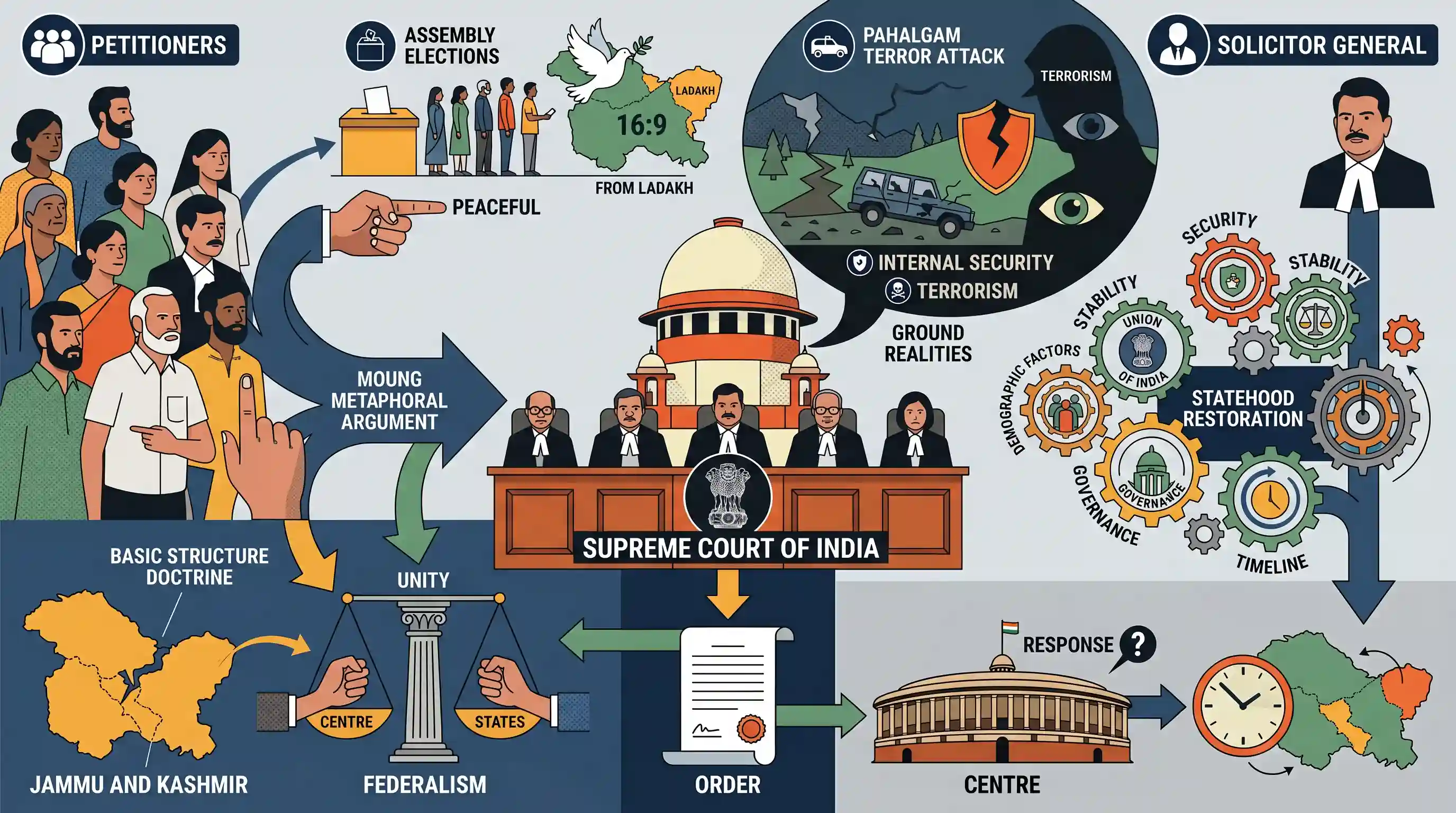
The Supreme Court of India heard a petition seeking the time-bound restoration of Jammu and Kashmir’s statehood, as promised by the Centre during the 2023 hearings on the abrogation of Article 370. While petitioners argued that recent peaceful Assembly elections nullify any security concerns and that the delay violates the Basic Structure's principle of federalism, the Bench, led by CJI B.R. Gavai, urged them to consider current 'ground realities,' citing the recent Pahalgam terror attack. The Solicitor General reiterated that multiple considerations are necessary before statehood is restored. The Court has sought a response from the Centre.
Key Points
- The Supreme Court asked petitioners demanding the immediate restoration of Jammu and Kashmir's statehood to be mindful of 'ground realities', referencing the Pahalgam terror attack.
- Petitioners argued that the recent peaceful Assembly elections indicate an absence of security impediments and that delaying statehood violates federalism, a part of the Basic Structure of the Constitution.
- Solicitor General Tushar Mehta contended that 'several considerations' are required for the restoration of statehood and questioned the intent behind the timing of the petition.
- This ongoing legal debate follows the 2023 Supreme Court verdict which upheld the abrogation of Article 370 but recorded the Centre's assurance to restore J&K's statehood 'at the earliest'.
Important Terms
Article 370

A temporary constitutional provision (Part XXI) that granted Jammu and Kashmir special autonomy and a separate constitution until its abrogation by a Presidential Order in August 2019.
UPSC context
GS Paper II: Significant for topics on Indian Constitution, historical underpinnings, and the evolution of Centre-State relations.
Basic Structure Doctrine
A judicial principle established in the Kesavananda Bharati case (1973) stating that Parliament cannot amend the fundamental features of the Constitution, such as federalism and democracy.
UPSC context
GS Paper II: Essential for understanding limits on parliamentary power and judicial protection of constitutional identity.
Federalism
A constitutional feature where power is divided between the Centre and States. It is recognized as part of the Basic Structure, ensuring States maintain democratic legitimacy.
UPSC context
GS Paper II: Key for questions on Centre-State relations and the impact of UT reorganisation on regional representation.
Constitution Bench
A Supreme Court bench consisting of at least five judges, mandated by Article 145(3) to decide cases involving substantial questions of law regarding constitutional interpretation.
UPSC context
GS Paper II: Tests knowledge of judicial functioning and the mechanism for resolving landmark constitutional disputes.
Judicial Review
The power of the judiciary to examine the constitutionality of legislative acts and executive orders, ensuring they do not violate fundamental rights or the Basic Structure.
UPSC context
GS Paper II: Fundamental to the checks and balances system and the judiciary's role as the protector of the Constitution.
Internal Security
The maintenance of peace and law within a territory, often cited by the Centre as a prerequisite for restoring statehood in conflict-prone regions like J&K.
UPSC context
GS Paper III: Central to topics on terrorism and the balance between security imperatives and democratic rights.
Prelims Trap
"The Supreme Court in 2023 validated Parliament's power to downgrade any State to a Union Territory under Article 3."
The SC deliberately left this specific constitutional question unanswered in 2023. It upheld the J&K Reorganisation Act primarily by relying on the Centre's assurance that statehood would be restored.
Static Concepts Connected
How does Article 3 govern the alteration of state boundaries and status?
- Prior recommendation: A Bill seeking to alter state boundaries or names requires the President's prior recommendation before it can be introduced in either House of Parliament.
- State Legislature views: The President refers the Bill to the affected State Legislature to express its views within a specified time, though these views are not binding on Parliament.
- Simple majority: The Bill can be passed by a simple majority in Parliament and is explicitly not considered a Constitutional Amendment under Article 368.
Which landmark cases established Federalism as part of the Basic Structure?
- Kesavananda Bharati (1973): This historic 1973 judgment first laid down the Basic Structure Doctrine, explicitly listing the 'federal character of the Constitution' as a foundational, unamendable feature.
- S.R. Bommai (1994): This 1994 ruling cemented federalism's basic structure status, specifically utilizing it to protect state governments from the arbitrary imposition of President's Rule under Article 356.
Cross-Topic Patterns
Terror tactics + Economic normalcy in J&K
The TRF's tactical shift toward soft targets like tourists aims to derail the post-election narrative of democratic stability and economic revival, directly linking internal security threats to local economic resilience.
Judicial restraint + Executive security prerogative
The Supreme Court's citation of 'ground realities' reflects the separation of powers doctrine, where constitutional courts generally defer to the Executive’s assessment of internal security matrices for administrative timelines.

A 2026 Mains question will likely ask candidates to balance internal security imperatives with the Basic Structure's federalism mandate.
Linked PYQs · 5
Linked PYQs · 5
- 2025MainsGS2
Discuss the nature of Jammu and Kashmir Legislative Assembly after the Jammu and Kashmir Reorganization Act, 2019. Briefly describe the powers and functions of the Assembly of the Union Territory of Jammu and Kashmir.
- 2016MainsGS2
To what extent is Article 370 of the Indian Constitution, bearing marginal note "Temporary provision with respect to the State of Jammu and Kashmir", temporary? Discuss the future prospects of this provision in the context of Indian polity.
- 2024MainsGS2
What changes has the Union Government recently introduced in the domain of Centre-State relations ? Suggest measures to be adopted to build the trust between the Centre and the States and for strengthening federalism.
- 2025MainsGS2
Indian Constitution has conferred the amending power on the ordinary legislative institutions with a few procedural hurdles. In view of this statement, examine the procedural and substantive limitations on the amending power of the Parliament to change the Constitution.
- 2023MainsGS3
Winning of 'Hearts and Minds' in terrorism-affected areas is an essential step in restoring the trust of the population. Discuss the measures adopted by the Government in this respect as part of the conflict resolution in Jammu and Kashmir.
