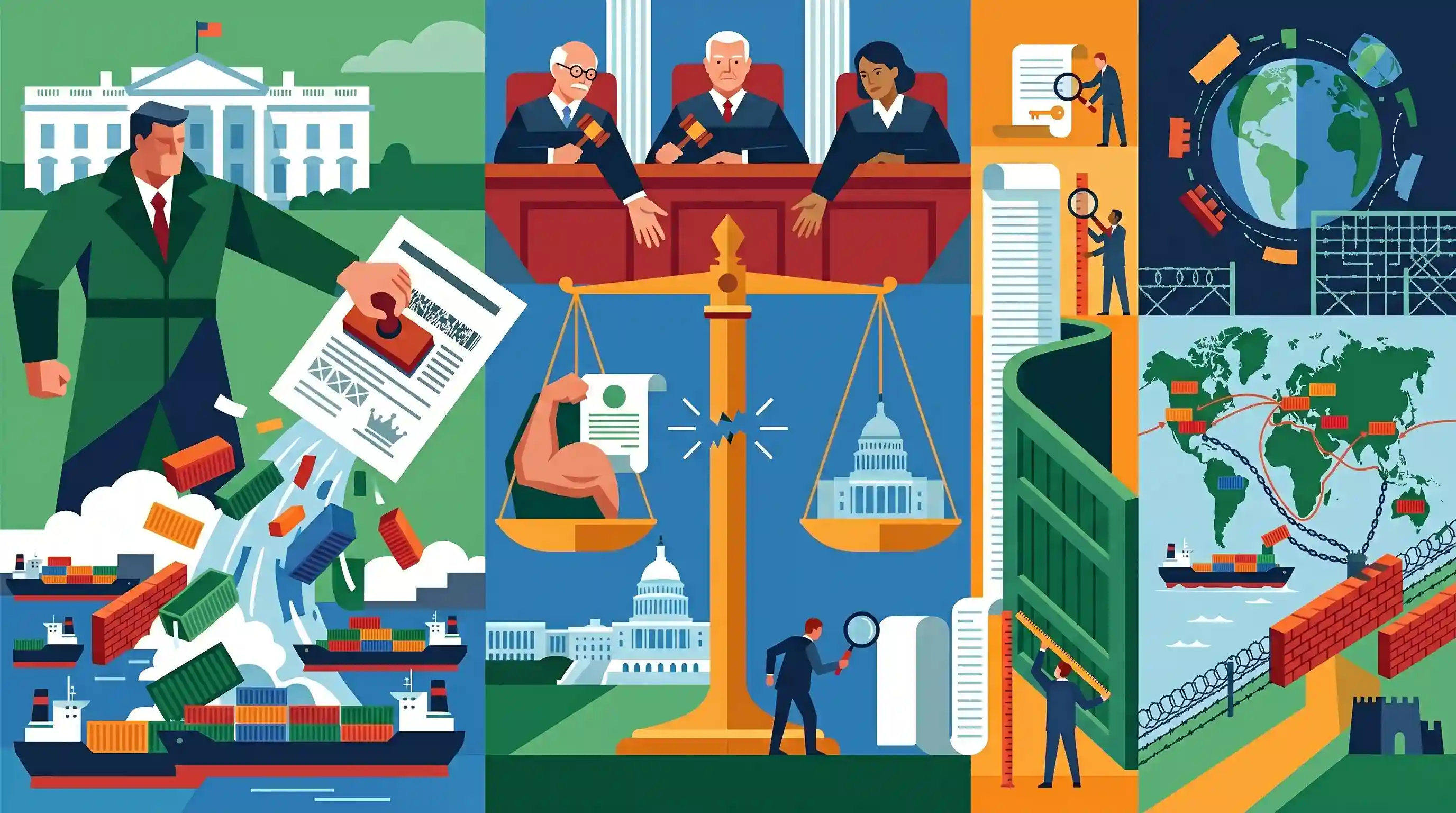
US Supreme Court skepticism over unilateral executive tariffs
Source:The Hindu ↗
Why It Matters
The article offers a real-world comparative case study on the 'Separation of Powers' and 'Delegated Legislation' (nondelegation doctrine, major questions doctrine) between the Executive and Legislature in the U.S. Additionally, sweeping U.S. tariffs signify a strong trend toward protectionism, which has massive implications for global macroeconomic stability and trade dynamics—core issues in GS2 (Polity/IR) and GS3 (Economy).
Summary
The U.S. Supreme Court is hearing a case challenging President Donald Trump's unilateral imposition of sweeping tariffs using the 1977 International Emergency Economic Powers Act (IEEPA). Justices have shown skepticism, questioning if the executive branch is usurping Congress's constitutional authority to levy taxes. The legal dispute revolves around the 'major questions doctrine' and the 'nondelegation doctrine', acting as a critical test of separation of powers and executive overreach, with far-reaching consequences for global trade and protectionism.
Key Points
- The U.S. Constitution assigns the power to levy taxes and tariffs to Congress, but the executive branch argues the 1977 IEEPA grants the President authority to impose tariffs during national emergencies.
- Supreme Court justices expressed skepticism over this broad interpretation, citing the 'major questions doctrine' which mandates clear congressional authorization for policies with massive economic consequences.
- Challengers utilized the 'nondelegation doctrine' to argue that core legislative powers, such as taxation, cannot be loosely delegated to the executive branch.
- The tariffs in question include sweeping import taxes on nations like Canada, China, and Mexico, expected to raise $3 trillion over the next decade.
- The case represents a major check on executive power and will define the limits of the President's authority over foreign affairs, international trade, and protectionist economic policies.
Important Terms
International Emergency Economic Powers Act (IEEPA)

A 1977 U.S. law granting the President broad authority to regulate international commerce after declaring a national emergency. It is a prime example of delegated legislation in a constitutional framework.
UPSC context
GS Paper II: Executive discretion and delegated legislation. Tests the limits of executive power during emergencies versus legislative authority.
Major Questions Doctrine
A U.S. judicial principle requiring clear congressional authorization for executive branch actions that have 'vast economic and political significance,' preventing administrative overreach via vague statutes.
UPSC context
GS Paper II: Comparison of constitutions. Useful for analyzing judicial checks on executive overreach in administrative law.
Nondelegation Doctrine
The constitutional rule that the legislature cannot delegate its core lawmaking powers to the executive branch without providing an 'intelligible principle' or specific guidelines.
UPSC context
GS Paper II: Separation of Powers. Essential for understanding the limits of delegated legislation in India vs. the U.S.
Separation of Powers
A constitutional doctrine dividing government into distinct branches (Legislative, Executive, Judicial) to prevent the concentration of power and ensure a system of checks and balances.
UPSC context
GS Paper II: Fundamental feature. Compares India’s 'functional overlap' and parliamentary sovereignty with the U.S. 'strict' separation model.
U.S. Congress
The bicameral U.S. federal legislature. Under Article I, Section 8, it holds the exclusive power to 'lay and collect taxes, duties, and imposts' (the taxing power).
UPSC context
GS Paper II: Comparison of legislatures. Examines the 'power of the purse' as a check on executive trade and economic policy.
Judicial Review
The power of the judiciary to examine and invalidate legislative or executive actions that are inconsistent with the Constitution.
UPSC context
GS Paper II: Basic Structure. Compares the scope of review over economic policies in India vs. the U.S. (Learning Resources case).
Prelims Trap
The President of India can unilaterally levy new taxes during a proclaimed National Emergency under Article 352.
Article 265 strictly mandates that no tax shall be levied except by authority of law. Even during emergencies, the executive cannot impose taxes without parliamentary legislation.
Static Concepts Connected
What are the limits on delegated legislation in the Indian constitutional scheme?
- Essential legislative functions: Parliament cannot abdicate its core policy-making roles to the executive (established in the In Re Delhi Laws Act, 1951).
- Excessive delegation: Courts can strike down subordinate legislation if the parent Act provides no guiding principles or vague boundaries (e.g., Hamdard Dawakhana case).
- Taxation limitation: Imposing a tax requires express statutory authority; vague executive rules or emergency decrees cannot create new tax liabilities.
How does the Indian Constitution strictly separate taxation powers?
- Authority of law: Article 265 explicitly guarantees that the executive branch cannot levy or collect taxes unilaterally, requiring a valid parliamentary law.
- Money Bills: Taxation proposals are strictly guarded as Money Bills (Article 110), requiring introduction only in the directly elected Lok Sabha.
Cross-Topic Patterns
US Tariffs and WTO irrelevance
Using domestic emergency laws like the US IEEPA to impose tariffs sidesteps WTO mechanisms, accelerating the global shift toward economic nationalism and weaponized trade.
Major Questions & Excessive Delegation
The US 'major questions doctrine' mirrors India's judicial checks on 'excessive delegation', securing the legislature's primacy over massive economic policy decisions.

Expect a GS2 Mains comparative question in 2026 on how the judiciaries in the US and India limit delegated legislation.
Linked PYQs · 4
Linked PYQs · 4
- 2020MainsGS2
Judicial Legislation is antithetical to the doctrine of separation of powers as envisaged in the Indian Constitution. In this context justify the filing of large number of public interest petitions praying for issuing guidelines to executive authorities.
- 2019MainsGS2
From the resolution of contentious issues regarding distribution of legislative powers by the courts, 'Principle of Federal Supremacy' and 'Harmonious Construction' have emerged. Explain.
- 2025MainsGS3
What are the challenges before the Indian economy when the world is moving away from free trade and multilateralism to protectionism and bilateralism? How can these challenges be met?
- 2018MainsGS3
How would the recent phenomena of protectionism and currency manipulations in world trade affect macroeconomic stability of India?
