Six States Reach Consensus on Funding Mechanism for Kishau Dam
Source:ani ↗
Why It Matters
Interstate multipurpose river valley projects, especially those involving water sharing with Rajasthan, are highly tested in the RPSC RAS Prelims. The unique swap agreement where Rajasthan gains water from Himachal Pradesh in exchange for covering power component costs, alongside the Tons River geography, represents a prime subject for physical and economic geography questions.
Summary
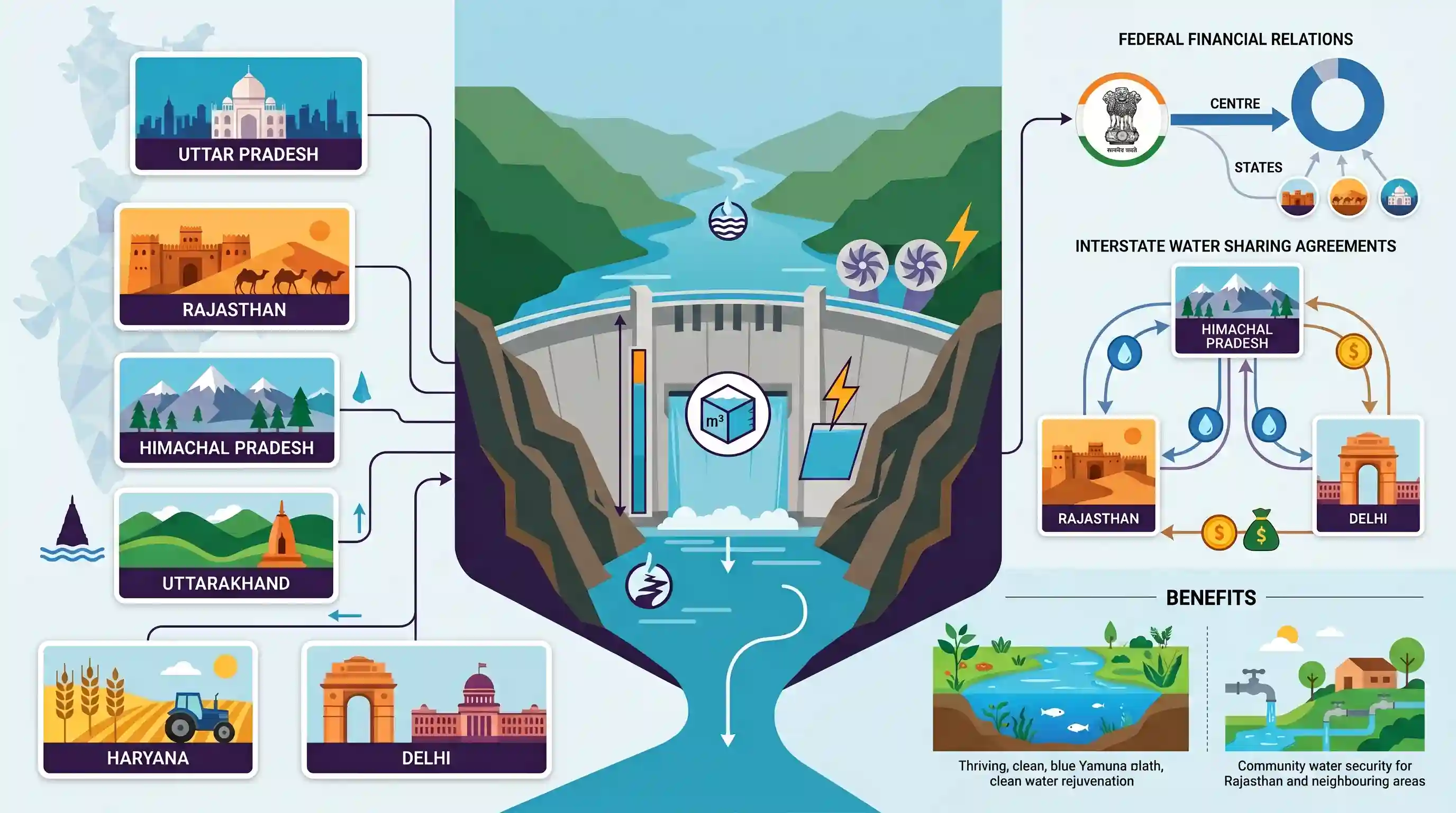
Six states and Union Territories—Uttar Pradesh, Rajasthan, Himachal Pradesh, Uttarakhand, Haryana, and Delhi—have reached a major consensus on the long-pending 'Kishau' Multipurpose Dam Project on the Tons River (a tributary of the Yamuna). The project will feature a 236-meter-high concrete dam generating 600 MW of power and storing 1,324 million cubic meters of water. Under the agreed framework, the Centre will fund 90% of the water component, while the states contribute 10%. To balance resources, Himachal Pradesh will transfer its water allocation to Rajasthan and Delhi in exchange for these two states funding Himachal Pradesh's share of the power component cost. This breakthrough will substantially assist Yamuna's rejuvenation and address water-security challenges in Rajasthan and neighboring states.
Key Points
- Consensus was achieved among six states/UTs (Uttar Pradesh, Rajasthan, Himachal Pradesh, Uttarakhand, Haryana, and Delhi) under the chairmanship of Union Home Minister Amit Shah to implement the Kishau Multipurpose Dam Project.
- The project is located on the Tons River (a key tributary of the Yamuna River) along the border of Dehradun (Uttarakhand) and Sirmour (Himachal Pradesh), about 45 km upstream of Dakpathar.
- Under the funding mechanism, 90% of the cost of the water component will be funded by the Central Government, while the remaining 10% will be shared among the six participating states.
- A unique resource-swap agreement was reached: Himachal Pradesh's share of the water will be allocated to Delhi and Rajasthan; in return, Delhi and Rajasthan will bear the financial cost of Himachal Pradesh's share of the power component.
- Technical specifications of the project include a 236-meter-high concrete dam, 600 MW (4 x 150 MW) of installed hydroelectric capacity, and a live water storage capacity of 1,324 million cubic meters (1.077 million acre-feet).
- The project will play an instrumental role in the rejuvenation of the Yamuna river, raising clean water flows and resolving long-pending water needs in northern India, including Rajasthan.
Important Terms
Kishau Multipurpose Dam Project

A 236-meter-high concrete gravity dam under construction on the Tons River (Yamuna tributary) to generate 660 MW of power and store water for six states.
UPSC context
GS I (Geography: Water Resources) & GS III (Infrastructure). Tests knowledge of multipurpose projects and inter-state agreements.
Tons River
The longest Himalayan tributary of the Yamuna River, originating from the Bandarpunch massif and forming a boundary between Uttarakhand and Himachal Pradesh.
UPSC context
GS I (Geography: Drainage Systems). Tests understanding of North Indian river geography and hydrological boundaries.
Ministry of Jal Shakti
Union ministry established in 2019 to ensure integrated water governance, managing drinking water, sanitation, river rejuvenation, and inter-state water disputes.
UPSC context
GS II (Government Policies & Ministries). Tests administrative understanding of bodies tackling India's water and sanitation challenges.
Ministry of Home Affairs
The core ministry responsible for internal security, border management, administration of Union Territories, and overseeing federal Centre-State relations.
UPSC context
GS II (Polity & Governance). Tests understanding of federal dynamics and the executive organ supervising internal safety.
Ministry of Power
The central ministry overseeing power generation, transmission, and distribution, acting as a liaison between central and state electricity bodies.
UPSC context
GS III (Infrastructure: Energy). Tests knowledge of concurrent-list power sector administration and energy policy.
Prime Minister's Office
The administrative body assisting the Prime Minister in executing executive, administrative, and constitutional duties, while coordinating various ministries.
UPSC context
GS II (Executive Structure). Tests knowledge of administrative coordination at the highest levels of governance.
Prelims Trap
The Kishau project is located on the Tons River, a major tributary of the Ganga that flows through Madhya Pradesh.
There are two rivers named Tons in India. The Kishau project is on the Himalayan Tons (Yamuna tributary). The other Tons (Tamas) originates in Madhya Pradesh and is a direct tributary of the Ganga. UPSC often exploits such homonyms.
Static Concepts Connected
What are the geographical features of the Himalayan Tons River?
- Origin and Confluence: Formed by the confluence of the Rupin and Supin streams in the Garhwal region of Uttarakhand.
- Yamuna Relationship: It is the largest and most voluminous tributary of the Yamuna, carrying more water than the Yamuna itself at their confluence near Kalsi.
- Boundary Role: Serves as a natural administrative boundary between Uttarakhand (Dehradun) and Himachal Pradesh (Sirmour).
What is the "National Project" status for water resources?
- Criteria: Identified projects with international/interstate dimensions or potential to irrigate over 200,000 hectares receive prioritized central funding.
- Funding Ratio: The Central Government funds 90% of the cost of the irrigation and drinking water component as a grant, while states contribute 10%.
- Power Component Exclusion: The power generation component of such projects is excluded from the 90:10 central grant and must be funded by beneficiary states.
Cross-Topic Patterns
Cooperative Federalism & Resource Swapping
Moves interstate hydro-relations from zero-sum litigation (Article 262) to resource-swapping (water-for-power), setting a precedent for resolving deadlocked river valley projects.
MHA & Interstate Dispute Resolution
Illustrates how the Ministry of Home Affairs leverages interstate coordination platforms to resolve developmental and water-security deadlocks across regional boundaries.

Geography questions on Yamuna tributaries may target the Tons river's unique volume and its distinction from the peninsular Tamas (Tons).
Linked PYQs · 3
Linked PYQs · 3
- 2023RPSC_PRELIMSGS1
The Mahi Bajaj Sagar project is a joint venture of:
- 2021RPSC_PRELIMSGS1
The 'Parwan' multipurpose irrigation project of Rajasthan will provide irrigation facilities to which districts?
- 2021RPSC_PRELIMSGS1
What is the share of the Rajasthan government in the financing of the National Agricultural Extension and Technical Mission?
