Opposition Boycotts Joint Parliamentary Committee on Executive Removal
Source:The Hindu ↗
Why It Matters
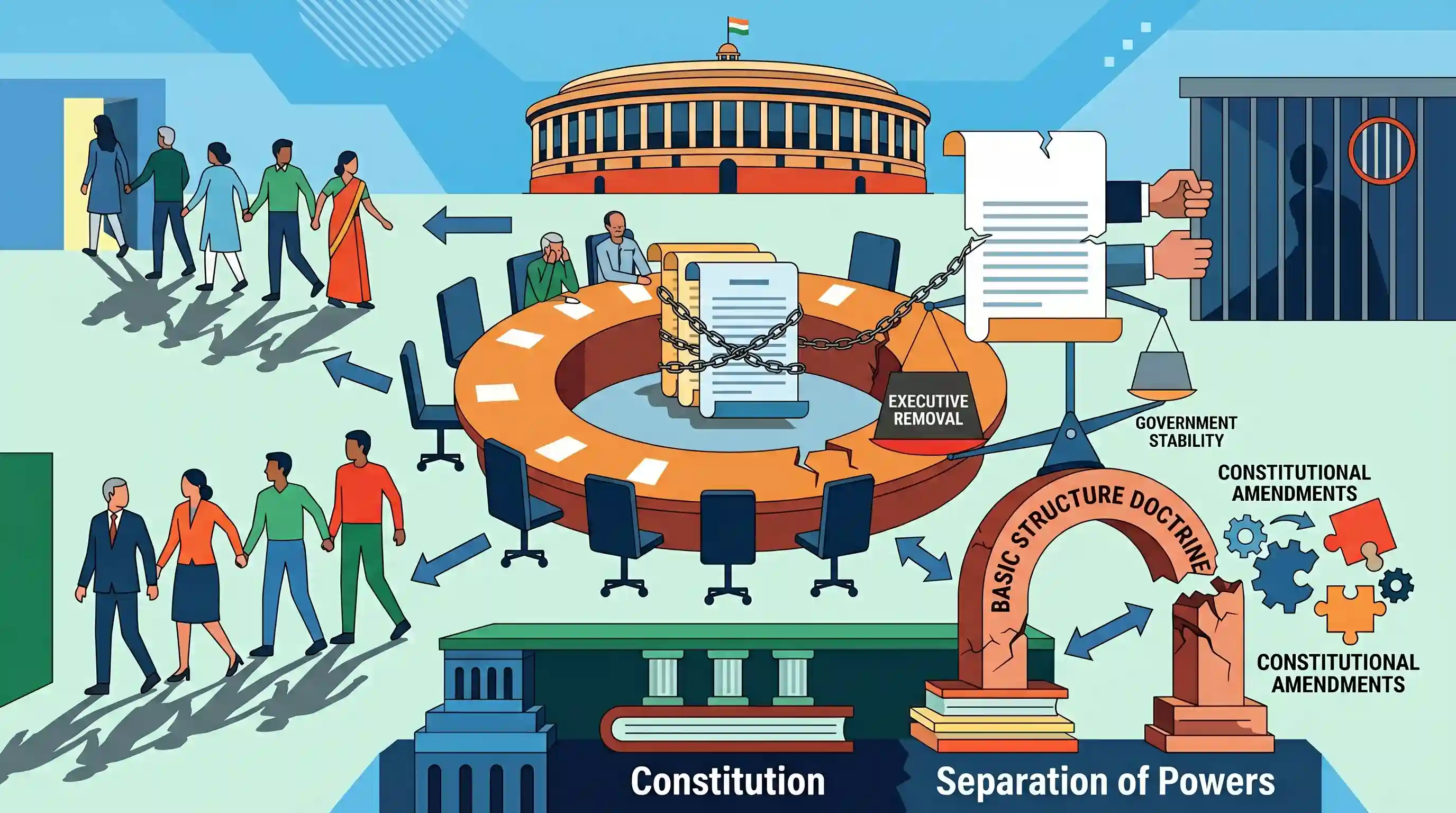
The proposed bills represent a major constitutional shift by legislating the automatic removal of the highest executive authorities (PM/CMs) under specific criminal custody conditions. This raises critical GS2 themes regarding executive accountability, potential misuse of law enforcement against political rivals, the basic structure doctrine, and the functional dynamics of parliamentary committees (JPCs) amid political boycotts.
Summary
The Congress, along with allies such as the TMC and SP, has announced a boycott of the Joint Parliamentary Committee (JPC) tasked with reviewing three bills related to the removal of the Prime Minister, Chief Ministers, and Ministers. The proposed legislation—including the Constitution (130th Amendment) Bill, 2025—mandates the removal of these executives if they are arrested on serious criminal charges and remain in custody for 30 days. The opposition claims the bills are politically motivated and violate constitutional principles, sparking a debate on executive accountability, the Basic Structure Doctrine, and the role of parliamentary oversight.
Key Points
- The Congress party and several opposition allies are boycotting a Joint Parliamentary Committee (JPC) reviewing three contentious bills.
- The bills propose the removal of the Prime Minister, Chief Ministers, and Ministers if they are arrested on serious criminal charges and remain in custody for 30 days.
- The legislation includes the Constitution (130th Amendment) Bill, 2025, and amendments to the Reorganisation Acts of J&K and Union Territories.
- Opposition parties argue the proposed laws violate the basic structure of the Constitution and could be weaponised to target political opponents.
Important Terms
Joint Parliamentary Committee (JPC)

An ad hoc parliamentary committee comprising members from both Houses, established to examine specific bills or investigate matters of public importance/financial irregularities.
UPSC context
GS II: Parliament and State Legislatures—Structure, functioning, conduct of business, and issues arising out of these.
Constitution (One Hundred and Thirtieth Amendment) Bill, 2025
A proposed law to remove the Prime Minister, Chief Ministers, and Ministers if detained for 30 consecutive days on charges punishable by 5+ years of imprisonment.
UPSC context
GS II: Constitutional Amendments; Executive accountability; Separation of Powers; Basic Structure Doctrine.
Jammu and Kashmir Reorganisation (Amendment) Bill, 2025
Legislation amending the 2019 Act to mandate the removal of the J&K Chief Minister or Ministers if they remain in custody for 30 days on serious charges.
UPSC context
GS II: Federalism; Administration of Union Territories; Special provisions for specific regions.
Articles 75, 164, and 239AA
Constitutional provisions governing the appointment and removal of the Union Council of Ministers (75), State Ministers (164), and Delhi's Council of Ministers (239AA).
UPSC context
GS II: Indian Constitution—historical underpinnings, evolution, features, amendments, and significant provisions.
Basic Structure Doctrine
A judicial principle established in the Kesavananda Bharati case (1973) stating that Parliament cannot amend certain essential features of the Constitution.
UPSC context
GS II: Comparison of the Indian constitutional scheme; Judicial review; Significant court rulings.
Criminalisation of Politics
The entry of individuals with criminal backgrounds into politics; the proposed bills aim to curb this by enforcing executive accountability for those in custody.
UPSC context
GS II: Salient features of the Representation of People's Act; Electoral reforms; Ethics in governance.
Prelims Trap
The 130th Amendment Bill disqualifies MPs and MLAs from their legislative seats if they remain in custody for 30 days.
The bill mandates removal from executive posts (PM, CM, Ministers), not disqualification as a legislator (MP/MLA). Disqualification from the legislature still requires conviction under RPA 1951.
Static Concepts Connected
When does a Constitutional Amendment require ratification by half the State Legislatures?
- Federal structure: Required for amendments altering the distribution of legislative powers (Schedule VII) or the representation of States in Parliament.
- Executive extent: Changes to the extent of executive power of the Union (Article 73) and States (Article 162), which directly impacts Chief Ministers.
- Judiciary & Amending power: Amendments to Chapter IV of Part V (Supreme Court), Chapter V of Part VI (High Courts), or Article 368 itself.
What are the core characteristics of a Joint Parliamentary Committee (JPC)?
- Ad-hoc nature: JPCs are temporary bodies set up to examine a specific bill or investigate specific irregularities, automatically dissolving upon report submission.
- Dual composition: They consist of members from both the Lok Sabha and Rajya Sabha, conventionally maintaining a 2:1 ratio to reflect House strength.
- Establishment mechanism: Created via a specific motion adopted by one House and agreed to by the other, distinguishing them from permanent Standing Committees.
Cross-Topic Patterns
Executive immunity vs. Investigative actions
Intersects Article 361 (protecting Presidents/Governors, but not PM/CMs, from arrest) with strict bail provisions of PMLA, framing the debate around using pre-trial custody to force executive removals.
State vs. UT Chief Ministers
Contrasts State CMs governed by Article 164 with UT CMs deriving power from Article 239A/239AA and parliamentary statutes, explaining why separate Reorganisation Act amendments are necessary.

Expect a 2026 Prelims question testing the difference between 'removal from ministership' (custody) and 'legislative disqualification' (conviction).
Linked PYQs · 4
Linked PYQs · 4
- 2025MainsGS2
Discuss the nature of Jammu and Kashmir Legislative Assembly after the Jammu and Kashmir Reorganization Act, 2019. Briefly describe the powers and functions of the Assembly of the Union Territory of Jammu and Kashmir.
- 2020MainsGS2
There is a need for simplification of procedure for disqualification of persons found guilty of corrupt practices under the Representation of Peoples Act". Comment.
- 2019MainsGS2
On what grounds a people's representative can be disqualified under the Representation of Peoples Act, 1951? Also mention the remedies available to such person against his disqualification.
- 2022PrelimsGS1
Consider the following statements: 1. A bill amending the Constitution requires a prior recommendation of the President of India. 2. When a Constitution Amendment Bill is presented to the President of India, it is obligatory for the President of India to give his/her assent. 3. A Constitution Amendment Bill must be passed by both the Lok Sabha and the Rajya Sabha by a special majority and there is no provision for joint sitting. Which of the statements given above are correct?
