Operation Sindoor Fighter Jet Controversy and Political Debate
Source:The Hindu ↗
Why It Matters
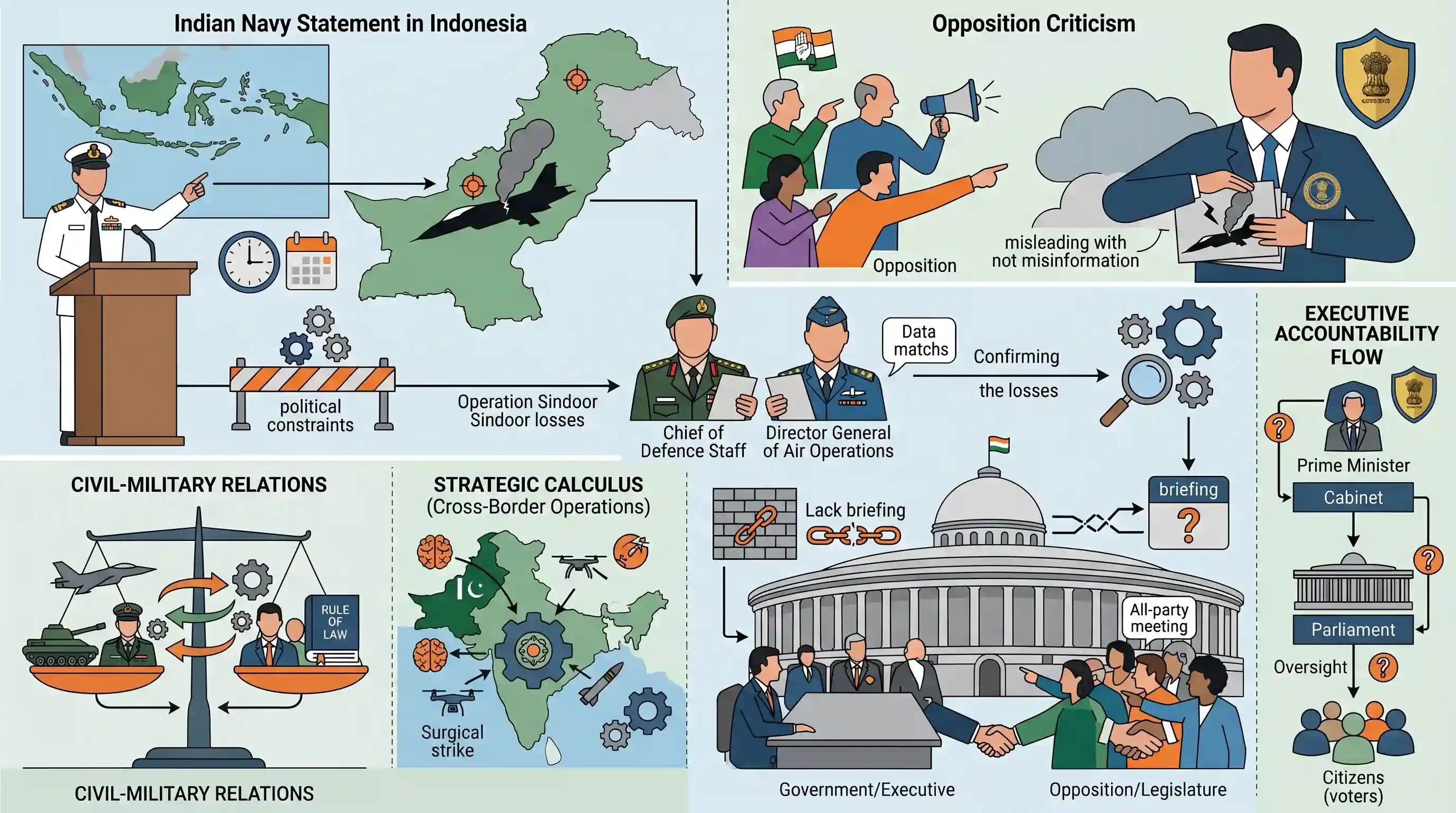
Highlights the tension between national security imperatives (like cross-border anti-terror operations) and democratic mechanisms of transparency. It touches upon civil-military relations, especially when operational outcomes are publicly attributed to political constraints, and tests the executive's accountability to Parliament and the Opposition on sensitive strategic issues.
Summary
The Congress party has strongly criticized the Central government over recent remarks made by an Indian Navy defence attache stationed in Indonesia. The official reportedly claimed that the Indian Air Force suffered the loss of fighter jets during "Operation Sindoor"—a military strike targeting terror-linked sites in Pakistan in May 2025—due to specific "political constraints." Congress leaders Jairam Ramesh and Pawan Khera accused the Modi administration of misleading the country by suppressing the truth about the combat losses. They pointed out that these recent comments corroborate earlier, more oblique admissions made by top military commanders, including the Chief of Defence Staff General Anil Chauhan and the Director General of Air Operations. Emphasizing the importance of democratic transparency, the Opposition condemned the government's refusal to brief the nation through an all-party meeting or by convening a Special Session of Parliament. This political friction highlights critical issues for UPSC aspirants, specifically the delicate balance of civil-military relations, the strategic calculus behind cross-border surgical strikes, and the continuous need for the executive branch to remain accountable to the legislature in matters of national security.
Key Points
- Congress accused the Centre of misleading the nation regarding the loss of Indian Air Force fighter jets during "Operation Sindoor", a cross-border strike targeting terror sites in Pakistan in May 2025.
- The allegations stem from a statement made by an Indian defence attache in Indonesia, who claimed the losses were due to "political constraints".
- Previous admissions of air combat losses were reportedly made by the Chief of Defence Staff and the DG Air Ops.
- Opposition leaders questioned the government's refusal to convene an all-party meeting or a Special Session of Parliament to ensure executive transparency and accountability.
Important Terms
Operation Sindoor

A May 2025 Indian military operation targeting terror-linked infrastructure in Pakistan following the Pahalgam attack; characterized by non-contact warfare using missiles and drones.
UPSC context
GS Paper III: Internal Security. Tests understanding of response doctrines to cross-border terrorism and strategic deterrence.
Defence Attaché
A military officer stationed at a foreign embassy representing a country's defense interests, facilitating military-to-military diplomacy and gathering intelligence under diplomatic immunity.
UPSC context
GS Paper II: International Relations. Relevance to India's expanding military diplomacy and the Vienna Convention on Diplomatic Relations.
Civil-Military Relations
The interaction between civilian political authorities and military leadership, governed in India by the principle of civilian supremacy over the armed forces.
UPSC context
GS Paper II & III: Governance/Security. Crucial for understanding democratic control and the apolitical nature of the Indian military.
Parliamentary Accountability
The constitutional requirement (Article 75) for the executive to remain answerable to Parliament through mechanisms like Question Hour, debates, and committees.
UPSC context
GS Paper II: Indian Polity. Tests knowledge of the executive’s responsibility to the legislature, especially regarding sensitive national security issues.
Chief of Defence Staff (CDS)
The highest-ranking uniformed military officer who serves as the permanent Chairman of the Chiefs of Staff Committee and principal military advisor to the government.
UPSC context
GS Paper III: Security Architecture. Relates to major defense reforms, tri-service integration, and streamlining military advice to the executive.
Prelims Trap
The Constitution of India explicitly provides the procedure to convene a 'Special Session' of Parliament.
The term "Special Session" is nowhere mentioned in the Constitution. The President summons all sessions under Article 85(1); it is merely political parlance.
Static Concepts Connected
What is the Constitutional basis for summoning sessions of Parliament?
- President's Authority: The President summons each House of Parliament under Article 85(1) based on the advice of the Cabinet Committee on Parliamentary Affairs.
- Six-month Rule: The maximum gap between two parliamentary sessions cannot exceed six months, ensuring that Parliament meets at least twice a year.
- Special Sessions: The term is not constitutionally defined; the government uses standard Article 85 powers to convene them for specific, urgent agendas.
What is the diplomatic status and role of a Defence Attaché?
- Military Diplomat: An armed forces officer posted to an embassy or high commission to represent their home country's military and defense establishment.
- Diplomatic Immunity: They are accredited diplomats and enjoy full diplomatic immunity and privileges under the Vienna Convention on Diplomatic Relations, 1961.
Cross-Topic Patterns
Civil-Military Relations & Accountability
Highlights the GS2/GS3 friction between the Executive's need for operational secrecy in cross-border strikes and its constitutional accountability to Parliament.
Article 85 & Special Sessions
The demand for a parliamentary briefing over combat losses links to static polity debates on Article 85, emphasizing the lack of constitutional definition for "Special Sessions."

Prelims 2026 will likely test the constitutional basis of 'Special Sessions' (Article 85) and diplomatic immunity parameters.
Linked PYQs · 2
Linked PYQs · 2
- 2016MainsGS3
The terms 'Hot Pursuit' and 'Surgical Strikes' are often used in connection with armed action against terrorist attacks. Discuss the strategic impact of such actions.
- 2021MainsGS2
To what extent, in your view, the Parliament is able to ensure accountability of the executive in India?
