India excluded from US-led Pax Silica technology alliance
Source:The Hindu ↗
Why It Matters
The geopolitics of critical technologies and semiconductor supply chains (Pax Silica vs Pax Sinica) is a major contemporary issue. India's exclusion from a key U.S.-led tech alliance poses critical questions about its strategic partnerships and its ambitions to become a global semiconductor hub, directly relevant to both GS Paper 2 (International Relations) and GS Paper 3 (Economy/Technology).
Summary
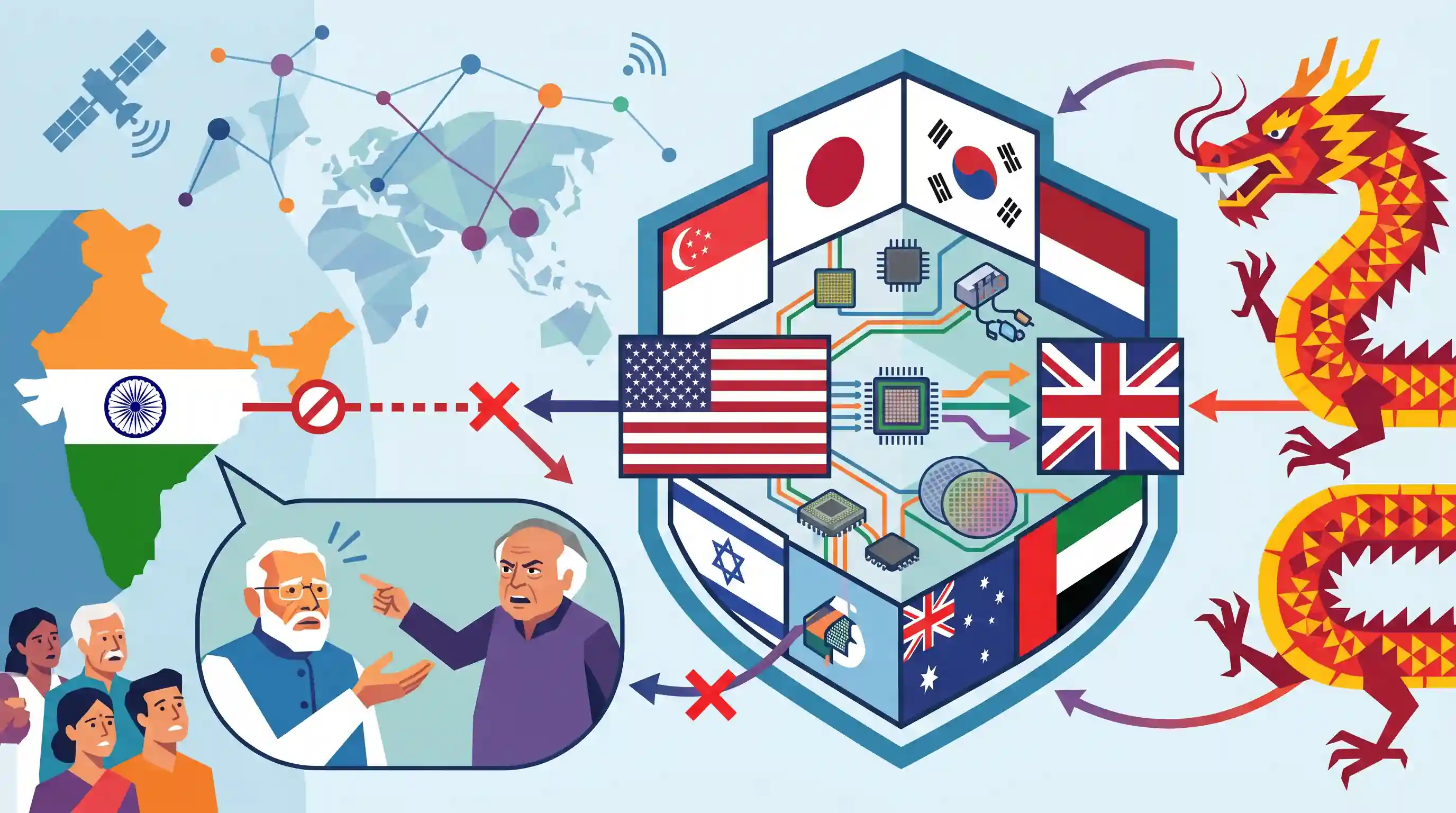
The U.S. has launched 'Pax Silica', a strategic 9-nation alliance aimed at securing global silicon and high-technology supply chains to counter Chinese dominance. Despite being a Quad member, India was excluded from the grouping, which includes the U.S., Japan, South Korea, Singapore, Netherlands, the U.K., Israel, the UAE, and Australia. Congress leader Jairam Ramesh criticized Prime Minister Narendra Modi over the exclusion, alleging it reflects a deterioration in India-U.S. relations. The development highlights the growing geopolitics of semiconductor supply chains and challenges in India's integration into Western critical technology initiatives.
Key Points
- The U.S. launched a 9-nation alliance called 'Pax Silica' to secure global silicon and high-tech supply chains, aimed at countering Chinese dominance ('Pax Sinica').
- India was notably excluded from the initiative despite being a member of the Quad, whereas the other Quad members (U.S., Japan, Australia) are included.
- Congress leader Jairam Ramesh criticized PM Modi for the exclusion, linking it to a perceived downturn in India-U.S. ties since May 2025 under Donald Trump.
- Pax Silica focuses on building secure, resilient, and innovation-driven supply chains among trusted partners to safeguard AI materials and reduce coercive dependencies.
Important Terms
Pax Silica

A U.S.-led strategic alliance launched to secure global supply chains for semiconductors, AI, and critical minerals among "trusted partners," primarily to counter Chinese technological dominance.
UPSC context
GS Paper II (International Relations) and GS Paper III (Science & Tech) - global groupings and tech geopolitics.
Pax Sinica
A historiographical term for a China-led period of peace; modernly refers to China’s expanding global influence and technology-led order that Western initiatives seek to counter.
UPSC context
GS Paper II (International Relations) - understanding the shifting global balance of power and China’s regional influence.
Quad (Quadrilateral Security Dialogue)
A strategic security dialogue between India, the U.S., Japan, and Australia focused on a "free and open Indo-Pacific" and collaboration on maritime and critical technology.
UPSC context
GS Paper II (Global Groupings) - tests knowledge of multilateral security and strategic partnerships involving India.
Semiconductor Supply Chain
The global network for designing and manufacturing microchips, increasingly seen as a national security asset and a focal point of geopolitical competition.
UPSC context
GS Paper III (Economy/Science & Tech) - relevant to India’s semiconductor mission and industrial self-reliance.
iCET (Initiative on Critical and Emerging Technology)
A 2022 framework between India and the U.S. to expand strategic technology partnership and defense industrial cooperation in sectors like AI, space, and semiconductors.
UPSC context
GS Paper II (Bilateral Agreements) - core to India-U.S. strategic and technology ties.
Friend-shoring
A trade strategy of sourcing essential goods and materials from geopolitical allies to ensure supply chain resilience and national security.
UPSC context
GS Paper III (Economy/International Trade) - how geopolitics reshapes trade routes and impacts India’s manufacturing potential.
Prelims Trap
"India is a founding member of the US-led 'Pax Silica' initiative to secure global semiconductor supply chains."
India was notably excluded from the initial 9-nation Pax Silica grouping, highlighting its current gaps in the global semiconductor value chain despite its Quad membership.
Static Concepts Connected
What does 'Friend-shoring' mean in international trade and geopolitics?
- Core definition: Rerouting supply chains and manufacturing to allied countries with shared political values to minimize exposure to geopolitical friction.
- Strategic shift: Marks a fundamental transition from pure cost-efficiency (traditional offshoring) toward national security and supply chain resilience.
- Key sectors: Applied primarily to critical minerals, active pharmaceutical ingredients (APIs), and semiconductor ecosystems to counter dependencies on China.
What are the core raw materials and components required for semiconductor manufacturing?
- Base elements: Silicon and Germanium are the foundational semiconducting elements used to manufacture the base wafers.
- Critical minerals: Gallium, Indium, and Germanium (whose exports are heavily controlled by China) are crucial for advanced chips.
- Gases & chemicals: Fabrication requires ultra-pure water, neon gas (for lithography lasers), and specialized chemicals like hydrofluoric acid for etching.
Cross-Topic Patterns
Pax Silica vs. bilateral iCET
While excluded from the multilateral Pax Silica, India continues to pursue similar semiconductor and defense-tech supply chain integration bilaterally with the US through the Initiative on Critical and Emerging Technology (iCET).
Minilateralism in critical tech trade
Groupings like Pax Silica, Chip 4, and the Minerals Security Partnership (MSP) reflect a permanent shift from broad WTO-led globalization to exclusive, security-driven 'tech clubs'.

Expect a 2026 Prelims question pairing tech alliances like 'Pax Silica', 'Chip 4', and 'MSP' with their core objectives (chips/minerals).
Linked PYQs · 3
Linked PYQs · 3
- 2024MainsGS2
‘The West is fostering India as an alternative to reduce dependence on China's supply chain and as a strategic ally to counter China's political and economic dominance.’ Explain this statement with examples.
- 2025MainsGS3
India aims to become a semiconductor manufacturing hub. What are the challenges faced by the semiconductor industry in India? Mention the salient features of the India Semiconductor Mission.
- 2020MainsGS2
Quadrilateral Security Dialogue (Quad)' is transforming itself into a trade bloc from a military alliance, in present times - Discuss.
