Jammu and Kashmir Statehood Restoration and Lt Governor Friction
Source:The Hindu ↗
Why It Matters
Highlights the ongoing friction between the Union-appointed L-G administration and political representatives in the Union Territory of Jammu & Kashmir, raising questions about the balance of power, democratic rights, and the timeline for the promised restoration of statehood.
Summary
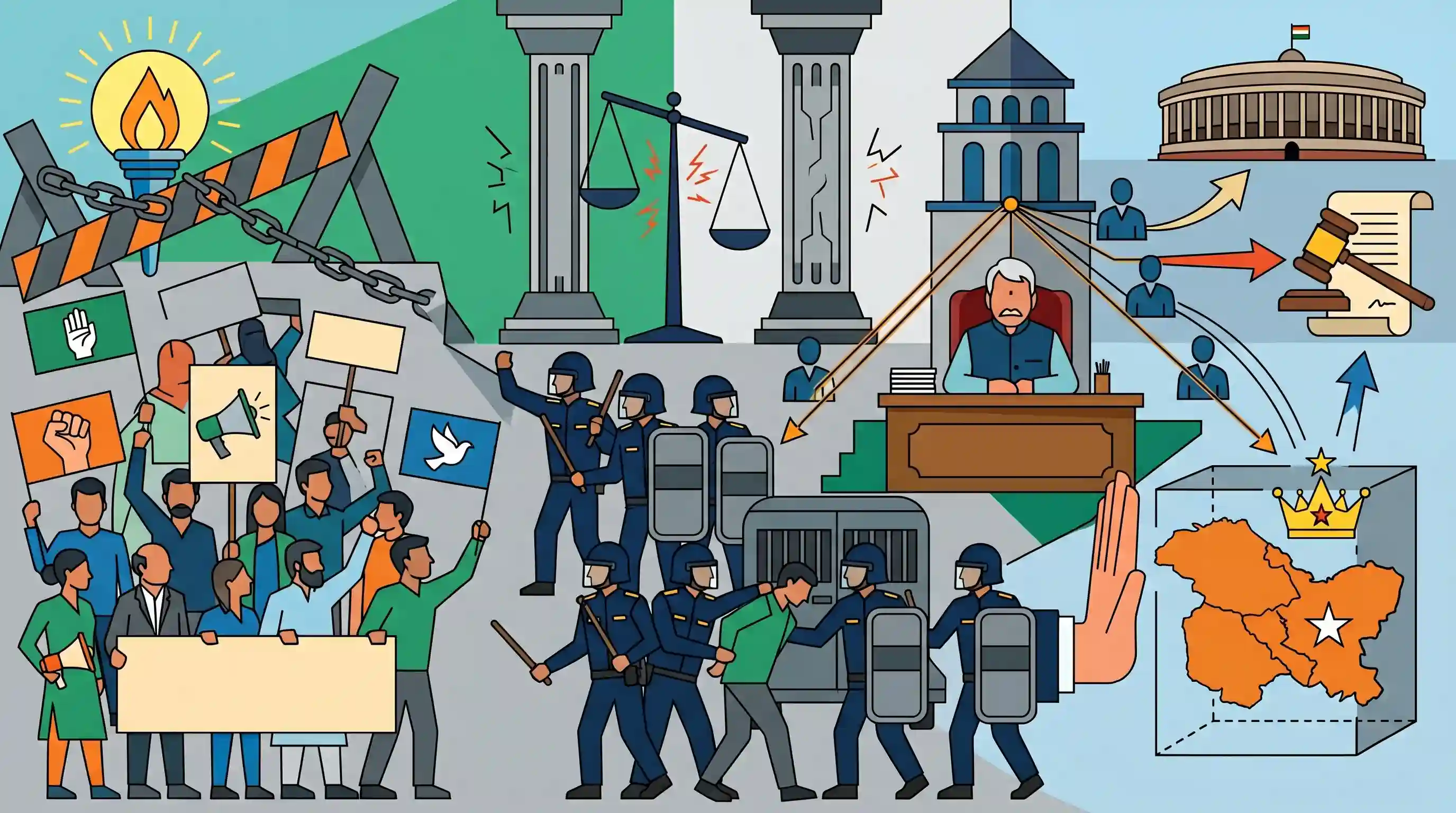
Congress leaders in Srinagar held protests demanding the restoration of full statehood to Jammu and Kashmir, as promised in Parliament and directed by the Supreme Court. The protests were thwarted by the Lieutenant Governor's administration, with heavy police deployment and the detention of party leaders. Congress leaders criticized the 'dual power center' in J&K, claiming the administration's actions violated their constitutional right to peaceful protest, and highlighted ongoing friction between political representatives and the L-G.
Key Points
- Congress leaders in J&K attempted a street protest demanding the restoration of full statehood to Jammu and Kashmir.
- The Lieutenant Governor (L-G) administration and J&K police restricted the protests, detaining several leaders and blocking access to the Congress headquarters.
- Political leaders condemned the restrictions as an unconstitutional suppression of their right to peaceful protest and a consequence of the 'dual power center' in the Union Territory.
- The protests are part of a broader campaign backed by the INDIA alliance, invoking promises made in Parliament and Supreme Court directives regarding statehood.
Important Terms
Lieutenant Governor (L-G)

The representative of the President in Union Territories like J&K, exercising executive authority and discretionary powers over reserved subjects like police and public order.
UPSC context
GS Paper 2: Union Territories, Federalism, and the friction between elected representatives and nominated heads.
Fundamental Right to Protest
A democratic right derived from Article 19(1)(a), (b), and (c), allowing citizens to voice dissent peacefully, subject to 'reasonable restrictions' for public order.
UPSC context
GS Paper 2: Fundamental Rights and the judicial balance between civil liberties and state security.
Supreme Court of India
India's highest judicial authority, which in December 2023 upheld the abrogation of Article 370 but directed the Union to restore J&K's statehood.
UPSC context
GS Paper 2: Separation of Powers and the role of the Judiciary in constitutional transitions.
Parliament of India
The supreme legislative body empowered under Article 3 of the Constitution to create new states or restore statehood through the legislative process.
UPSC context
GS Paper 2: Parliament and State Legislatures—structure, functioning, and the J&K Reorganisation Act.
INDIA Alliance
A multi-party coalition of opposition parties aimed at challenging the ruling government, reflecting a shift back toward coalition politics and federal bargaining.
UPSC context
GS Paper 2: Functioning of political parties, pressure groups, and the dynamics of coalition governments.
J&K Police
The law enforcement body in the UT of J&K, which remains under the direct administrative control of the L-G rather than the elected state government.
UPSC context
GS Paper 3: Internal Security and the challenges of 'dual power centers' in sensitive regions.
Indian National Congress (INC)
Founded in 1885, it is India’s oldest political party, currently advocating for the restoration of full statehood and constitutional rights in Jammu and Kashmir.
UPSC context
GS Paper 1 (Modern History) and GS Paper 2 (Polity): Evolution of political movements.
Prelims Trap
The Supreme Court's 2023 verdict set a specific, binding deadline for the restoration of J&K's statehood.
The SC set a binding deadline (Sept 2024) only for holding Assembly elections. For statehood restoration, it merely directed the Union to do it 'at the earliest' without a fixed date.
Static Concepts Connected
How does legislative competence differ between the J&K and Delhi Assemblies?
- Delhi Restrictions: Under Article 239AA, the Delhi Assembly is explicitly barred from legislating on State List entries 1, 2, and 18 (Public Order, Police, and Land).
- J&K Restrictions: Under the J&K Reorganisation Act 2019, the Assembly cannot legislate on Public Order and Police. However, unlike Delhi, it retains legislative competence over Land.
- Executive Control: In both models, the Lieutenant Governor wields direct discretionary executive control over the excluded subjects, bypassing the elected Council of Ministers.
What are the constitutional parameters governing the Right to Protest?
- Implicit Right: It is an implicit fundamental right jointly derived from Article 19(1)(a) (Speech and Expression) and Article 19(1)(b) (Peaceful Assembly without arms).
- Reasonable Restrictions: Under Articles 19(2) and 19(3), protests can be curbed in the interest of India's sovereignty, integrity, and 'public order' (the primary legal ground used by police).
- Spatial Limits: While citizens have a right to protest, the Supreme Court ruled (Shaheen Bagh case) that protests cannot indefinitely occupy public spaces.
Cross-Topic Patterns
Dual Control in Union Territories
The L-G versus elected representative friction in J&K directly parallels Delhi and Puducherry, highlighting inherent structural tensions within Article 239A and 239AA administrative models.
From Asymmetric Autonomy to UT Downgrade
J&K is a unique test-case in Indian federalism, shifting from 'asymmetric autonomy' (Article 370) to UT status, sparking debates on whether statehood is a basic constitutional feature.

Expect a GS-2 Mains question comparing the constitutional designs of UTs with legislatures (J&K vs Delhi) and their impact on federalism.
Linked PYQs · 3
Linked PYQs · 3
- 2024MainsGS2
What changes has the Union Government recently introduced in the domain of Centre-State relations ? Suggest measures to be adopted to build the trust between the Centre and the States and for strengthening federalism.
- 2016MainsGS2
Discuss the essentials of the 69th Constitutional Amendment Act and anomalies, if any, that have led to recent reported conflicts between the elected representatives and the institution of the Lieutenant Governor in the administration of Delhi. Do you think that this will give rise to a new trend in the functioning of the Indian federal politics?
- 2018MainsGS2
Whether the Supreme Court Judgement (July 2018) can settle the political tussle between the Lt. Governor and elected government of Delhi? Examine.
