Bilateral Trade Deal Transparency and National Strategic Autonomy
Source:Indian Express ↗
Why It Matters
The article highlights the intersection of international trade agreements, domestic economic programs ('Make in India'), and strategic foreign policy. It presents a critical view of how bilateral concessions can potentially constrain a nation's strategic autonomy, which is a key concept in UPSC GS2 and GS3 syllabi.
Summary
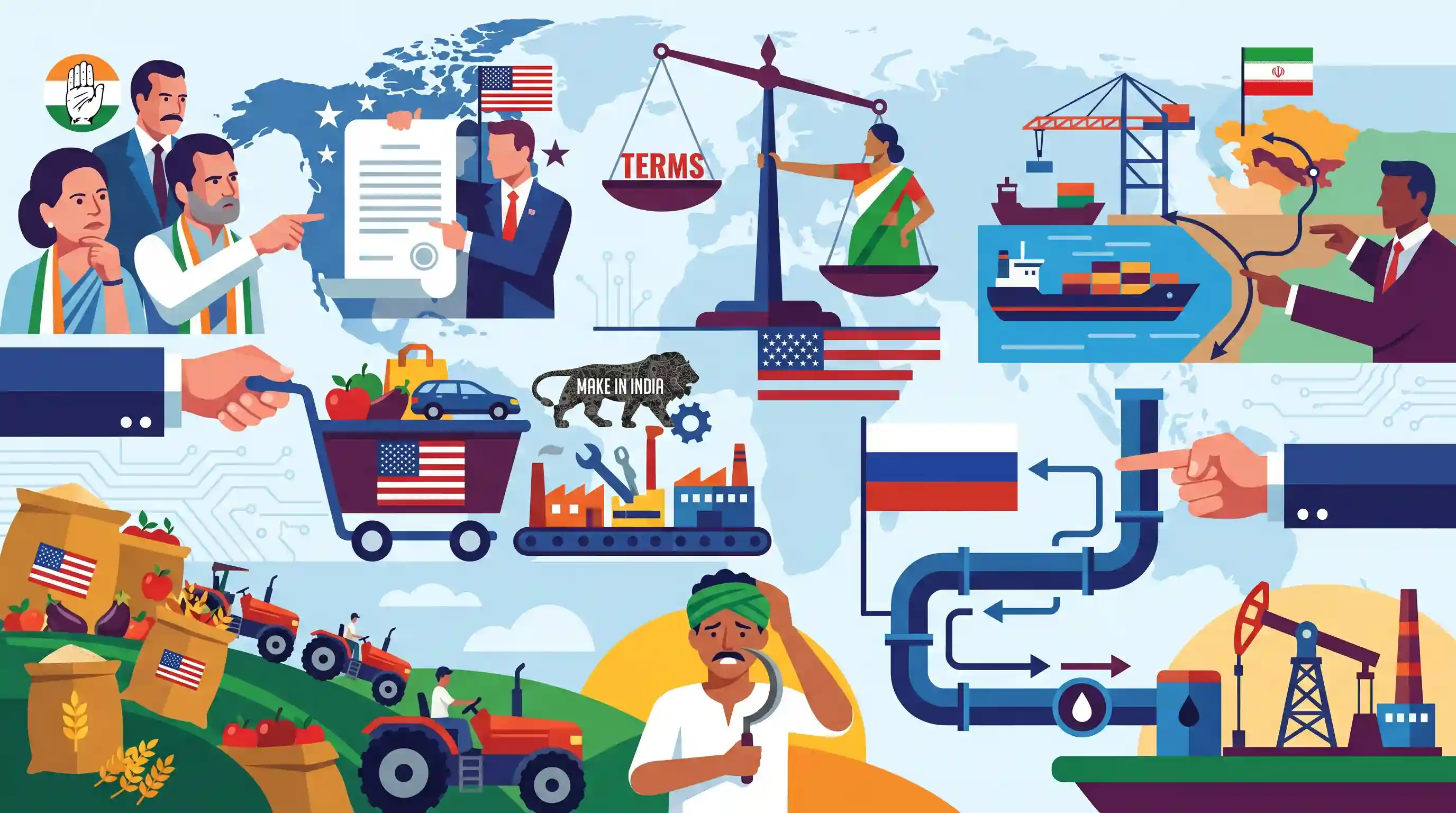
The Congress party has heavily criticized the recent India-US trade deal announced by US President Donald Trump, alleging a lack of transparency and expressing concerns over its potential negative impacts. Opposition leaders warned that the deal, which involves significant tariff reductions, could undermine the 'Make in India' program and harm the domestic agricultural sector by allowing an influx of American goods. Furthermore, concerns were raised that aligning too closely with US trade terms might compromise India's strategic autonomy, particularly its continued procurement of Russian oil and its involvement in Iran's Chabahar port.
Key Points
- Opposition leaders criticized PM Modi for allegedly rushing into a major trade deal with the US without adequate transparency or a formal joint statement.
- Concerns were raised that liberalizing trade, as indicated by Trump's announcement of tariff reductions from 50% to 18%, could harm India's domestic manufacturing and the 'Make in India' initiative.
- There are apprehensions that increased access for American agricultural imports might adversely impact Indian farmers.
- The Congress party warned that the deal could compromise India's strategic autonomy, specifically regarding its ability to purchase discounted Russian oil and operate the Chabahar port in Iran.
Important Terms
Strategic Autonomy

A foreign policy doctrine where a state makes independent decisions based on national interest, avoiding permanent alignment with any power bloc while maintaining flexibility to engage multiple global powers.
UPSC context
GS Paper II (International Relations); tests understanding of India's balancing act between the West, Russia, and the Global South.
Make in India
A flagship 2014 initiative aiming to transform India into a global manufacturing hub by encouraging domestic and foreign investment in 25 (now 27) key industrial sectors.
UPSC context
GS Paper III (Economy); evaluates industrial growth strategies, employment generation, and the impact of trade deals on domestic manufacturing.
Chabahar Port
A strategic deep-sea port in Iran developed by India to bypass Pakistan for trade with Afghanistan and Central Asia; critical for India's regional connectivity and maritime strategy.
UPSC context
GS Paper II (International Relations); key for topics on regional connectivity, India-Iran ties, and navigating US sanctions.
Minimum Support Price (MSP)
A government-assured floor price for agricultural produce, intended to protect farmers from sharp price drops and ensure food security; a major point of contention in trade negotiations.
UPSC context
GS Paper III (Agriculture); essential for understanding farm distress, WTO subsidies (Amber Box), and domestic market protections.
Non-Tariff Barriers
Trade restrictions like quotas, sanitary standards, and labeling requirements that restrict imports without using taxes; often cited in India-US disputes over GM crops and animal feed.
UPSC context
GS Paper III (Economy/Trade); tests knowledge of protectionist measures and technical barriers to trade (TBT) in global commerce.
Adani Group
A major Indian multinational conglomerate involved in ports, energy, and infrastructure; frequently cited in political debates regarding corporate influence on trade policy and foreign investments.
UPSC context
GS Paper II & III; relevant to the 'Crony Capitalism' debate and the role of private players in strategic infrastructure/diplomacy.
Prelims Trap
India's operation of the Chabahar Port is permanently exempt from US sanctions under international law.
The exemption was a conditional, temporary waiver granted by the US to aid Afghanistan reconstruction, subject to executive review and expiry—not an immunity guaranteed by international law.
Static Concepts Connected
How does the WTO categorize agricultural subsidies?
- Amber Box: Trade-distorting support like MSP or fertilizer subsidies, subject to reduction commitments (de minimis limits).
- Blue Box: Subsidies tied to programs that limit production, aiming to reduce over-farming; currently exempt from reduction limits.
- Green Box: Non-trade distorting support such as R&D, pest control, or direct income support (e.g., PM-Kisan).
What are US secondary sanctions and CAATSA?
- CAATSA: A US federal law designed to penalize countries engaging in significant transactions with Russia, Iran, and North Korea.
- Secondary Sanctions: Penalties applied to third-party nations or foreign companies for doing business with sanctioned countries, blocking US financial access.
- Waiver Mechanism: The US executive can grant temporary exemptions (like previously for Chabahar) based on specific national security interests.
Cross-Topic Patterns
Economic concessions for energy dictates
The US using trade deals to force India away from discounted Russian oil illustrates the weaponization of market access for geopolitical objectives, linking GS3 economy to GS2 energy security.
Agri-trade vs Domestic food security
Tariff liberalization with developed nations consistently clashes with India's need to protect small-holder farmers against heavily subsidized Western produce, highlighting WTO subsidy disparities.

Expect a 2026 GS-2 question evaluating if India's 'Strategic Autonomy' in energy procurement is compromised by transactional trade deals.
Linked PYQs · 4
Linked PYQs · 4
- 2019MainsGS2
‘What introduces friction into the ties between India and the United States is that Washington is still unable to find for India a position in its global strategy, which would satisfy India's national self-esteem and ambitions.’ Explain with suitable examples.
- 2025MainsGS3
What are the challenges before the Indian economy when the world is moving away from free trade and multilateralism to protectionism and bilateralism? How can these challenges be met?
- 2012MainsGS2
How have the US sanctions against Iran affected India's bilateral relations with Iran?
- 2018MainsGS2
In what ways would the ongoing US-Iran Nuclear Pact Controversy affect the national interest of India? How should India respond to this situation?
