Pakistan UNSC Presidency Sparks Diplomatic Debate in India
Source:The Hindu ↗
Why It Matters
The article highlights critical challenges in India's foreign policy, particularly concerning its counter-terrorism agenda at multilateral forums like the UN and its bilateral relations with neighboring countries. It is highly relevant for GS2 Mains (International Relations), as it touches upon UN structures, India's neighborhood policies, and diplomatic challenges vis-à-vis Pakistan.
Summary
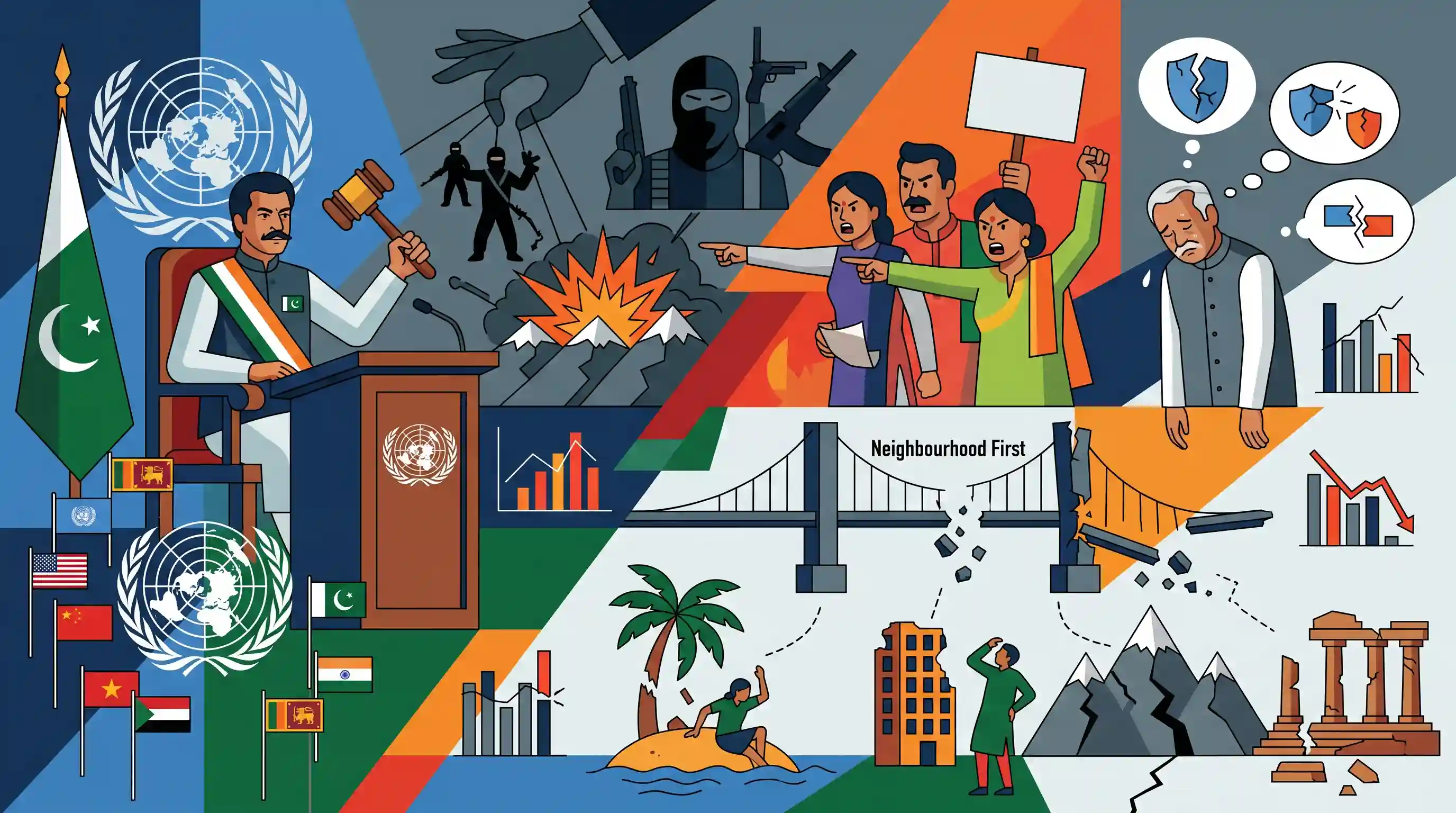
The Congress party has strongly criticized the Indian government over Pakistan assuming the presidency of the UN Security Council (UNSC) for July 2025, alongside its roles as chair of the Taliban Sanctions Committee and vice-chair of the UN Counter-Terrorism Committee. The opposition labeled these developments as a "huge diplomatic setback," questioning the efficacy of India's foreign policy under the NDA government, particularly in light of recent cross-border terror incidents like the Pahalgam attack. Furthermore, the Congress highlighted broader diplomatic challenges, pointing to deteriorating relations with key neighboring nations, including the Maldives, Bangladesh, Nepal, and Sri Lanka, and questioning the effectiveness of India's "Neighbourhood First" policy.
Key Points
- The Congress party labeled Pakistan's assumption of the UN Security Council (UNSC) presidency for July 2025 as a major diplomatic setback for the Modi government.
- Pakistan, currently a non-permanent member of the UNSC for the 2025-26 term, is also slated to chair the Taliban Sanctions Committee.
- In June 2025, Pakistan assumed the vice-chair position of the UN Counter-Terrorism Committee, which opposition leaders argue undermines India's global stance on terrorism.
- The opposition linked these developments to ongoing cross-border terrorism threats, citing the recent attack in Pahalgam, Jammu and Kashmir.
- Concerns were also raised about India's waning influence in its immediate neighborhood, with relations allegedly souring with the Maldives, Nepal, Bangladesh, and Sri Lanka.
Important Terms
United Nations Security Council (UNSC)

The UN's primary organ for international peace and security, consisting of 15 members (5 permanent, 10 non-permanent). It is the only UN body capable of issuing binding resolutions.
UPSC context
GS Paper II: International Relations. Essential for questions on global governance, UN reforms, and India’s bid for permanent membership.
UN Counter-Terrorism Committee (CTC)
A subsidiary body of the UNSC (established by Resolution 1373) that monitors member states' compliance with measures to prevent terrorist acts and criminalize the financing of terrorism.
UPSC context
GS Paper III: Internal Security. Relevant for discussions on international cooperation against terrorism and India's role in counter-terrorism diplomacy.
1988 Sanctions Committee (Taliban Sanctions Committee)
A UNSC body (established by Resolution 1988) that manages sanctions—including travel bans and assets freezes—against individuals and entities associated with the Taliban that threaten Afghanistan’s stability.
UPSC context
GS Paper II: India and its Neighborhood. Critical for analyzing the security dynamics of the Af-Pak region and India’s regional interests.
Neighbourhood First Policy
India’s core foreign policy doctrine that prioritizes diplomatic ties, economic connectivity, and regional stability with its immediate neighbors in South Asia and the Indian Ocean Region.
UPSC context
GS Paper II: India and its Neighborhood. A foundational topic for evaluating India’s regional leadership, challenges from China, and bilateral relations.
Non-Permanent Member (UNSC)
The ten UNSC members elected by the General Assembly for two-year terms. They participate in decision-making and hold the monthly rotating presidency but lack the veto power of the P5.
UPSC context
GS Paper II: International Relations. Relevant for understanding the power dynamics, rotation system, and agenda-setting capabilities of the Security Council.
Prelims Trap
"The UN General Assembly elects the monthly UNSC President based on a majority vote."
The UNSC presidency is not elected. It rotates automatically every month in alphabetical order of the member states' English names.
Static Concepts Connected
How does the UNSC structure its non-permanent membership and presidency?
- Election mechanism: 10 non-permanent members are elected by a two-thirds majority of the UNGA for a two-year term, and cannot be immediately re-elected.
- Regional Quotas: Seats are strictly distributed regionally (e.g., 5 for African and Asian states, 2 for Latin America, etc.).
- Monthly rotation: The presidency rotates monthly in alphabetical order of the English names of all 15 UNSC members (both permanent and non-permanent).
What are the key UNSC counter-terrorism committees?
- CTC (Counter-Terrorism Committee): Established by Res 1373 post-9/11. Focuses on state capacity building against terror financing and safe havens; it does not maintain a sanctions list.
- 1267 Committee: Oversees global asset freezes, travel bans, and arms embargoes against individuals and entities associated with ISIL (Da'esh) and Al-Qaida.
- 1988 Committee: Separated from the 1267 list in 2011 to deal specifically with the Taliban and associated individuals/entities.
Cross-Topic Patterns
UN structural flaws & Counter-Terrorism
A state historically accused of sponsoring terror chairing the Taliban Sanctions Committee highlights the UN's vulnerability to regional bloc politics and lack of qualitative vetting for subsidiary bodies.
Domestic politics & Neighbourhood First
Shifting relations with Maldives, Bangladesh, and Nepal reflect how neighborhood domestic transitions increasingly leverage the 'India Out' card and Chinese economic presence, challenging India's regional diplomacy.

Expect a Prelims question distinguishing UNSC Resolutions 1267, 1988, and 1373, or a Mains Q on structural flaws in UN counter-terrorism.
Linked PYQs · 4
Linked PYQs · 4
- 2025MainsGS2
"The reform process in the United Nations remains unresolved, because of the delicate imbalance of East and West and entanglement of the USA vs. Russo-Chinese alliance.” Examine and critically evaluate the East-West policy confrontations in this regard.
- 2025MainsGS3
Terrorism is a global scourge. How has it manifested in India? Elaborate with contemporary examples. What are the counter measures adopted by the State? Explain.
- 2024MainsGS2
Discuss the geopolitical and geostrategic importance of Maldives for India with a focus on global trade and energy flows. Further also discuss how this relationship affects India's maritime security and regional stability amidst international competition ?
- 2022MainsGS2
India is an age-old friend of Sri Lanka.’ Discuss India's role in the recent crisis in Sri Lanka in the light of the preceding statement.
