Congress Set to Unveil Revamped Rajasthan State Team
Source:timesofindia ↗
Why It Matters
The restructuring of state-level political organizations highlights the evolving dynamics of political representation in Rajasthan. The targeted inclusion of women, Dalits, and OBCs is relevant to topics covering social justice, state politics, and demographic representation, which are frequently tested themes in RPSC examinations (such as questions on the number of women in the State Council of Ministers).
Summary
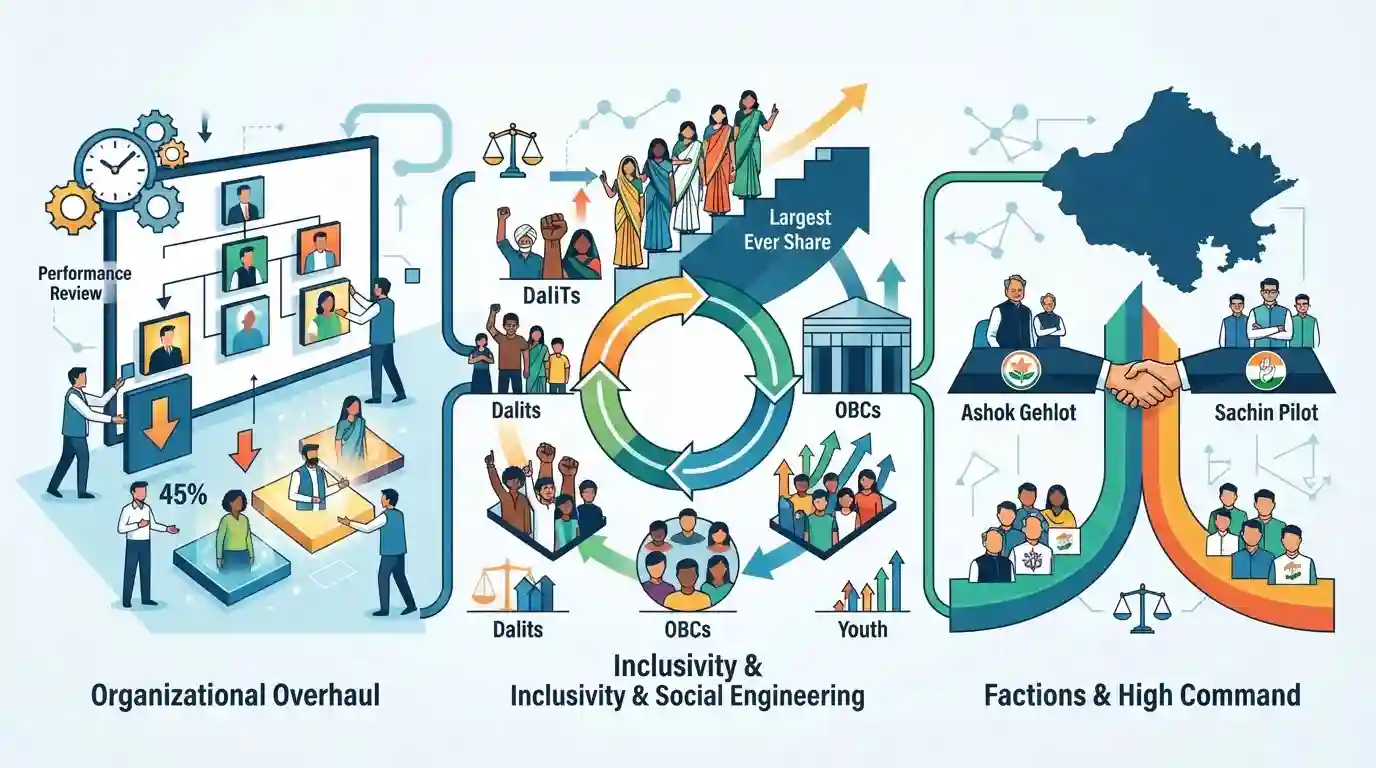
The Indian National Congress is set to announce a revamped organizational structure for its Rajasthan state unit, with a distinct focus on inclusivity and social engineering. PCC Chief Govind Singh Dotasra is scheduled to finalize the new team with the high command, intending to give women their biggest-ever share of leadership posts. The overhaul will also significantly boost the representation of Dalits, OBCs, and youth, aiming to correct historical imbalances and mitigate the influence of a few dominant communities. Concurrently, the restructuring seeks to harmonize internal factions by equitably distributing posts among loyalists of senior leaders Ashok Gehlot and Sachin Pilot, even as nearly half of the current office-bearers are expected to be relieved of their duties due to performance evaluations.
Key Points
- The Rajasthan Pradesh Congress Committee (PCC) is poised for a major organizational overhaul to optimize social engineering and representation.
- Women are expected to secure their largest-ever share of office-bearer positions in the new state unit.
- Representation of Dalits, Other Backward Classes (OBCs), and younger leaders will be significantly increased to counter the perception of dominance by select communities.
- Nearly half of the existing office-bearers are likely to be dropped based on a rigorous performance review.
- The restructuring aims to balance internal factions, specifically accommodating loyalists from both the Ashok Gehlot and Sachin Pilot camps.
Prelims Trap
"The RPA 1951 mandates 33% reservation for women in the internal organizational structures of registered political parties."
The 106th Amendment mandates quotas in the Lok Sabha and State Assemblies, not within party structures. Inner-party quotas and organizational restructuring remain entirely voluntary in India.
Static Concepts Connected
What is the statutory basis for regulating inner-party democracy in India?
- Section 29A RPA: Mandates registration of political parties with the Election Commission but does not actively regulate or enforce democratic internal organizational elections.
- ECI Guidelines: Requires parties to periodically submit details of organizational elections, though the ECI lacks strong punitive powers to enforce compliance.
- Law Commission Reports: The 170th and 255th Law Commission reports strongly recommended creating a statutory framework to govern internal party democracy and candidate selection.
What are the core features of the 106th Constitutional Amendment Act?
- Reserved Seats: Inserts Articles 330A and 332A to reserve 1/3rd of seats for women in the Lok Sabha and State Legislative Assemblies, including SC/ST quotas.
- Delimitation Linkage: Implementation is explicitly contingent upon the publication of the first census and subsequent delimitation exercise conducted after the Act's commencement.
- Sunset Clause: The reservation will initially be operational for 15 years, requiring Parliamentary approval for any further extension.
Cross-Topic Patterns
Inner-party Democracy & 10th Schedule
Severe factionalism forces parties to use organizational posts for appeasement, highlighting how the Anti-Defection Law fails to curb internal dissent without statutory frameworks for inner-party democracy.
Women's Quotas: Voluntary vs Statutory
While the 106th CAA secures legislative quotas, India lacks mandatory internal party quotas (unlike Nordic models), leaving women's political empowerment heavily dependent on voluntary high-command restructuring.

Mains 2026 GS2 could link the statutory vacuum in inner-party democracy (RPA limits) with voluntary women's quotas post-106th Amendment.
Linked PYQs · 1
Linked PYQs · 1
- 2025RPSC_PRELIMSGS1
How many women were there in the Rajasthan Council of Ministers as of the end of November 2024?
