Constitution Amendment Bill and JPC consensus divides INDIA bloc
Source:The Hindu ↗
Why It Matters
The proposed legislation touches upon core constitutional principles regarding the continuity of the executive and the criminalization of politics. It highlights the role of Joint Parliamentary Committees in legislative scrutiny and demonstrates the dynamics of consensus-building among political parties.
Summary
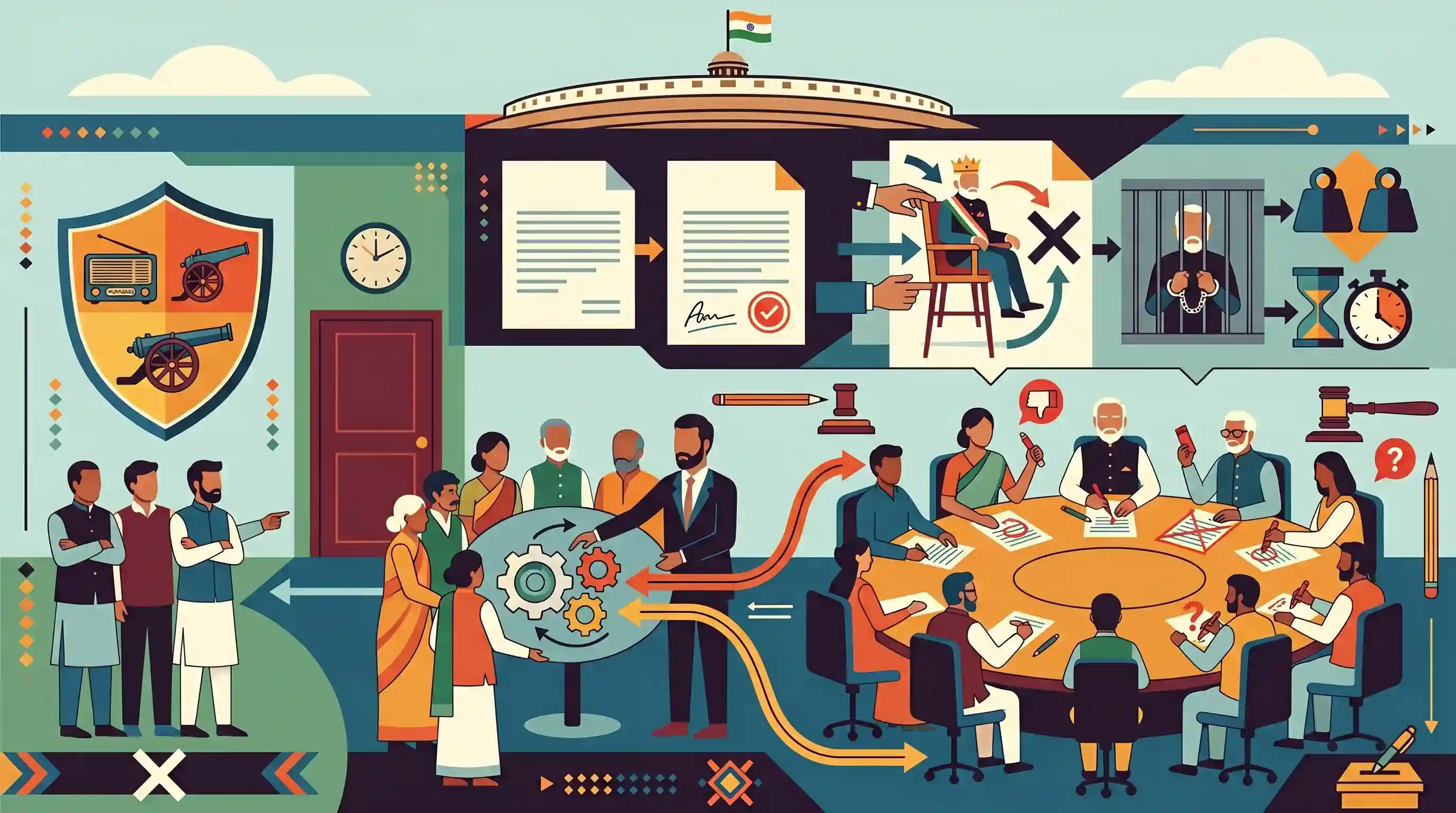
The Congress party is striving to build consensus within the INDIA bloc regarding participation in a Joint Parliamentary Committee (JPC) established to review three significant Bills. These Bills, including the Constitution (130th Amendment) Bill, 2025, aim to establish procedures for removing the Prime Minister, Chief Ministers, and Ministers arrested on serious criminal charges for 30 days. While some opposition parties favor boycotting the panel, citing historical precedents like the 1987 Bofors JPC boycott, others argue that joining is necessary to formally record their objections to the legislation.
Key Points
- The Congress party is consulting INDIA bloc partners to build consensus on joining a Joint Parliamentary Committee (JPC) to review three contentious Bills.
- The Bills seek to outline procedures for the removal of the Prime Minister, Chief Ministers, and Ministers if arrested on serious criminal charges for 30 days.
- The Bills include the 130th Constitution Amendment Bill, 2025, the J&K Reorganisation (Amendment) Bill, 2025, and the Government of UTs (Amendment) Bill, 2025.
- The INDIA bloc is divided on participation: TMC, SP, and Shiv Sena (UBT) favor boycotting the JPC, while Left parties and NCP (Sharad Pawar) support joining to record objections.
- Proponents of a boycott recall the Opposition\'s boycott of the 1987 Joint Parliamentary Committee on the Bofors case.
Important Terms
Constitution (One Hundred and Thirtieth Amendment) Bill, 2025

A proposed legislation seeking to amend Articles 75, 164, and 239AA to mandate the removal of the Prime Minister, Chief Ministers, or Ministers if detained for 30 consecutive days on serious criminal charges.
UPSC context
GS Paper 2: Constitution and Polity. Tests understanding of executive accountability, basic structure doctrine, and constitutional amendments.
Joint Parliamentary Committee (JPC)
An ad-hoc parliamentary committee consisting of members from both Lok Sabha and Rajya Sabha (usually in a 2:1 ratio) constituted to investigate specific issues or scrutinize complex bills.
UPSC context
GS Paper 2: Parliament and State Legislatures. Tests knowledge of parliamentary oversight mechanisms and committee system functions.
INDIA bloc
The Indian National Developmental Inclusive Alliance; a multi-party political coalition of major opposition parties formed to challenge the ruling National Democratic Alliance (NDA) in national elections.
UPSC context
GS Paper 2: Salient features of the Representation of People’s Act. Relevant for understanding party systems and coalition politics in India.
Jammu and Kashmir Reorganisation (Amendment) Bill, 2025
Proposed legislation to amend the 2019 Act, enabling the Lieutenant Governor to remove the Chief Minister or Ministers of Jammu and Kashmir if detained for 30 consecutive days on serious charges.
UPSC context
GS Paper 2: Federalism and Union Territories. Tests knowledge of administrative structures in UTs and legislative control over regional executives.
Government of Union Territories (Amendment) Bill, 2025
A bill introduced to amend the Government of Union Territories Act, 1963, extending the 30-day detention-based removal rule to ministers in Union Territories like Puducherry.
UPSC context
GS Paper 2: Structure and functioning of the Executive. Relevant for understanding the legal framework governing UT administrations and ministerial accountability.
Prelims Trap
"Under the Constitution, a Minister is automatically removed or disqualified if detained in judicial custody for 30 consecutive days."
Disqualification currently requires formal judicial *conviction* (minimum 2 years sentence) under RPA, not mere detention. The 130th Amendment Bill only *proposes* removal for 30-day detention.
Static Concepts Connected
What governs the disqualification and removal of elected Ministers in India?
- Constitutional grounds: Articles 102/191 cover office of profit, unsound mind, insolvency, and lack of citizenship.
- RPA 1951: Section 8(3) mandates immediate disqualification upon judicial conviction with a sentence of 2+ years (established by the Lily Thomas judgment).
- Pleasure Doctrine: Under Articles 75 and 164, Ministers hold office strictly during the pleasure of the President or Governor.
What are the structural features of a Joint Parliamentary Committee (JPC)?
- Ad-hoc nature: JPCs are temporary panels formed to examine a specific complex bill or investigate an issue, dissolving after submitting their report.
- Formation mechanism: Constituted via a formal motion passed in one House and concurred by the other House.
- Membership ratio: Typically maintains a 2:1 ratio of Lok Sabha to Rajya Sabha members.
Cross-Topic Patterns
Federal friction + RPA evolution
The debate over removing CMs arrested by central agencies (ED/CBI) bridges Centre-State relations with the ongoing evolution of the Representation of the People Act.
JPC conventions + Legislative checks
Historical precedents like the 1987 Bofors boycott show how JPC participation serves as both a political signaling tool and a mechanism for executive accountability.

Expect a Prelims question contrasting the RPA's 'conviction' criteria (Lily Thomas) with the new proposed 'detention' criteria for removal.
Linked PYQs · 4
Linked PYQs · 4
- 2023MainsGS2
Explain the structure of the Parliamentary Committee system. How far have the financial committees helped in the institutionalisation of Indian Parliament?
- 2018MainsGS2
Why do you think the committees are considered to be useful for parliamentary work? Discuss, in this context, the role of the Estimates Committee.
- 2025MainsGS2
Indian Constitution has conferred the amending power on the ordinary legislative institutions with a few procedural hurdles. In view of this statement, examine the procedural and substantive limitations on the amending power of the Parliament to change the Constitution.
- 2020MainsGS2
There is a need for simplification of procedure for disqualification of persons found guilty of corrupt practices under the Representation of Peoples Act". Comment.
