Delimitation Freeze Demand and Women Reservation Implementation
Source:The Hindu ↗
Why It Matters
The interplay between population control, political representation, and delimitation highlights a significant tension in Indian federalism between demographic realities and equitable state representation. Additionally, the debate over delinking women's reservation from delimitation touches upon crucial constitutional processes and structural governance reforms.
Summary
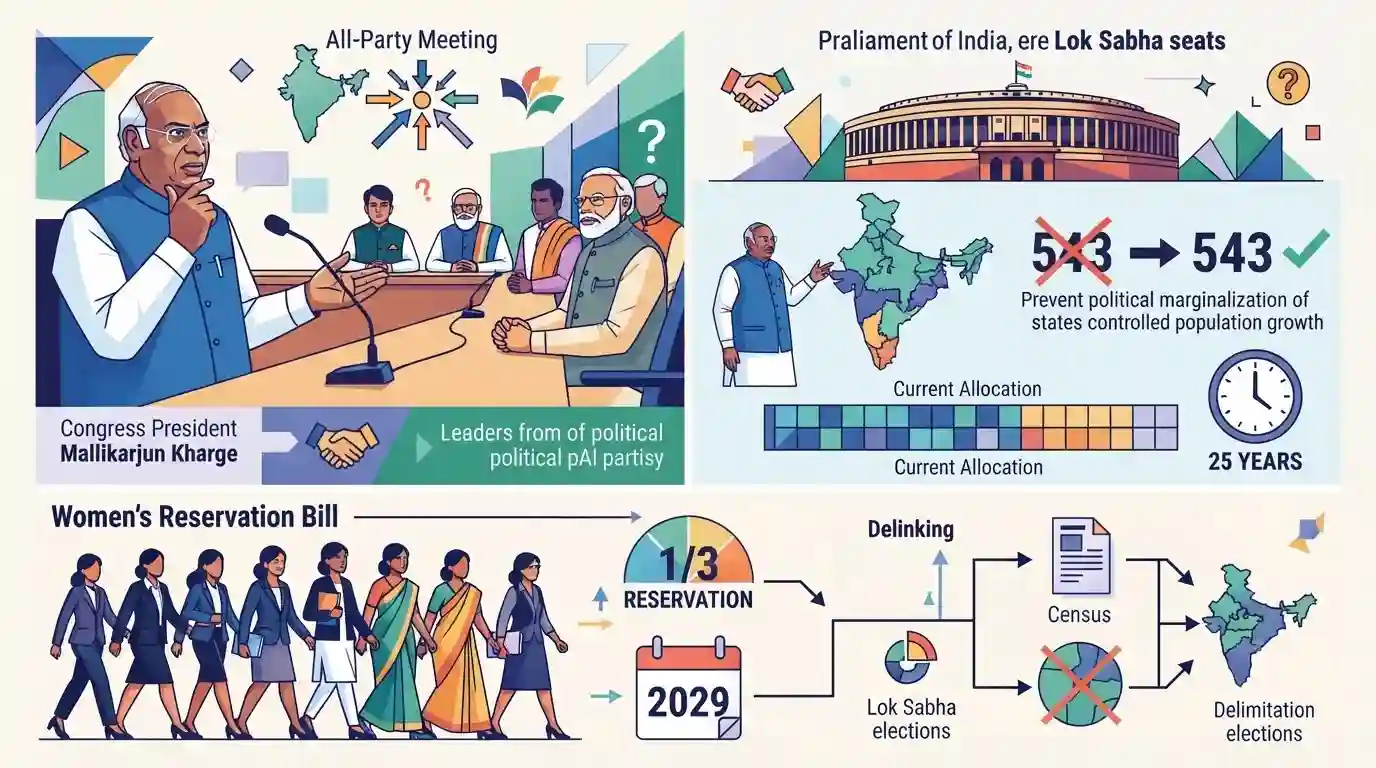
Congress President Mallikarjun Kharge has urged PM Narendra Modi to convene an all-party meeting regarding the upcoming delimitation exercise. Kharge proposed freezing the total strength of the Lok Sabha at 543 and maintaining the current State-wise allocation of seats for another 25 years to prevent the political marginalization of Southern states, which have successfully curbed population growth. Additionally, he demanded the implementation of the women's reservation bill (one-third reservation) for the 2029 Lok Sabha elections, explicitly calling for it to be delinked from the pending census and delimitation processes.
Key Points
- Congress demands an all-party meeting to discuss the implications of the upcoming delimitation exercise on regional representation.
- A proposal was made to freeze the Lok Sabha strength at 543 and retain current State-wise seat allocations for another 25 years.
- Concerns were raised that Southern states might be penalized with reduced political representation due to their successful population control measures compared to Northern states.
- The party reiterated the demand to implement one-third reservation for women starting from the 2029 Lok Sabha elections.
- A key demand is to delink the implementation of women's reservation from the completion of the decadal census and delimitation processes.
Important Terms
Delimitation Act

Under Article 82, Parliament enacts a Delimitation Act after every census to set up a Commission. This body redraws Lok Sabha and Assembly constituency boundaries to ensure equitable representation based on updated demographic data.
UPSC context
GS Paper 2 (Indian Polity). Tests understanding of electoral representation, Article 82, and the federal implications of redrawing constituencies.
Nari Shakti Vandan Adhiniyam
The 106th Constitutional Amendment Act (2023) granting 33% reservation for women in the Lok Sabha, State Assemblies, and Delhi Assembly. Its implementation is currently tied to the completion of the next census and delimitation exercise.
UPSC context
GS Paper 2 (Social Justice). Tests awareness of women's political empowerment, the 106th CAA, and legislative prerequisites for its implementation.
Lok Sabha
The lower house of India's Parliament. Its total elective strength was frozen at 543 by past amendments to prevent the political marginalization of Southern states that successfully stabilized their population growth.
UPSC context
GS Paper 2 (Parliament, Federalism). Tests the mechanics of parliamentary seat allocation, Article 81, and inter-state federal disputes.
Prelims Trap
"Orders of the Delimitation Commission can be challenged in the Supreme Court on constitutional grounds."
Delimitation Commission orders have the force of law and cannot be called into question before any court. Even Parliament/State Assemblies cannot modify them.
Static Concepts Connected
What is the constitutional framework governing the Delimitation Commission in India?
- Article 82: Mandates Parliament to enact a Delimitation Act after every census to readjust seat allocation across constituencies.
- 84th Amendment (2001): Froze the total Lok Sabha seats and their state-wise allocation based on the 1971 Census until the first census post-2026.
- Absolute Authority: Its orders have the force of law, cannot be questioned in any court, and cannot be modified even by Parliament.
What are the implementation conditions for the 106th Constitutional Amendment Act (Women's Reservation)?
- Census Dependency: The 33% reservation is explicitly contingent on the publication of the first official census taken after the Act's commencement.
- Subsequent Delimitation: A delimitation exercise must follow the aforementioned census to specifically identify and demarcate the constituencies to be reserved for women.
Cross-Topic Patterns
Demographic divergence & Federalism
The "penalty for success" paradox highlights a core federal tension: Southern states, having stabilized population growth, fear reduced political leverage compared to high-population Northern states in the Lok Sabha.
Finance Commission vs Delimitation
Similar to the delimitation debate, the 15th Finance Commission's mandated shift to 2011 census data sparked protests from Southern states over the equitable devolution of central taxes.

Expect a multi-statement question linking Article 82, the 84th Amendment freeze, and the 106th Amendment's implementation prerequisites.
Linked PYQs · 3
Linked PYQs · 3
- 2012PrelimsGS1
With reference to the Delimitation Commission, consider the following statements: 1. The orders of the Delimitation Commission cannot be challenged in a Court of Law. 2. When the orders of the Delimitation Commission are laid before the Lok Sabha or State Legislative Assembly, they cannot effect any modifications in the orders. Which of the statements given above is/are correct?
- 2024PrelimsGS1
How many Delimitation Commissions have been constituted by the Government of India till December 2023?
- 2024PrelimsGS1
Consider the following statements regarding 'Nari Shakti Vandan Adhiniyam' : 1. Provisions will come into effect from the 18th Lok Sabha. 2. This will be in force for 15 years after becoming an Act. 3. There are provisions for the reservation of seats for Scheduled Castes Women within the quota reserved for the Scheduled Castes. Which of the statements given above are correct?
