Bilateral Trade Agreement Implications for Agriculture and Energy
Source:The Hindu ↗
Why It Matters
The article highlights the critical trade-offs in bilateral Free Trade Agreements (FTAs), particularly how opening domestic markets affects vulnerable sectors like agriculture. It also underscores the intricate link between geopolitics, trade pacts, and national energy security, making it highly relevant for GS2 (Bilateral Agreements) and GS3 (Agriculture & Energy Security).
Summary
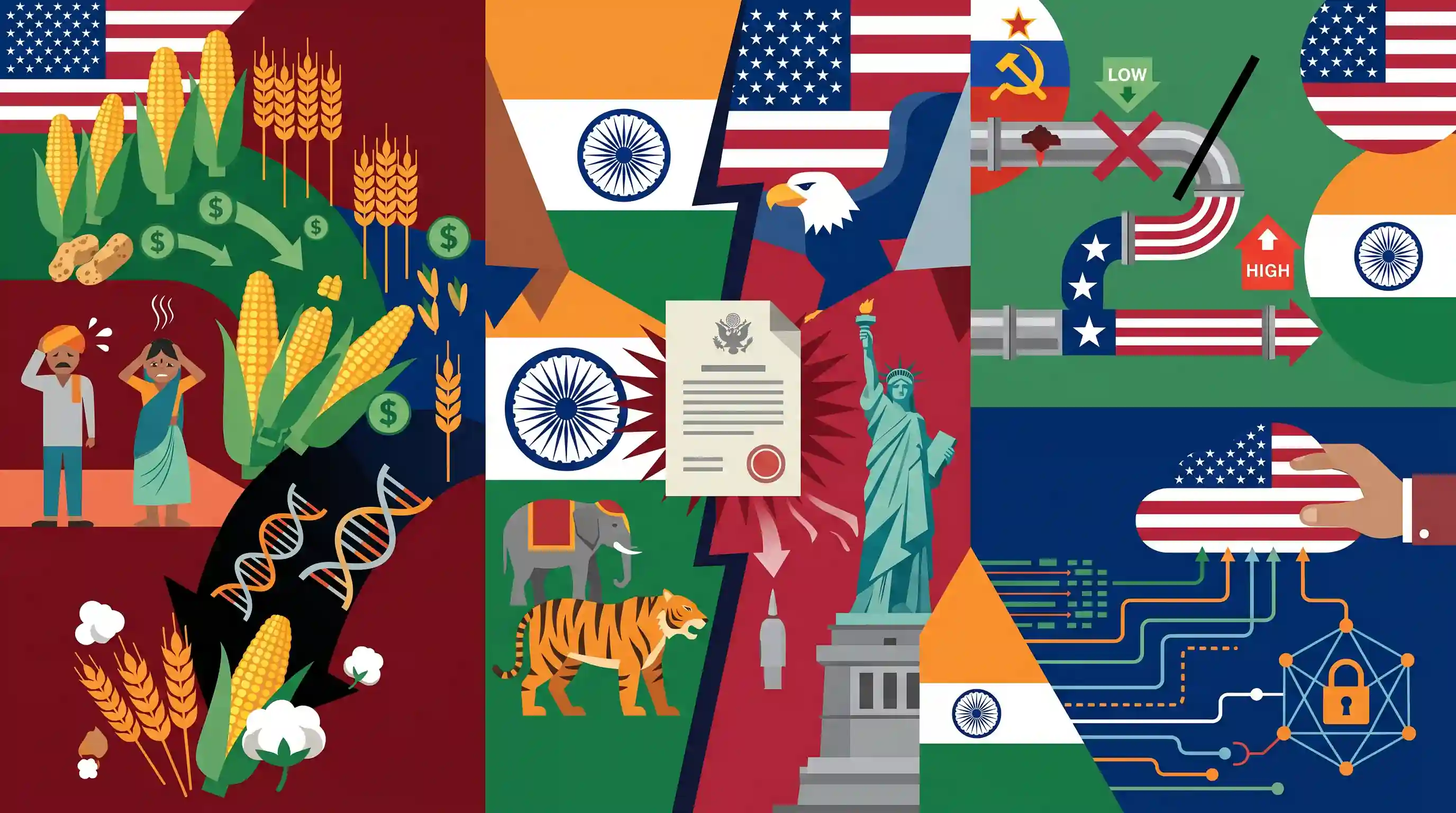
The Congress party strongly criticized the impending India-US interim trade agreement, alleging it mortgages India's agricultural interests, energy security, and digital autonomy. Spokesperson Jairam Ramesh claimed the deal would flood the market with subsidized US farm products, including potentially Genetically Modified (GM) crops, harming domestic farmers. Additionally, he argued the pact restricts cheap Russian oil imports, forcing India to purchase costlier US crude and thereby jeopardizing energy security. The opposition asserted the agreement compromises digital sovereignty and acts as a capitulation to US demands rather than a negotiation between sovereign equals.
Key Points
- The proposed India-US trade agreement is criticized for allegedly harming Indian farmers by allowing duty-free imports of heavily subsidized US agricultural goods (like maize, soybean, and cotton).
- The deal could lead to the removal of non-tariff barriers, potentially clearing the path for Genetically Modified (GM) crops to enter the Indian market.
- Critics argue the pact undermines India's energy security by restricting cheap Russian oil imports and forcing a shift to costlier US crude oil.
- The opposition claims the agreement compromises India's digital autonomy and represents a strategic capitulation, contrasting it with past agreements negotiated as 'sovereign equals'.
Important Terms
India-US Interim Trade Agreement (ITA)

An "early harvest" deal (Feb 2026) reducing US tariffs on Indian goods to 18% in exchange for India lowering duties on American agricultural/industrial products and committing to a $500 billion purchase plan.
UPSC context
GS Paper II: Bilateral agreements. Tests understanding of trade diplomacy, "Early Harvest" pacts, and the shift from transactional friction to strategic partnership.
Digital Sovereignty
The ability of a state to independently govern its digital infrastructure, data flows, and regulatory frameworks (e.g., digital services taxes) without external coercion or dependence on foreign tech platforms.
UPSC context
GS Paper III: Economy/Security. Tests knowledge of data localization, digital taxation (Pillar 1), and challenges posed by Big Tech in trade negotiations.
Strategic Autonomy
A foreign policy doctrine where a nation makes independent decisions based on its national interest without being coerced by other powers or joining formal military/political blocs.
UPSC context
GS Paper II: International Relations. A core theme testing India's ability to balance ties with the US and Russia amidst global sanctions.
Energy Security
The uninterrupted availability of energy sources at affordable prices; currently central to India's balancing act between discounted Russian crude oil and diversifying supplies via US energy partnerships.
UPSC context
GS Paper III: Infrastructure/Energy. Tests understanding of the economic impact of global sanctions and India's "all-aligned" energy procurement strategy.
Non-Tariff Barriers (NTBs)
Trade restrictive measures other than customs duties, such as import licensing, technical standards, or sanitary regulations, which often act as barriers to market access for Indian agricultural products.
UPSC context
GS Paper III: Economy/Trade. Tests understanding of modern trade friction beyond simple tariffs, particularly in agriculture and pharma.
Reciprocal Tariffs
A trade principle (e.g., US Executive Order 14257) where a country matches the tariff rates of its trading partners to ensure a level playing field and reduce trade deficits.
UPSC context
GS Paper III: Economy. Tests knowledge of trade policy mechanisms used by major powers to exert pressure during bilateral negotiations.
Prelims Trap
Bilateral trade agreements override India's domestic environmental laws regarding Genetically Modified (GM) crop imports.
FTAs reduce tariffs but do not bypass domestic Non-Tariff Barriers like GEAC approvals (EPA 1986) or SPS measures for biosecurity.
Static Concepts Connected
How does India regulate the import of Genetically Modified (GM) crops?
- GEAC Authority: Regulated under the Environment Protection Act, 1986, which mandates clearance for hazardous microorganisms and GMOs.
- FSSAI Oversight: The Food Safety and Standards Authority of India monitors and restricts GM ingredients in imported food products.
- WTO SPS Measures: India applies Sanitary and Phytosanitary (SPS) measures, permitted under the WTO, to legally block agricultural imports threatening domestic biosecurity.
What characterizes an Early Harvest Scheme (Interim Trade Agreement)?
- Precursor to FTA: A bilateral pact to liberalize tariffs on a specific, limited list of goods to build trust before negotiating a comprehensive FTA.
- WTO Compliance: Under GATT Article XXIV, these interim agreements must eventually mature into full FTAs covering 'substantially all trade' to remain legal.
Cross-Topic Patterns
Data Localization vs. FTAs
The US consistently pushes against digital trade barriers in FTAs, directly colliding with India's DPDP Act and RBI's stringent data localization mandates for payment systems.
Energy Multi-alignment limits
India's purchase of discounted Russian crude via price-cap loopholes tests the economic limits of its strategic and defense convergence with the United States.

Expect a multi-statement Prelims question interlinking GM crop import regulations, WTO SPS measures, and FTA frameworks.
Linked PYQs · 4
Linked PYQs · 4
- 2023MainsGS3
What are the direct and indirect subsidies provided to farm sector in India? Discuss the issues raised by the World Trade Organization (WTO) in relation to agricultural subsidies.
- 2025MainsGS2
"Energy security constitutes the dominant kingpin of India's foreign policy, and is linked with India's overarching influence in Middle Eastern countries.” How would you integrate energy security with India's foreign policy trajectories in the coming years?
- 2020MainsGS2
What is the significance of Indo-US defence deals over Indo-Russian defence deals? Discuss with reference to stability in the Indo-Pacific region.
- 2025MainsGS2
"With the waning of globalization, post-Cold War world is becoming a site of sovereign nationalism.” Elucidate.
