Congress Alleges Financial Mismanagement in Bihar State Administration
Source:The Hindu ↗
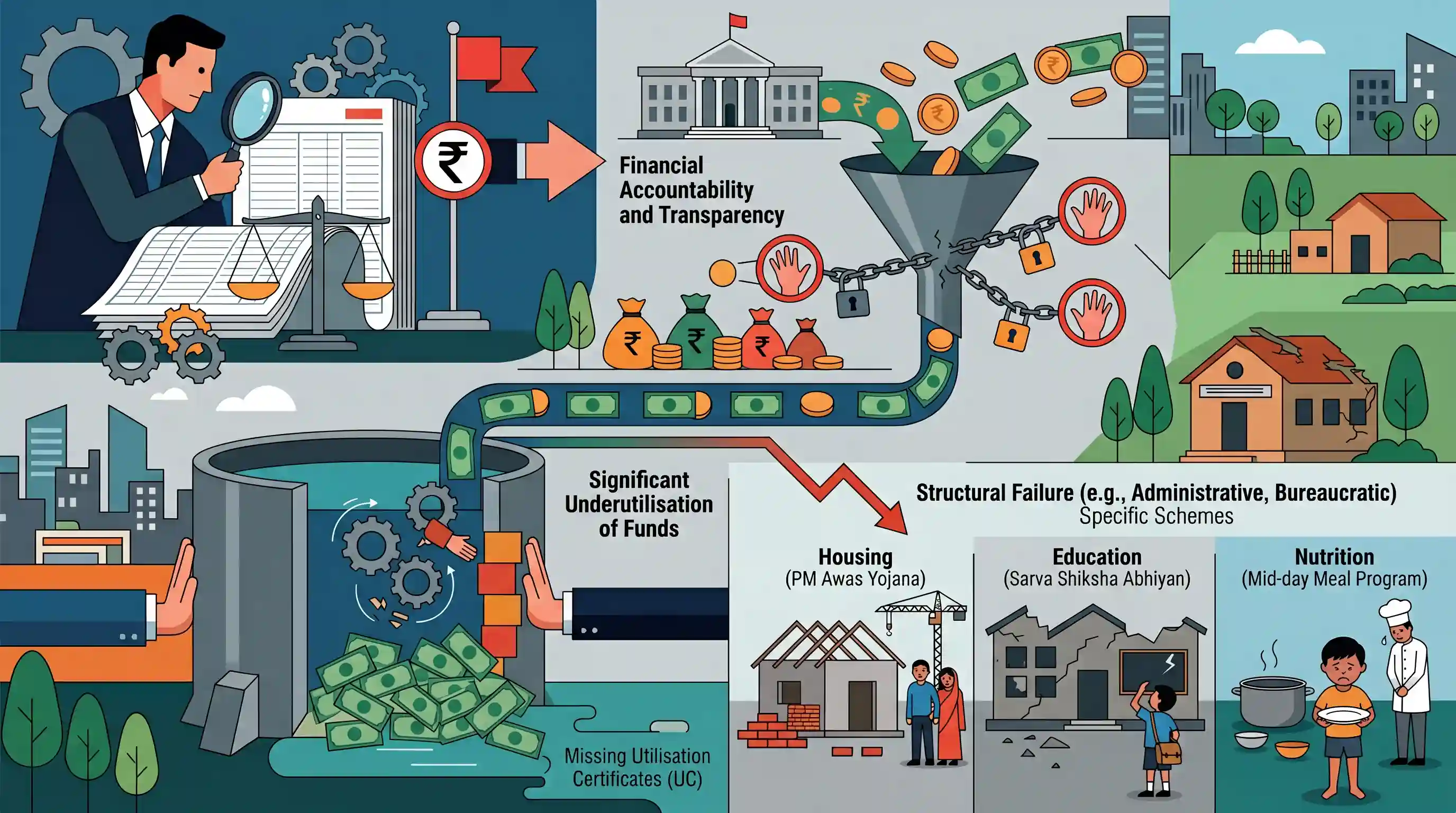
Why It Matters
The article underscores crucial issues of governance and financial accountability, specifically the failure to submit utilisation certificates and the underutilisation of funds meant for Centrally Sponsored Schemes. This provides a real-world case study for the functional importance of the CAG and the administrative bottlenecks in implementing welfare schemes.
Summary
During the ongoing Bihar Assembly elections, Congress leaders accused the incumbent NDA government of financial mismanagement and corruption. Citing the 2025 Comptroller and Auditor-General (CAG) report, the opposition alleged that the state government spent ₹70,877.61 crore without submitting utilisation certificates. Furthermore, structural administrative failures have led to significant underutilisation of funds—amounting to ₹3.59 lakh crore over five years—which has severely impacted the execution of critical Centrally Sponsored Schemes like the Pradhan Mantri Awas Yojana, Sarva Shiksha Abhiyan, and the mid-day meal programme.
Key Points
- Congress leaders claimed the ruling BJP-JD(U) alliance in Bihar is facing defeat and accused the government of large-scale corruption and administrative negligence.
- Citing a 2025 CAG report, the opposition highlighted that the Bihar government spent ₹70,877.61 crore without submitting required utilisation certificates, raising questions about financial propriety.
- Around ₹3.59 lakh crore in budgetary allocations remained unutilised over the past five years, with up to 35% of the state budget going unspent in certain years.
- Major Centrally Sponsored Schemes (CSS) such as the Sarva Shiksha Abhiyan, Pradhan Mantri Awas Yojana, and mid-day meal programme saw massive underutilisation of funds, directly impacting marginalized communities.
Important Terms
Comptroller and Auditor-General (CAG)

A constitutional authority (Article 148) who audits all receipts and expenditures of the Government of India and the States to ensure financial accountability and transparency in public spending.
UPSC context
GS Paper II (Constitutional Bodies); tests legislative oversight of the executive and the role of independent auditing in democracy.
Pradhan Mantri Awas Yojana (PMAY)
A flagship Centrally Sponsored Scheme providing affordable "Housing for All" through financial assistance and interest subsidies for the urban and rural poor to build pucca houses with basic amenities.
UPSC context
GS Paper II (Welfare Schemes); relevant for understanding government interventions for vulnerable sections and social infrastructure goals.
Sarva Shiksha Abhiyan (SSA)
A program (now merged into Samagra Shiksha) focused on universalizing elementary education for children aged 6–14 and fulfilling the mandate of the Right to Education (RTE) Act.
UPSC context
GS Paper II (Social Sector: Education); tests knowledge of human resource development and the right to free education.
Mid-day meal programme
A nutritional support scheme (renamed PM POSHAN) providing hot cooked meals to school children to improve enrollment, retention, and nutritional status while addressing classroom hunger and social equity.
UPSC context
GS Paper II (Social Justice); critical for topics on hunger, health, and government efforts to improve child welfare indicators.
National Democratic Alliance (NDA)
The National Democratic Alliance, a centre-right coalition of political parties led by the BJP, which has governed at the Centre and in various states since 1998.
UPSC context
GS Paper II (Political Parties); relevant for studying coalition politics and federal party dynamics in the Indian democratic system.
INDIA bloc
The Indian National Developmental Inclusive Alliance, a multi-party opposition coalition formed to challenge the ruling NDA in national and state elections.
UPSC context
GS Paper II (Role of Opposition); tests knowledge of parliamentary democracy and the function of organized opposition alliances.
Prelims Trap
The CAG has the authority to halt the release of Central funds to States if Utilisation Certificates are delayed.
The CAG conducts post-expenditure audits and reports to the legislature. The power to withhold future funds lies with the Union Finance Ministry, not the CAG.
Static Concepts Connected
What is a Propriety Audit conducted by the CAG?
- Definition: Assesses the wisdom, faithfulness, and economy of government expenditure beyond mere legal or formal compliance.
- Purpose: Identifies cases of waste, extravagance, or improper expenditure, even if the spending technically followed the rules.
- Nature: Propriety audit is discretionary for the CAG, unlike compliance and financial audits which are mandatory.
Why do States face 'absorptive capacity' deficits in utilizing allocated funds?
- Matching grants: Financially stressed States often struggle to provide their mandatory share for Centrally Sponsored Schemes (CSS).
- Administrative bottlenecks: Weak institutional capacity, delayed tendering, and lack of trained personnel slow down project execution.
- Compliance delays: Failure to submit Utilisation Certificates (UCs) on time halts the release of subsequent Central installments.
Cross-Topic Patterns
Public Finance + Fiscal Federalism
The requirement of matching state shares and strict conditionalities (like UCs) for CSS highlights structural friction in Center-State financial relations.
Administrative capacity + Welfare outcomes
Persistent fund underutilisation shifts the focus from mere 'budgetary allocation' to 'absorptive capacity' as the real bottleneck for social safety nets like PMAY and SSA.

Expect a 2026 Mains question linking state-level 'absorptive capacity' deficits and strict CSS conditionalities to poor welfare outcomes.
Linked PYQs · 3
Linked PYQs · 3
- 2018MainsGS2
“The Comptroller and Auditor General (CAG) has a very vital role to play.” Explain how this is reflected in the method and terms of his appointment as well as the range of powers he can exercise.
- 2024MainsGS2
“The duty of the Comptroller and Auditor General is not merely to ensure the legality of expenditure but also its propriety.” Comment.
- 2019MainsGS2
Performance of welfare schemes that are implemented for vulnerable sections is not so effective due to absence of their awareness and active involvement at all stages of policy process. Discuss.
