Quit India Movement Leadership Imprisonment and Historical Stances
Source:The Hindu ↗
Why It Matters
The Quit India Movement of 1942 is a cornerstone of the Indian freedom struggle syllabus in Modern History. Understanding the imprisonment of key leaders, the specific locations of their detention, and the contrasting stances of various organizations (like the Muslim League, Hindu Mahasabha, Communist Party, and RSS) is important for both Prelims and Mains (GS Paper 1).
Summary
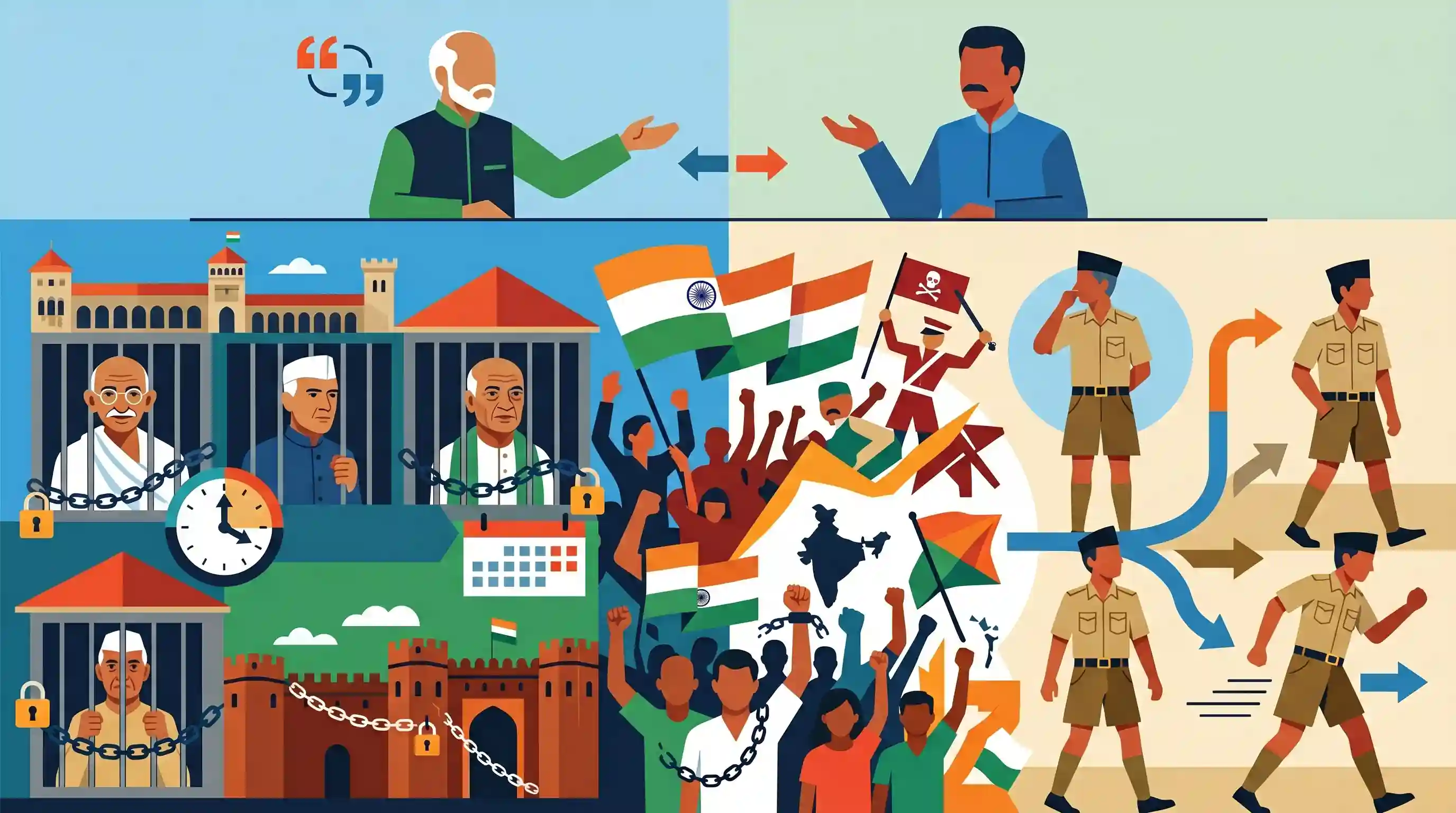
Congress general secretary Jairam Ramesh highlighted that the entire top leadership of the Congress, including Mahatma Gandhi, Jawaharlal Nehru, and Sardar Vallabhbhai Patel, spent three years in jail during the 1942 Quit India movement. He contrasted this with the RSS, which he alleged fiercely opposed the movement. Ramesh's comments, pointing out the specific locations of their imprisonment like Aga Khan Palace and Ahmednagar Fort, came in response to Prime Minister Narendra Modi's tribute to the participants of the Quit India movement.
Key Points
- The Congress party marked the anniversary of the Quit India Movement by highlighting the imprisonment of its top leadership in 1942.
- Mahatma Gandhi, Sarojini Naidu, and Mirabehn were detained at the Aga Khan Palace in Pune.
- Jawaharlal Nehru, Sardar Vallabhbhai Patel, Maulana Abul Kalam Azad, and Govind Ballabh Pant were jailed at Ahmednagar Fort.
- Congress leader Jairam Ramesh contrasted these sacrifices with the RSS, alleging that the RSS fiercely opposed the Quit India movement.
- The comments were a counter to Prime Minister Narendra Modi's homage to the participants of the Quit India movement.
Important Terms
Quit India Movement

A massive civil disobedience movement launched by Mahatma Gandhi in August 1942 demanding an immediate end to British rule, characterized by the slogan 'Do or Die.'
UPSC context
GS Paper I (Modern Indian History). Crucial for understanding the 'August Kranti' and the final phase of the freedom struggle.
Indian National Congress (INC)
Founded in 1885, it was the principal political organization leading the Indian independence movement and orchestrating major mass agitations like the Quit India Movement.
UPSC context
GS Paper I. Central to the institutional and leadership history of the Indian national movement.
Rashtriya Swayamsevak Sangh (RSS)
A Hindu nationalist volunteer organization founded in 1925; its official stance during the Quit India Movement remains a point of historical and political debate regarding its participation.
UPSC context
GS Paper I. Relevant for studying different ideologies and the roles of various organizations during the freedom struggle.
Aga Khan Palace
A historic palace in Pune that served as a prison for Mahatma Gandhi and other leaders during the 1942 movement; it is currently a monument of national importance.
UPSC context
GS Paper I. Historically significant site linked to the detention and sacrifices of prominent nationalist figures.
Ahmednagar Fort
A 15th-century fort in Maharashtra where top Congress leaders, including Jawaharlal Nehru, were imprisoned from 1942 to 1945; Nehru wrote 'The Discovery of India' here.
UPSC context
GS Paper I. Important for questions on the geographical and logistical aspects of British repression during the movement.
Parallel Governments
Independent administrative bodies established by local revolutionaries in areas like Ballia, Tamluk, and Satara to replace British colonial authority during the Quit India Movement.
UPSC context
GS Paper I. Tests detailed knowledge of the spontaneous and decentralized resistance efforts during the 1942 revolt.
Prelims Trap
The Quit India Movement saw unanimous participation from all major political organizations in India.
Several major groups, including the RSS, Hindu Mahasabha, Muslim League, Communist Party of India (CPI), and Dr. B.R. Ambedkar, officially opposed or boycotted the movement.
Static Concepts Connected
What were the immediate British responses to the Quit India Resolution?
- Operation Zero Hour: British authorities arrested the entire top INC leadership on August 9, 1942, before the movement could be formally launched.
- Detention Centers: Gandhi, Kasturba, and Sarojini Naidu were held at Aga Khan Palace; Nehru, Azad, and Patel were sent to Ahmednagar Fort.
- Underground Leadership: With top leaders jailed, figures like Aruna Asaf Ali, Ram Manohar Lohia, and Usha Mehta took charge of the underground resistance.
Why did various Indian political factions oppose the Quit India Movement?
- Communist Party (CPI): Supported the British war effort against fascism after the USSR joined the Allies (the 'People's War' line).
- Muslim League: Opposed the movement, demanding that the British partition India and guarantee the creation of Pakistan before leaving.
- Dr. B.R. Ambedkar: Viewed the movement as risky, preferring to cooperate with the British to secure structural and constitutional safeguards for Dalits.
Cross-Topic Patterns
Prison Literature in the Freedom Struggle
Nehru authored 'The Discovery of India' while jailed at Ahmednagar Fort (1942-45). UPSC frequently pairs national leaders with the seminal texts they wrote during specific historical incarcerations.
Foreigners in the Indian National Movement
Mirabehn's (Madeleine Slade) detention alongside Gandhi connects to the recurring UPSC theme of prominent Western women (like Annie Besant, Sister Nivedita, and Nellie Sengupta) actively shaping Indian nationalism.

Expect a 2026 prelims matching question pairing key freedom fighters with their 1942 detention centers or stances on the movement.
Linked PYQs · 3
Linked PYQs · 3
- 2011PrelimsGS1
Which one of the following observations is not true about the Quit India Movement of 1942?
- 2021PrelimsGS1
With reference to 8th August, 1942 in Indian history, which one of the following statements is correct?
- 2024MainsGS1
What were the events that led to the Quit India Movement? Point out its results.
