Parliamentary Rules on Quoting Documents During Debates
Source:The Hindu ↗
Why It Matters
The incident brings focus to the rules governing parliamentary proceedings, specifically regarding the quoting of documents and the role of the Presiding Officer in maintaining decorum. It also re-emphasizes the strategic significance of the 2020 India-China border standoff in eastern Ladakh, a key topic for International Relations and Internal Security.
Summary
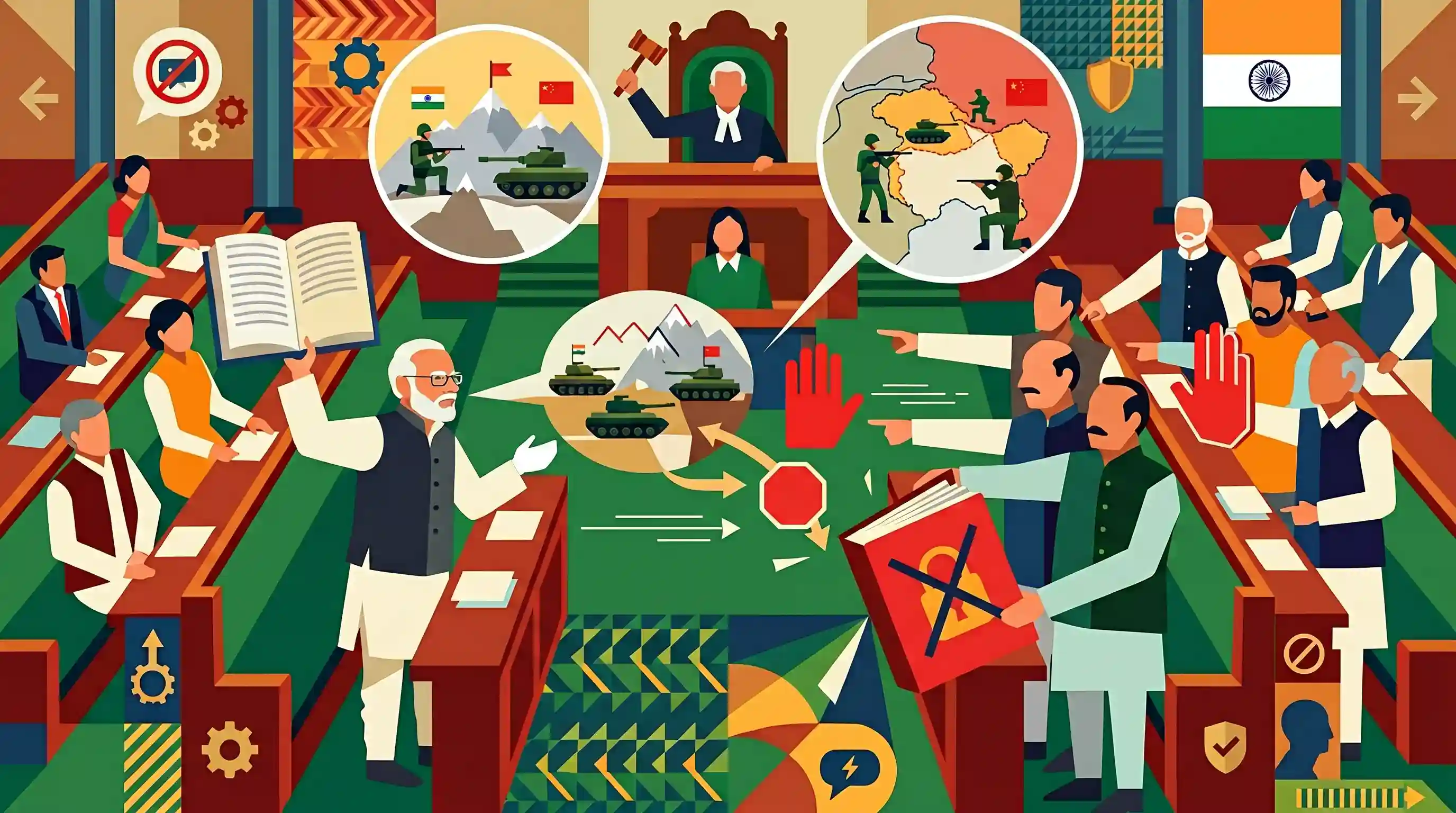
A political controversy erupted in the Lok Sabha when the government stopped Leader of the Opposition Rahul Gandhi from quoting former Army Chief Gen. Manoj Naravane's unpublished memoir about the 2020 India-China border clash. Gandhi sought to highlight an incident involving Chinese tanks at Rechin La, but Union Ministers invoked Lok Sabha Rule 349 to prevent the use of an unverified, unpublished book. Congress leaders countered that the excerpts had been published in a magazine, accusing the government of hiding the truth about the border crisis.
Key Points
- The Congress party accused the government of misusing parliamentary rules to prevent Leader of the Opposition Rahul Gandhi from discussing the India-China border issue in the Lok Sabha.
- Gandhi attempted to quote from the unpublished memoir of former Army Chief Gen (Retd) Manoj Naravane regarding a 2020 incident where Chinese tanks moved towards Rechin La in eastern Ladakh.
- Senior government ministers objected, citing Lok Sabha rules (Rule 349) against quoting unverified and unpublished documents in the House.
- The Congress argued that the excerpt was already published in a magazine, making the government's objection invalid.
- The controversy highlights the persistent political friction regarding the government's handling of the 2020 eastern Ladakh border crisis.
Important Terms
Rule 349 (i) of Lok Sabha Rules of Procedure

Clause (i) mandates that members shall not read books, newspapers, or letters while the House is sitting, except in connection with the House's business.
UPSC context
GS Paper II: Parliament functioning and conduct of business. Tests understanding of floor management and procedural constraints on members.
Leader of the Opposition (LoP)
A statutory post (1977 Act) held by the leader of the largest opposition party having at least one-tenth of the total House seats.
UPSC context
GS Paper II: Indian Polity. Crucial for checks and balances, accountability, and the concept of a 'Shadow Cabinet'.
Line of Actual Control (LAC)
The de facto, non-demarcated boundary separating Indian-controlled territory from Chinese-controlled territory, divided into Western, Middle, and Eastern sectors.
UPSC context
GS Paper II/III: International Relations and Internal Security. Essential for understanding border disputes and strategic challenges.
Rechin La
A strategic mountain pass on the Line of Actual Control in eastern Ladakh, known for the significant Indian Army 'pre-emptive' operation in August 2020.
UPSC context
GS Paper III: Border management and security. Tests knowledge of specific conflict flashpoints and geographic details.
Rules of Procedure and Conduct of Business in Lok Sabha
The comprehensive regulatory framework adopted under Article 118 of the Constitution to govern the day-to-day operations and decorum of the Lower House.
UPSC context
GS Paper II: Structure and functioning of the Executive and the Judiciary. Foundation of parliamentary oversight.
Speaker of the Lok Sabha
The highest authority in the Lok Sabha, responsible for maintaining order, interpreting rules (like Rule 349), and certifying the House's collective will.
UPSC context
GS Paper II: Constitutional bodies and their powers. Tests the quasi-judicial role of the Chair in House proceedings.
Prelims Trap
"MPs enjoy absolute freedom of speech in Parliament and can quote any document without restriction."
Freedom of speech under Article 105 is not absolute; it is subject to the Constitution and parliamentary rules (like Rule 349 requiring authentication of documents).
Static Concepts Connected
What are the major restrictions on an MP's freedom of speech in the Lok Sabha?
- Subject to rules: Rights under Article 105 are explicitly subject to constitutional provisions and the rules of procedure of the House.
- Document authentication: Members quoting from unverified or unpublished documents must formally authenticate them to avoid misleading the House (breach of privilege).
- Judiciary & Sub-judice: Discussions on pending court cases or the conduct of Supreme Court/High Court judges (except during impeachment) are prohibited.
Why are Rechin La and the Kailash Range strategically crucial in Eastern Ladakh?
- Tactical oversight: Located on the southern bank of Pangong Tso, these high-altitude passes provide a direct line of sight over China's Moldo garrison and Spanggur Gap.
- Chushul gateway: Dominating these passes prevents adversary mechanized forces from easily rolling through the wide Chushul Valley, which acts as a strategic gateway to Leh.
Cross-Topic Patterns
Parliamentary rules + Executive accountability
The invocation of Rule 349 highlights the tension between the Opposition's role in demanding transparency and the Executive's use of procedural rules to control the parliamentary narrative.
High-altitude armor + Border infrastructure
Chinese tank movements near Rechin La emphasize the changing nature of high-altitude warfare, driving India's rapid infrastructure push (e.g., DS-DBO road) to sustain mechanized forces in the region.

Expect a map question sequencing Ladakh features (Galwan, Chushul, Rechin La) N-to-S, or a statement Q on limits to MPs' free speech.
Linked PYQs · 4
Linked PYQs · 4
- 2020MainsGS2
Once a Speaker, Always a Speaker' ! Do you think this practice should be adopted to impart objectivity to the office of the Speaker of Lok Sabha ? What could be its implications for the robust functioning of parliamentary business in India?
- 2012MainsGS2
Do you think that China's emergence as one of the largest trading partners of India has adversely affected the settlement of the outstanding border problem?
- 2024MainsGS3
India has a long and troubled border with China and Pakistan fraught with contentious issues. Examine the conflicting issues and security challenges along the border. Also give out the development being undertaken in these areas under the Border Area Development Programme (BADP) and Border Infrastructure and Management (BIM) Scheme.
- 2016MainsGS3
Border management is a complex task due to difficult terrain and hostile relations with some countries. Elucidate the challenges and strategies for effective border management.
