Congress Urges Government to Pause and Renegotiate US Trade Deal
Source:The Hindu ↗
Why It Matters
This development underscores the complexities of bilateral trade negotiations, where India must balance securing market access for exports against protecting sensitive domestic sectors like agriculture, energy, and data sovereignty from unequal protectionist pressures.
Summary
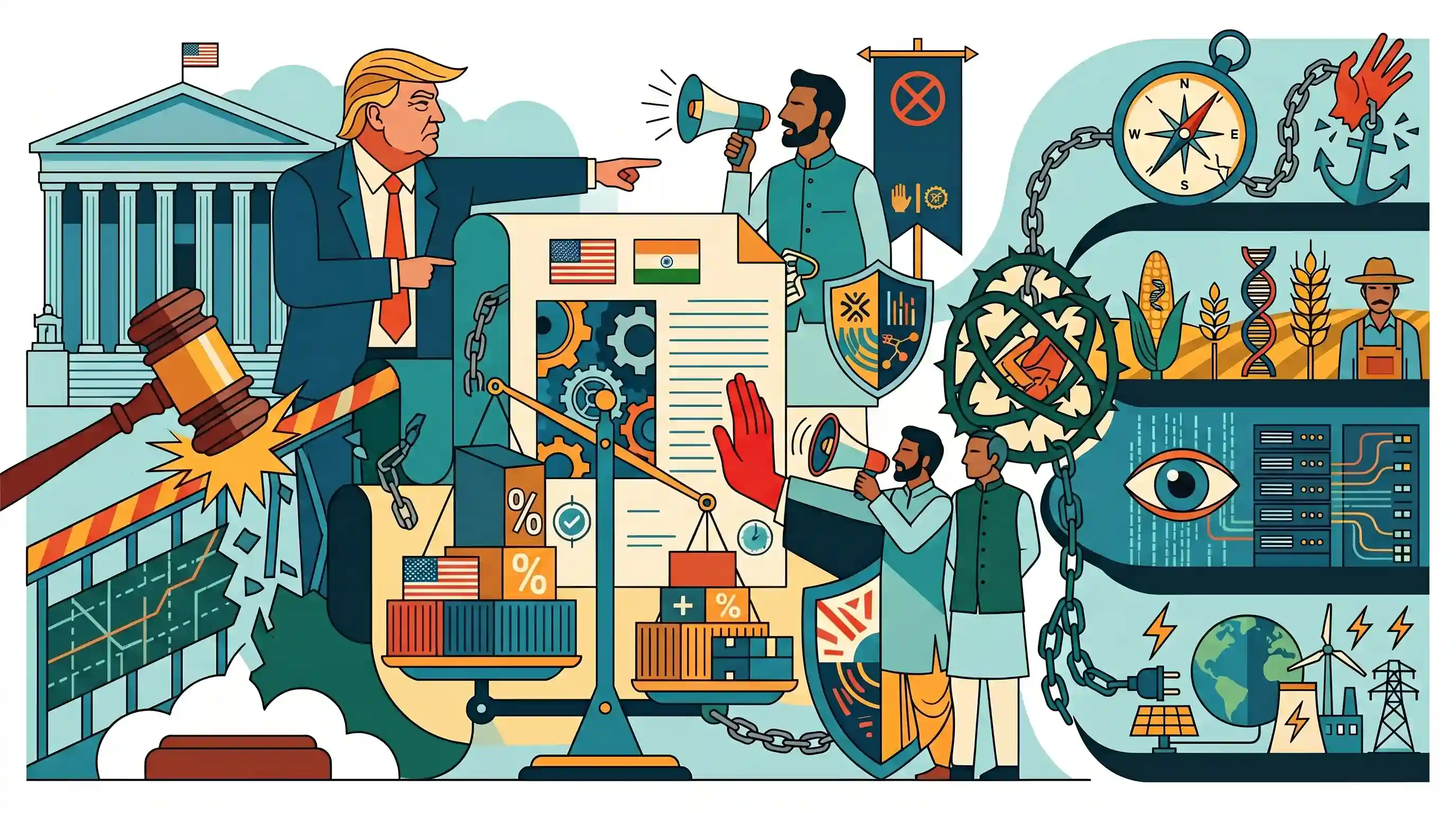
The Congress party has urged the Indian government to put the India-U.S. interim trade deal on hold following a U.S. Supreme Court ruling that struck down President Donald Trump's global tariffs. Despite the ruling, Trump intends to maintain the interim agreement with India, which retains an 18% general tariff on Indian exports and a 10% import surcharge under Section 122 of the U.S. Trade Act of 1974. Opposition leaders heavily criticized the deal, labeling it a 'trap deal' that jeopardizes India's strategic autonomy, agricultural sector (through potential GM crop imports), data sovereignty, and energy security.
Key Points
- The U.S. Supreme Court struck down President Donald Trump's global tariffs, ruling they exceeded his presidential authority.
- Despite this Supreme Court ruling, the interim trade deal with India remains in effect, retaining an 18% general tariff rate on Indian exports and a 10% temporary import surcharge.
- The Congress party urged the Modi government to pause and renegotiate the deal, characterizing it as a 'trap deal' signed out of 'desperation'.
- Opposition leaders argue the deal compromises India's strategic autonomy, energy security (by limiting diversified oil sourcing), data security, and agricultural interests through the potential import of GM crops.
Important Terms
India-U.S. Interim Trade Deal

A 2026 framework agreement reducing U.S. tariffs on Indian exports to 18% in exchange for greater market access for American agricultural products and reduced reliance on Russian energy.
UPSC context
GS Paper II (Bilateral Relations); tests understanding of trade diplomacy, 'reciprocity' in negotiations, and impacts on the domestic farm sector.
Strategic Autonomy
The capacity of a nation to make independent foreign policy and economic decisions based on national interest, without yielding to external pressure or dependency on a single power.
UPSC context
GS Paper II (International Relations); core doctrine of Indian diplomacy, especially regarding balancing relations between the U.S. and Russia.
Trade Act of 1974 (U.S.)
A U.S. law, particularly Section 122, granting the President temporary authority (150 days) to impose import surcharges up to 15% to address balance-of-payments emergencies.
UPSC context
GS Paper II (Effect of policies of developed countries on India); tests knowledge of foreign legal instruments affecting Indian exports.
International Emergency Economic Powers Act (IEEPA)
A 1977 law allowing the U.S. President to regulate commerce during national emergencies; recently limited by the U.S. Supreme Court regarding its use for trade protectionism.
UPSC context
GS Paper II (International Relations); relevant for understanding how domestic laws of partner nations create geopolitical and trade volatility for India.
Protectionism
Economic policy of restricting imports from other countries through methods such as tariffs on imported goods, restrictive quotas, and a variety of other government regulations.
UPSC context
GS Paper III (Indian Economy); focuses on the global trend of 'deglobalization' and its impact on India's export-oriented growth.
WTO (World Trade Organization)
The global international organization dealing with the rules of trade between nations; bilateral deals like the India-U.S. pact must technically align with its non-discrimination principles.
UPSC context
GS Paper III (Issues related to subsidies and trade); tests understanding of multilateral vs. bilateral trade frameworks.
Prelims Trap
Interim trade agreements (Early Harvest Schemes) automatically receive WTO MFN waivers like full FTAs.
Under GATT Article XXIV, only comprehensive FTAs/Customs Unions covering 'substantially all trade' are exempt from the MFN principle. Prolonged interim deals risk WTO violations.
Static Concepts Connected
What differentiates an Early Harvest Scheme from a full FTA?
- Limited Scope: Focuses on targeted tariff reductions for a narrow list of goods and services as a trust-building precursor to comprehensive talks.
- WTO MFN Exception: GATT Article XXIV requires FTAs to cover "substantially all trade" to qualify for MFN exceptions, making prolonged interim deals legally vulnerable at the WTO.
How are GM crop imports legally regulated in India?
- Apex Authority: The Genetic Engineering Appraisal Committee (GEAC) under the Environment Protection Act, 1986 must approve the environmental release and import of any genetically engineered organism.
- Human Consumption: The Food Safety and Standards Authority of India (FSSAI) governs the safety and clearance of imported GM food items intended for direct human consumption.
Cross-Topic Patterns
Data Sovereignty vs. Free Trade FTAs
FTAs increasingly push for free cross-border data flows. India opposes these clauses to protect domestic digital sovereignty and ensure localized data access for law enforcement.
Energy Security & Trade Deal Coercion
Western trade deals often subtly restrict India's ability to procure discounted oil from sanctioned nations (like Russia/Iran), directly conflicting with India's strategic autonomy doctrine.

Expect a 2026 prelims multi-statement question contrasting Early Harvest Schemes with CEPAs, linked to US/UK bilateral trade negotiations.
Linked PYQs · 3
Linked PYQs · 3
- 2012MainsGS2
Discuss the likely negative impact of the protectionist measures proposed by the US on India's software industry.
- 2023MainsGS3
What are the direct and indirect subsidies provided to farm sector in India? Discuss the issues raised by the World Trade Organization (WTO) in relation to agricultural subsidies.
- 2020PrelimsGS1
With reference to Trade-Related Investment Measures (TRIMS), which of the following statements is/are correct? 1. Quantitative restrictions on imports by foreign investors are prohibited. 2. They apply to investment measures related to trade in both goods and services. 3. They are not concerned with the regulation of foreign investment. Select the correct answer using the code given below:
