LPG price hike and PMUY subsidy reduction impact on inflation
Source:The Hindu ↗
Why It Matters
This issue provides a practical case study of how geopolitical conflicts (West Asia crisis) and strategic supply choke points (Strait of Hormuz) directly impact domestic retail inflation, energy security, and the viability of poverty alleviation schemes like PMUY. It is highly relevant for GS-3 (Energy, Economy) and GS-2 (Vulnerable Sections, Government Policies).
Summary
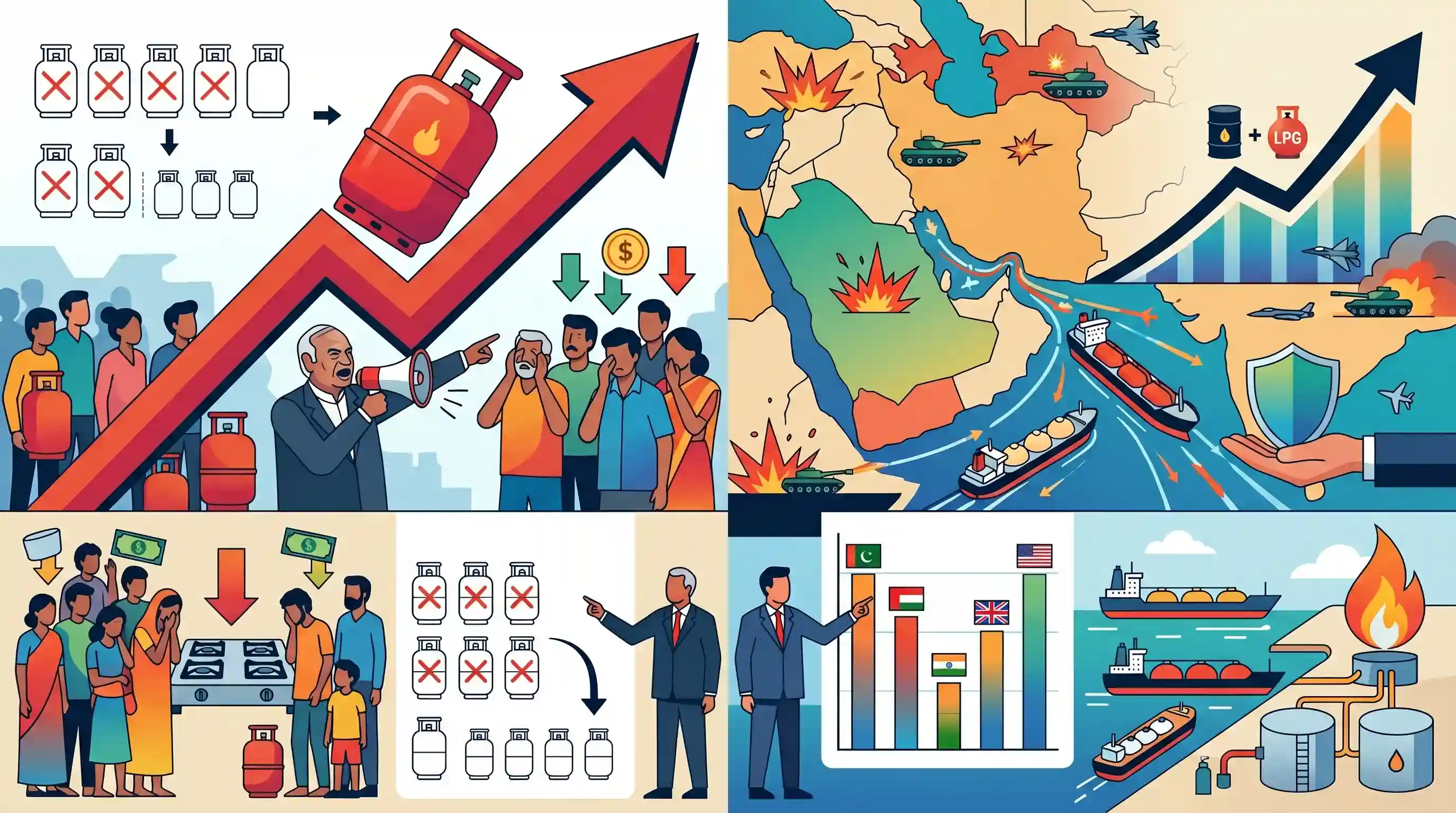
The Indian government faces opposition backlash after hiking the domestic LPG cylinder price to ₹942 in Delhi. The Congress party, led by Mallikarjun Kharge, accused the government of profiteering, highlighting that millions of Pradhan Mantri Ujjwala Yojana (PMUY) beneficiaries are unable to afford refills. The subsidy for PMUY has also been reduced from nine to four refills annually. In its defense, the government cited a 46% surge in the Saudi Contract Price—the global LPG benchmark—driven by the ongoing West Asia conflict and supply tightening through the strategic Strait of Hormuz. The government noted that domestic prices remain lower than those in many neighboring and developed nations, and emphasized its success in maintaining uninterrupted energy shipments despite geopolitical turbulence.
Key Points
- The price of a 14.2-kg domestic LPG cylinder in Delhi has been hiked to ₹942, marking a cumulative increase of ₹89 over the past four months.
- Subsidies under the Pradhan Mantri Ujjwala Yojana (PMUY) have been reduced to cover only the first four refills annually (down from nine), keeping the effective price for beneficiaries at ₹642.
- Congress President Mallikarjun Kharge criticized the hike, pointing out that over 3.3 crore Ujjwala families could not afford a single refill in 2025-26, and questioned the government\'s claims of fuel source diversification.
- The government attributed the price rise to a 46% spike in the Saudi Contract Price (CP), caused by supply constraints through the Strait of Hormuz following the outbreak of war in West Asia.
- Despite global market volatility and supply chain disruptions, India successfully maintained uninterrupted energy shipments through the Strait of Hormuz and kept domestic prices relatively lower than neighboring and advanced economies.
Important Terms
Pradhan Mantri Ujjwala Yojana (PMUY)

Launched in 2016, this flagship scheme provides deposit-free LPG connections to women from below-poverty-line (BPL) households to promote clean cooking fuel and reduce indoor air pollution.
UPSC context
GS-II (Welfare Schemes) and GS-III (Energy Security); tests impact of social policies on public health and gender empowerment.
Saudi Contract Price (SCP)
The international benchmark price for LPG set monthly by Saudi Aramco; it serves as the primary reference for determining the domestic landed cost of LPG in India.
UPSC context
GS-III (Indian Economy); relates to fuel pricing mechanisms, import parity, and India’s vulnerability to global commodity price volatility.
Strait of Hormuz
A strategic maritime chokepoint between the Persian Gulf and the Gulf of Oman through which approximately 20% of the world’s oil and 35% of liquefied natural gas (LNG) pass.
UPSC context
GS-I (World Geography) and GS-II (International Relations); critical for understanding global energy supply chains and West Asian geopolitics.
Energy Security
The uninterrupted availability of energy sources at an affordable price, ensuring that a nation’s economic growth and social welfare are protected from supply disruptions or price shocks.
UPSC context
GS-III (Infrastructure and Security); evaluates India’s strategies for diversification, strategic reserves, and self-reliance (Atmanirbhar Bharat) in energy.
Oil Marketing Companies (OMCs)
Public sector enterprises (e.g., IOCL, BPCL, HPCL) responsible for the refining, marketing, and distribution of petroleum products and LPG throughout the country.
UPSC context
GS-III (Economy/Infrastructure); tests the role of PSUs in fuel price regulation and the implementation of government subsidies.
Prelims Trap
Domestic LPG retail pricing in India is directly indexed to the Brent Crude global benchmark.
LPG prices are primarily linked to the Saudi Contract Price (CP)—a specific international benchmark for a propane-butane blend—not the general crude oil benchmark.
Static Concepts Connected
What is the strategic significance of the Strait of Hormuz for India's energy security?
- Geographic Location: Connects the Persian Gulf to the Gulf of Oman and Arabian Sea, bordered by Iran, Oman, and the United Arab Emirates.
- Global Chokepoint: Serves as the transit route for a massive share of global petroleum and LNG/LPG shipments, making it a highly sensitive geopolitical chokepoint.
- Inflation Link: Supply disruptions here immediately spike international benchmarks like the Saudi CP, leading to imported inflation and higher subsidy burdens in India.
What are the core mechanisms and objectives of the Pradhan Mantri Ujjwala Yojana (PMUY)?
- Target Beneficiaries: Provides deposit-free LPG connections explicitly in the name of adult women from Below Poverty Line (BPL) and other marginalized households.
- Health & Environment: Designed to reduce severe indoor air pollution and respiratory diseases caused by the traditional burning of polluting biomass fuels.
- Subsidy Delivery: Utilizes Direct Benefit Transfer (DBT) to route refill subsidies directly into beneficiaries' bank accounts, thereby plugging leakages and diversion.
Cross-Topic Patterns
Imported inflation via maritime chokepoints
Middle East conflicts blocking the Strait of Hormuz translate directly into India's fiscal deficit through higher OMC under-recoveries and welfare subsidy burdens.
Subsidy cuts vs. Behavioral shifts
Reducing PMUY subsidies to 4 refills annually risks pushing BPL families back to polluting biomass, undermining the scheme's core health and environmental objectives.

Expect a 2026 multi-statement Q linking West Asian chokepoints (Hormuz) directly to domestic inflation and welfare subsidy (PMUY) burdens.
Linked PYQs · 4
Linked PYQs · 4
- 2018MainsGS3
“Access to affordable, reliable, sustainable and modern energy is the sine qua non to achieve Sustainable Development Goals (SDGs).” Comment on the progress made in India in this regard.
- 2022MainsGS2
Besides the welfare schemes, India needs deft management of inflation and unemployment to serve the poor and the underprivileged sections of the society. Discuss.
- 2024PrelimsGS1
Consider the following statements : Statement-I : Sumed pipeline is a strategic route for Persian Gulf oil and natural gas shipments to Europe. Statement-II : Sumed pipeline connects the Red Sea with the Mediterranean Sea. Which one of the following is correct in respect of the above statements?
- 2020PrelimsGS1
Consider the following statements: 1. The weightage of food in Consumer Price Index (CPI) is higher than that in Wholesale Price Index (WPI). 2. The WPI does not capture changes in the prices of services, which CPI does. 3. Reserve Bank of India has now adopted WPI as its key measure of inflation and to decide on changing the key policy rates. Which of the statements given above is/are correct?
