MVA Consensus on Sharad Pawar for Rajya Sabha Polls
Source:Indian Express ↗
Why It Matters
Rajya Sabha elections are frequently tested in UPSC due to their unique features: the single transferable vote (STV) system, proportional representation, the open ballot requirement, and nuances around the Anti-Defection Law (cross-voting in RS polls doesn't automatically trigger disqualification under the 10th Schedule). The article also serves as a prime case study of coalition politics and the interplay between national and regional parties.
Summary
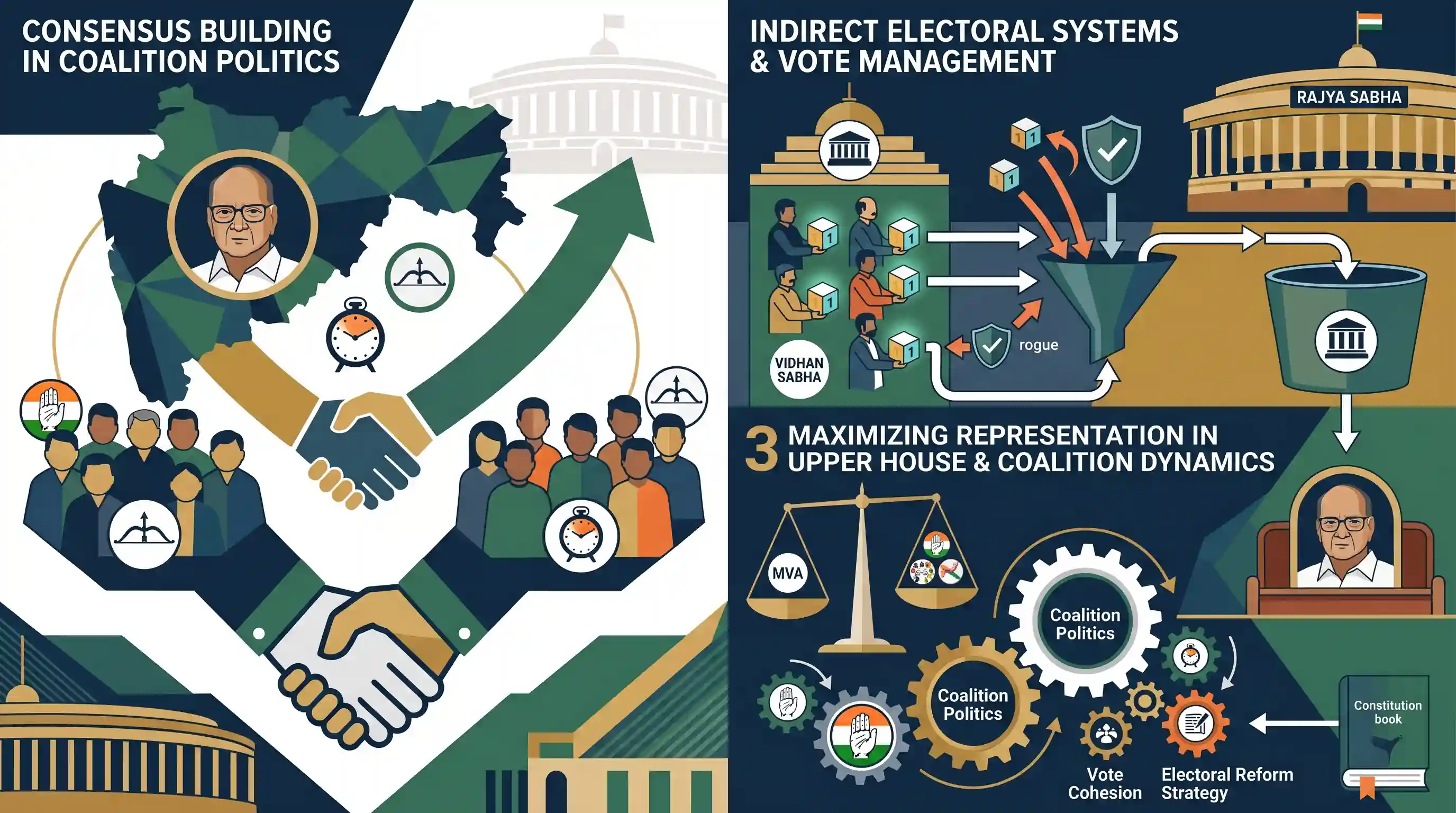
The Congress party and its allies in the Maha Vikas Aghadi (MVA) coalition have reached a consensus to rally behind NCP (Sharadchandra Pawar) leader Sharad Pawar for the upcoming Rajya Sabha elections in Maharashtra. This coordinated strategy is designed to pool their Members of Legislative Assembly (MLAs) votes effectively, preventing potential cross-voting and maximizing their representation in the Upper House. The move underscores the critical role of coalition dynamics and vote management in India's indirect elections.
Key Points
- The Maha Vikas Aghadi (MVA) coalition has achieved consensus regarding candidate backing for the upcoming Rajya Sabha elections in Maharashtra.
- The Congress has strategically chosen to rally behind regional stalwart Sharad Pawar to ensure cohesive voting.
- This alignment aims to pool MLA votes effectively under the proportional representation by means of a single transferable vote (STV) system used for the Upper House.
- The consensus acts as a safeguard against potential cross-voting, highlighting the complex internal negotiations required in modern coalition politics.
Important Terms
Tenth Schedule (Anti-Defection Law)

Constitutional provisions (52nd Amendment, 1985) for disqualifying MPs/MLAs on grounds of defection, such as voluntarily leaving a party or defying a whip. It aims to ensure government stability.
UPSC context
GS Paper II: Parliament and State Legislatures. Tests knowledge of constitutional stability, party discipline, and the Speaker's powers.
Representation of the People Act, 1951
A statutory law providing the framework for the conduct of elections, qualifications and disqualifications of candidates, corrupt practices, and election disputes in India.
UPSC context
GS Paper II: Salient features of RPA. Essential for understanding electoral eligibility, disqualification (Section 8), and transparency.
Maha Vikas Aghadi (MVA)
A Maharashtra-based political alliance formed in 2019, primarily comprising the Indian National Congress, Shiv Sena (UBT), and the Nationalist Congress Party (Sharadchandra Pawar).
UPSC context
GS Paper II: Indian Constitution—Coalition Politics. Tests understanding of regional alliances and executive-legislative dynamics in states.
Nationalist Congress Party (Sharadchandra Pawar)
A political faction led by Sharad Pawar, recognized by the Election Commission after the 2023 NCP split, using the 'man blowing turha' (trumpet) symbol.
UPSC context
GS Paper II: Political Parties. Relevant for understanding the 'test of majority' and Election Symbols Order, 1968.
Shiv Sena (UBT)
The faction of the Shiv Sena led by Uddhav Thackeray, formed after the 2022 split, and allotted the 'flaming torch' symbol by the Election Commission.
UPSC context
GS Paper II: Governance. Examines party splits, the role of the Election Commission, and judicial review of factional disputes.
Prelims Trap
MLAs cross-voting in Rajya Sabha elections face immediate disqualification under the Tenth Schedule.
Cross-voting in Rajya Sabha polls does not attract disqualification under the Anti-Defection Law (Kuldip Nayar case, 2006). Moreover, parties cannot issue binding whips for these elections.
Static Concepts Connected
What is the electoral system for Rajya Sabha members?
- System used: Proportional representation by means of a single transferable vote (STV).
- Electorate: Only elected members of State Legislative Assemblies (MLAs) can vote; nominated members cannot.
- Ballot type: Open ballot system, introduced via a 2003 RPA amendment, requiring MLAs to show marked ballots to a party agent.
How does the Anti-Defection Law apply to Rajya Sabha elections?
- No disqualification: Cross-voting in RS polls does not invite disqualification under the Tenth Schedule (Kuldip Nayar case).
- Whips prohibited: The Election Commission has explicitly ruled that political parties cannot issue binding whips for Rajya Sabha elections.
Cross-Topic Patterns
Rajya Sabha vs Presidential Elections
While both use proportional representation via STV, Presidential polls mandate a strict secret ballot, whereas Rajya Sabha elections require an open ballot to prevent horse-trading.
Tenth Schedule nuances
The inapplicability of anti-defection to RS cross-voting is frequently tested alongside the rule allowing nominated RS members to join a party only within six months of taking their seat.

Expect a multi-statement question contrasting open ballots, whip applicability, and Anti-Defection rules in Rajya Sabha vs Presidential polls.
Linked PYQs · 3
Linked PYQs · 3
- 2022MainsGS2
“While the national political parties in India favour centralisation, the regional parties are in favour of State autonomy.” Comment.
- 2014PrelimsGS1
Which one of the following Schedules of the Constitution of India contains provisions regarding anti-defection?
- 2022PrelimsGS1
With reference to anti-defection law in India, consider the following statements: 1. The law specifies that a nominated legislator cannot join any political party within six months of being appointed to the House. 2. The law does not provide any time-frame within which the presiding officer has to decide a defection case. Which of the statements given above is/are correct?
