Opposition questions absorption of Agniveers in private security
Source:The Hindu ↗
Why It Matters
The Agnipath scheme and the subsequent employment of 'Agniveers' are critical for evaluating India's human resource management within the armed forces. The issue intersects with broader governance challenges regarding youth employment, national security, and the social security net for short-service military personnel.
Summary
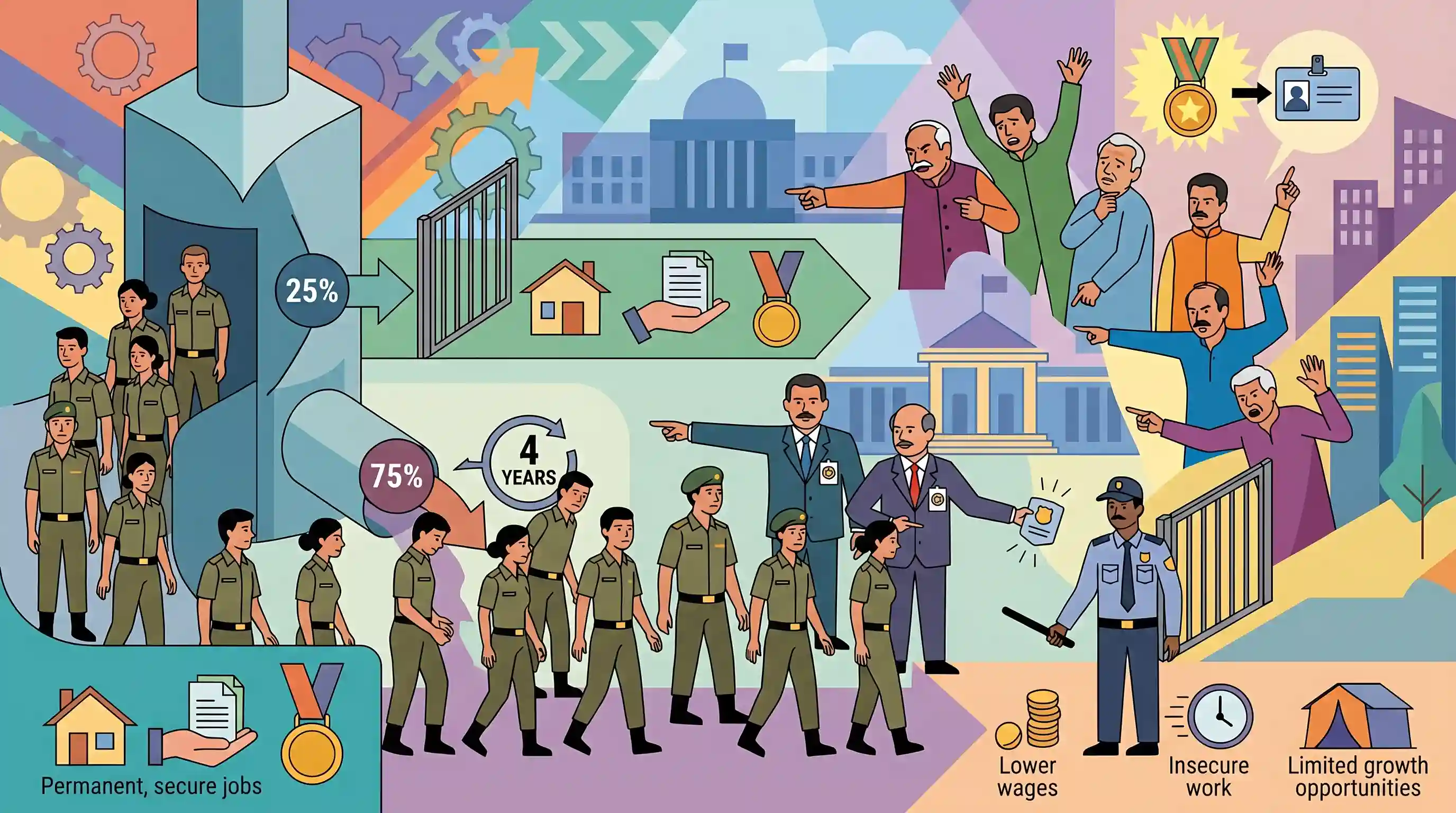
The Congress party has strongly criticized a purported plan by the Union Ministry of Home Affairs to encourage the absorption of retiring Agniveers into private security agencies. Opposition leaders labeled the proposal a 'cruel joke' and an insult to youth aspiring to join the armed forces. They highlighted the stark contrast between the government's earlier promises of pensionable jobs and the reality of low-paying, insecure employment in the private security sector. The debate casts a spotlight on the post-service welfare of recruits under the Agnipath scheme, where only 25% are retained permanently after a four-year stint.
Key Points
- The Congress party criticized a purported Union Home Ministry plan proposing the employment of retiring Agniveers in top private security firms.
- Opposition leaders, including Rahul Gandhi, termed the proposal an 'insult' to patriotic youth who aspire to serve in the armed forces.
- Critics argue that private security jobs offer low wages (₹15,000-₹18,000 per month) and lack the pension and social security benefits traditionally provided to ex-servicemen.
- The controversy reignites the debate over the short-term Agnipath military recruitment scheme, under which only 25% of personnel are permanently retained after four years.
Important Terms
Agnipath Scheme

A short-term recruitment model for the Indian Armed Forces where youth serve for four years; aimed at lowering the military's age profile and reducing pension expenditure.
UPSC context
GS Paper II/III: Government Policies & Interventions, Security Challenges and their Management. Tests understanding of defense reforms.
Agniveers
The specific rank and title given to youth recruited under the Agnipath scheme for the Indian Army, Navy, and Air Force.
UPSC context
GS Paper III: Security. Focuses on human resource management in the armed forces.
Seva Nidhi Package
A tax-free lump-sum payout (approx. ₹11.71 lakh) provided to Agniveers after four years, comprising their personal contributions matched by the government plus interest.
UPSC context
GS Paper II: Welfare Schemes for Vulnerable Sections. Tests knowledge of post-service financial security mechanisms.
Ex-Servicemen (ESM) Status
A legal designation for retired military personnel that grants access to pensions and job reservations; discharged Agniveers currently do not receive this full status.
UPSC context
GS Paper II: Governance. Central to the debate on military welfare and post-retirement rights.
Private Security Agencies (Regulation) Act (PSARA)
A 2005 Act governing the licensing and operation of private security firms; it mandates preference for individuals with military or police backgrounds.
UPSC context
GS Paper II: Statutory Bodies and Regulatory Frameworks. Relevant for internal security and corporate regulation.
Central Armed Police Forces (CAPF)
Uniformed internal security forces (e.g., BSF, CRPF) under the Ministry of Home Affairs; 10% of their vacancies are reserved for discharged Agniveers.
UPSC context
GS Paper III: Security Forces and their Mandate. Tests knowledge of internal security architecture.
Prelims Trap
Agniveers exiting after four years are entitled to regular gratuity and a fully government-funded Seva Nidhi package.
Agniveers do not receive gratuity. Additionally, the Seva Nidhi package is a contributory corpus (30% salary deduction + equal government match), not a fully government-funded grant.
Static Concepts Connected
What are the core exit benefits and rules for exiting Agniveers?
- Seva Nidhi: Exiting Agniveers receive a tax-free corpus of approx ₹11.71 lakh, formed by a 30% monthly salary deduction and matching government contribution.
- No Pension/Gratuity: The 75% of recruits who are demobilized are not entitled to traditional military pensions, gratuity, or the Ex-Servicemen Contributory Health Scheme (ECHS).
- CAPF Reservation: The Ministry of Home Affairs mandates a 10% horizontal reservation and age-limit relaxations for ex-Agniveers in CAPFs and Assam Rifles.
How is the private security sector regulated in India?
- PSARA 2005: Regulated under the Private Security Agencies (Regulation) Act (PSARA), 2005, which establishes licensing, uniform, and operational standards.
- State Controlling Authority: State governments appoint a Controlling Authority responsible for issuing licenses and ensuring strict antecedent checks of agency operators and guards.
- Mandatory Training: The Act ensures agencies provide mandatory training (including physical fitness and fire-fighting) to guards before deployment.
Cross-Topic Patterns
Defense recruitment + Demographic dividend
The transition of 75% of Agniveers back into the civilian workforce ties into India’s broader demographic dividend challenges, specifically linking defense policy to the National Skills Qualifications Framework (NSQF).
Agnipath + CAPF modernization
The mandated 10% horizontal reservation for Agniveers in CAPFs alters the recruitment pipeline, bridging external defense human resources with internal border-guarding and law enforcement forces.

Expect a 2026 Prelims question testing the exact funding mechanics of Seva Nidhi and the nuances of CAPF horizontal reservations.
Linked PYQs · 3
Linked PYQs · 3
- 2023MainsGS2
Skill development programmes have succeeded in increasing human resources supply to various sectors. In the context of the statement analyse the linkages between education, skill and employment.
- 2021MainsGS2
“Earn while you learn' scheme needs to be strengthened to make vocational education and skill training meaningful.” Comment.
- 2024PrelimsGS1
Operations undertaken by the Army towards upliftment of the local population in remote areas to include addressing of their basic needs is called:
