Congress Demands Probe into Ujjain Land Deals in Madhya Pradesh
Source:The Hindu ↗
Why It Matters
This development touches upon essential MPPSC GS paper topics including executive accountability, the role of the Leader of the Opposition, anti-corruption statutory institutions (like the MP Lokayukta), and regional geographical/cultural landmarks in Madhya Pradesh (Ujjain).
Summary
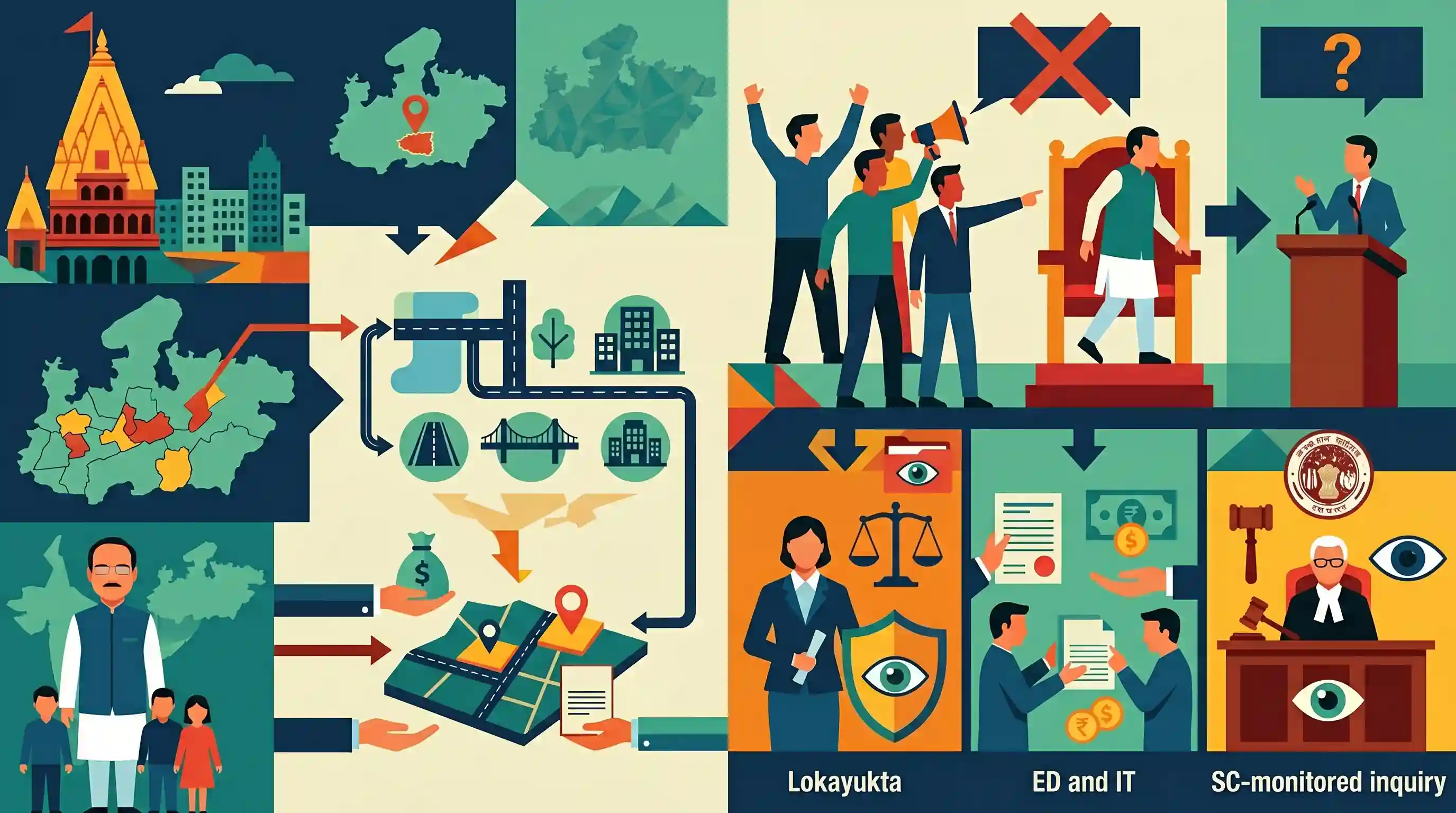
The Congress party has raised allegations of speculative land deals involving Madhya Pradesh Chief Minister Mohan Yadav's family in Ujjain where infrastructure development was planned. Congress leaders have demanded his resignation or a public explanation, calling for investigations by the state Lokayukta, the Enforcement Directorate (ED), and the Income Tax Department, alongside a Supreme Court-monitored judicial inquiry.
Key Points
- The Indian National Congress has accused Madhya Pradesh Chief Minister Mohan Yadav's family and associates of making large-scale, speculative land purchases in Ujjain areas slated for upcoming infrastructure and development projects.
- Former MLA Praveen Pathak alleged that the timing of these deals points to the potential misuse of official power and prior knowledge of government planning for private financial gain.
- The Congress party has demanded a public explanation or the resignation of the Chief Minister, alongside a judicial inquiry supervised by a retired Supreme Court judge, and investigations by the ED, IT Department, and the MP Lokayukta.
- State-level Congress leaders, including MP Congress President Jitu Patwari and Leader of the Opposition Umang Singhar, plan to raise the issue during the Assembly session beginning on July 20, 2026, and organize a protest in Bhopal on July 15, 2026.
Important Terms
Enforcement Directorate (ED)

A premier economic law enforcement and financial intelligence agency under the Department of Revenue, Ministry of Finance, responsible for investigating money laundering and foreign exchange violations.
UPSC context
GS Paper 2 (Statutory/Regulatory Bodies) and GS Paper 3 (Money Laundering); tests institutional mandates and economic enforcement.
Lokayukta of Madhya Pradesh
The statutory anti-corruption ombudsman of Madhya Pradesh, established to investigate allegations of corruption, maladministration, and abuse of power against ministers and other state public functionaries.
UPSC context
GS Paper 2 (Anti-Corruption and Governance); tests the function, appointment, and limitations of state-level ombudsmen in public accountability.
Madhya Pradesh Lokayukta and Up-Lokayukta Act, 1981
The state law that created the independent Lokayukta organization in Madhya Pradesh, replacing the State Vigilance Commission with a statutory body free from executive influence.
UPSC context
GS Paper 2 (State Legislature and Accountability); tests statutory anti-corruption frameworks and legislative oversight of the executive.
Income Tax Department
A government agency under the Department of Revenue, Ministry of Finance, controlled by the CBDT, that administers direct tax legislation and levies direct taxes in India.
UPSC context
GS Paper 3 (Indian Economy and Taxation); tests administrative structures for direct tax enforcement and mechanisms to prevent tax evasion.
Prelims Trap
In the absence of the Chief Minister, the senior-most cabinet minister automatically presides over the meetings of the State Council of Ministers.
Under Rules of Business, the CM must explicitly nominate a minister to preside in their absence; seniority does not grant automatic presiding authority.
Static Concepts Connected
Who presides over the State Cabinet in the Chief Minister's absence?
- Explicit Nomination: The Chief Minister must specifically designate a minister to preside over the Council of Ministers' meetings in their absence.
- No Automatic Seniority: Seniority or holding portfolios like Home Affairs does not automatically confer the right to preside without explicit CM authorization.
- Rules of Business: These procedures are governed by the state's Rules of Business framed under Article 166(3) of the Constitution.
What is the appointment mechanism for a State Lokayukta?
- Gubernatorial Warrant: The Lokayukta is appointed by the Governor of the State by warrant under his hand and seal.
- Consultation Committee: The selection process typically involves formal consultation with the Chief Justice of the High Court and the Leader of the Opposition.
- Statutory Origin: Lokayuktas are statutory authorities created by respective state legislations, meaning powers and jurisdictions vary significantly across India.
Cross-Topic Patterns
Temple Iconography + Hydro-geography
UPSC blends cultural landmarks with river systems. The unique south-facing Mahakaleshwar Jyotirlinga on the Shipra River highlights how physical geography dictates regional sacred architecture.
Executive Accountability + Federal Variation
While the Lokpal covers the Prime Minister with caveats, the jurisdiction of state Lokayuktas over sitting Chief Ministers varies widely, serving as a key study in asymmetric federal accountability.

State executive business rules (Art 166) and Lokayukta appointment dynamics are prime targets for multi-statement polity questions in 2026.
Linked PYQs · 4
Linked PYQs · 4
- 2020MPPSC_PRELIMSGS1
Which of the following Chief Minister of Madhya Pradesh have not held the office of the leader of the opposition in Madhya Pradesh Legislative Assembly? 1. Digvijay Singh 2. Motilal Vora 3. Virendra Kumar Sakhlecha 4. Shyamcharan Shukla
- 2020MPPSC_PRELIMSGS1
In Which city of Madhya Pradesh, the Parikrama of 7 Sea, 9 Narayanas and 84 Mahadevas completed?
- 2013MPPSC_PRELIMSGS1
On which riverside the temple 'Mahakaal' in ujjan is situated?
- 2021MPPSC_PRELIMSGS1
Who is included in the Committee to recommend name for the appointment of Chairperson and Members of State Human Rights Commission?
