Historical Economic Growth Rates and Infrastructure Expansion
Source:The Hindu ↗
Why It Matters
The article brings up the historical economic concept of the 'Hindu rate of growth', contrasting it with India's current infrastructural and digital transformation. It is highly relevant for GS3 questions on economic growth paradigms, digitalization, and infrastructure development, as well as GS2 questions regarding the impact of political stability and executive leadership on long-term governance.
Summary
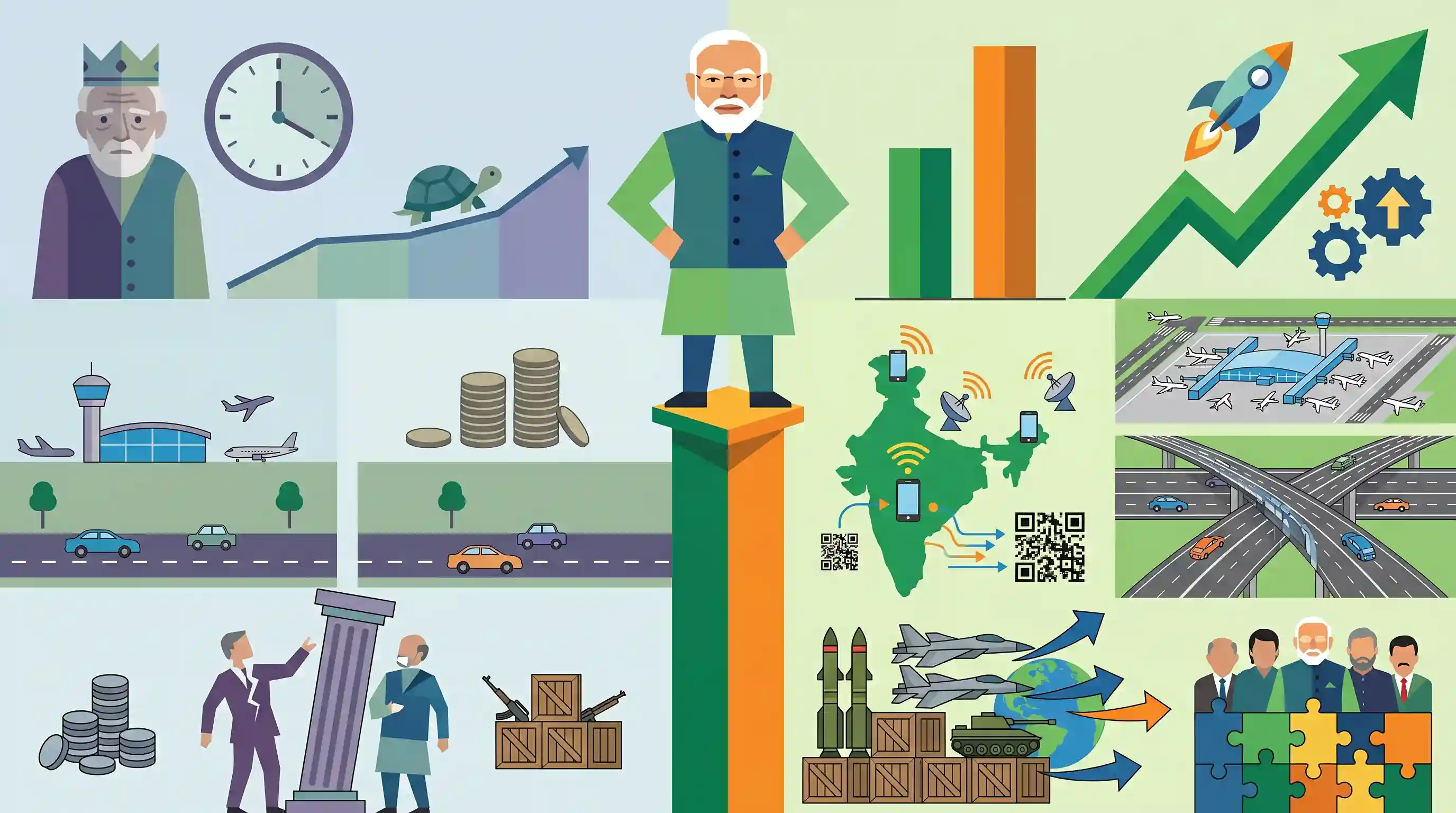
Prime Minister Narendra Modi recently set a milestone as India's longest continuously serving elected Prime Minister, surpassing Jawaharlal Nehru’s record of 4,398 days in office. Speaking at the 25th anniversary of the National Democratic Alliance (NDA), he criticized the Congress party for the country's historically sluggish economic growth. He argued that the term 'Hindu rate of growth'—coined by economist Raj Krishna to describe the slow growth era—should instead be called the 'Congress growth rate.' Modi contrasted this history with his administration's achievements over the past 12 years, highlighting significant strides in physical and digital infrastructure. He cited the doubling of operational airports (from 74 to 157), a vast expansion of expressways, India's global leadership in digital transactions, and a 12-fold increase in defense exports. Furthermore, he credited political stability and decisive governance under the NDA coalition as the key drivers behind India's rapid modernization and long-term policy execution.
Key Points
- PM Modi has become the longest continuously serving elected Prime Minister of India, surpassing Jawaharlal Nehru's record of 4,398 days.
- He criticized past Congress governments for India's sluggish historical economic growth, asserting that what economists called the 'Hindu Growth Rate' should be termed the 'Congress Growth Rate'.
- Highlighted rapid infrastructure development over the last 12 years, including the doubling of operational airports from 74 to 157 and the vast expansion of the expressway network.
- Showcased India's transition to a digital economy, driven by the massive adoption of digital transactions and digital public infrastructure.
- Noted a significant 12-fold surge in India's defense exports compared to earlier regimes.
- Emphasized that political stability and cohesive coalition management (NDA) have been fundamental to delivering decisive governance and modernization.
Important Terms
Hindu rate of growth

An economic term describing India's persistently low annual GDP growth rate (approx. 3.5%–4%) between the 1950s and 1980s, before liberalisation.
UPSC context
GS-III Indian Economy; tests knowledge of pre-1991 economic stagnation and impact of socialist policies like the License Raj.
Raj Krishna
The Indian economist who coined the term "Hindu rate of growth" in 1978 to critique stagnation under central planning and heavy state control.
UPSC context
GS-III Indian Economy; identifies key economic thinkers and their critiques of India's historical developmental models.
National Democratic Alliance (NDA)
A center-right political coalition in India formed in 1998, led by the Bharatiya Janata Party (BJP), currently governing at the Union level.
UPSC context
GS-II Polity; tests understanding of coalition dynamics, executive functioning, and the evolution of multi-party alliances in India.
Digital Public Infrastructure (DPI)
Open, interoperable digital systems (like Aadhaar, UPI, and DigiLocker) that function as public goods to drive inclusive growth and service delivery.
UPSC context
GS-III Economy and Science & Tech; tests digital inclusion, e-governance, and India's global leadership in digital transactions.
Defense Exports
The sale of indigenous military technology and hardware abroad, a key pillar of India's "Atmanirbhar Bharat" (Self-Reliant India) initiative.
UPSC context
GS-III Security/Economy; tests progress in indigenous manufacturing, strategic autonomy, and reduction of defense import dependence.
License-Permit-Quota Raj
A restrictive system of industrial licensing and red tape (1947–1990) that hindered private enterprise and contributed to slow economic growth.
UPSC context
GS-III Indian Economy; essential for discussing the structural bottlenecks that necessitated the 1991 LPG reforms.
Prelims Trap
'Hindu rate of growth' indicates a period of high population growth among the majority community in post-independence India.
It is an economic term coined by Raj Krishna in 1978 denoting the stagnant 3.5% GDP growth rate of India from the 1950s to 1980s, entirely unrelated to demographic or population trends.
Static Concepts Connected
What is the 'Hindu Rate of Growth'?
- Definition: Refers to the low, stagnant annual GDP growth rate (averaging 3.5%) in India from the 1950s to the 1980s.
- Origin: Coined by Indian economist Raj Krishna in 1978 to describe this persistent economic stagnation.
- Cause: Attributed to inward-looking, socialist-inspired economic policies, the license raj, and high state intervention prior to the 1991 reforms.
Constitutional provisions regarding the Prime Minister's term
- No fixed tenure: The Constitution does not fix the PM's tenure; they hold office during the pleasure of the President under Article 75(2).
- Majority support: The PM remains in office as long as they command the confidence of the majority in the Lok Sabha.
Cross-Topic Patterns
DPI + Formalization of Economy
Digital Public Infrastructure is frequently linked with the rapid formalization of MSMEs and an increased tax base, evolving beyond mere financial inclusion into a core macroeconomic driver.
Defense Exports + Import Substitution
The surge in defense exports connects GS3 Security (indigenization, negative import lists) with GS3 Economy by reducing forex outflow and improving the Current Account Deficit.

A 2026 Prelims question will likely pair the historical 'Hindu rate of growth' definition with recent macroeconomic shifts driven by DPI.
Linked PYQs · 3
Linked PYQs · 3
- 2023MainsGS3
What is the status of digitalization in the Indian economy? Examine the problems faced in this regard and suggest improvements.
- 2024MainsGS2
“The growth of cabinet system has practically resulted in the marginalisation of the parliamentary supremacy.” Elucidate.
- 2022MainsGS3
Is inclusive growth possible under market economy ? State the significance of financial inclusion in achieving economic growth in India.
