VBSA Bill Proposal and Higher Education Regulatory Reforms
Source:The Hindu ↗
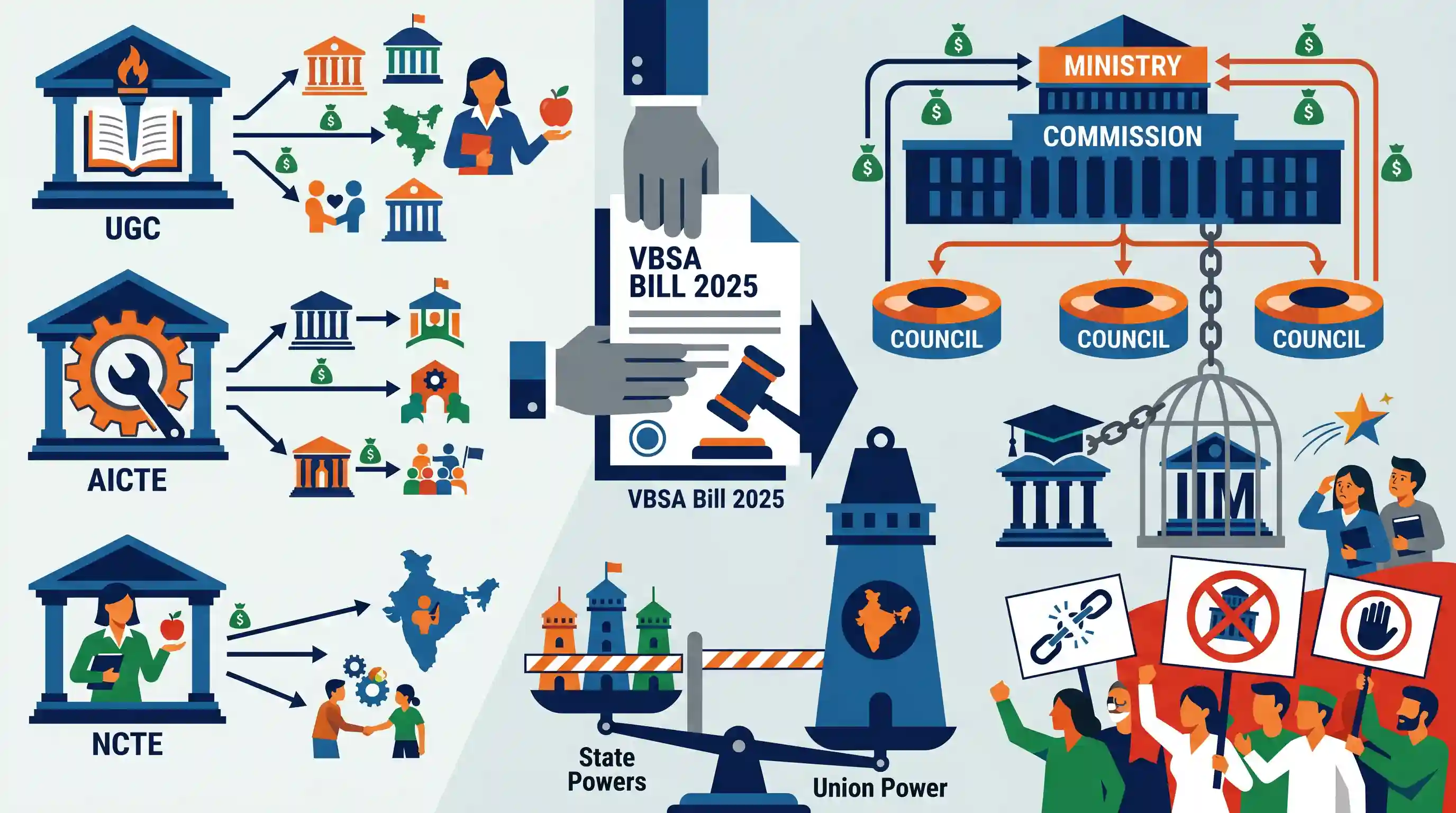
Why It Matters
The restructuring of higher education regulation is a crucial governance reform aligned with the National Education Policy. For UPSC candidates, analyzing the VBSA Bill provides insight into the tension between centralized standardization (Entry 66 of Union List) and federal principles, as well as the ongoing debate over the autonomy of higher education institutions in India.
Summary
The Congress party has voiced strong opposition to the proposed Viksit Bharat Shiksha Adhishthan (VBSA) Bill, 2025, which aims to replace prominent higher education regulatory bodies—UGC, AICTE, and NCTE—with a single overarching Commission and three distinct Councils. Critics argue that the Bill threatens the autonomy of premier institutions like IITs and IIMs by increasing bureaucratic control and consolidating grant-giving powers within the Ministry of Education. Additionally, concerns have been raised about the potential dilution of federalism, as the legislation is perceived as an encroachment on State powers in higher education.
Key Points
- The VBSA Bill, 2025, proposes establishing a unified 12-member Commission alongside Regulatory, Accreditation, and Standards Councils to replace the UGC, AICTE, and NCTE.
- Congress opposes the Bill, asserting that it bureaucratizes higher education by granting executive control to Member Secretaries rather than academics.
- Concerns have been raised regarding the potential shift of grant-giving powers to the Education Ministry, although the Ministry claims a UGC-like funding mechanism will be maintained.
- The proposed overarching regulatory framework is seen as a threat to the academic and operational autonomy of institutes of national importance such as IITs, IIMs, and NITs.
- Critics argue the Bill encroaches on State powers, raising issues related to federalism and Entry 66 of the Union List (Coordination and determination of standards in higher education).
Important Terms
Viksit Bharat Shiksha Adhishthan (VBSA) Bill, 2025

Proposed legislation to create a single higher education regulator in India, replacing UGC, AICTE, and NCTE. It aims to implement NEP 2020 by separating regulation, accreditation, and standard-setting from funding.
UPSC context
GS Paper II/Social Justice: Key legislative reform in higher education; tests understanding of regulatory bodies and government interventions.
University Grants Commission (UGC)
The existing statutory body (1956) responsible for coordinating, determining, and maintaining standards of higher education and providing grants to universities. The VBSA Bill proposes to repeal its governing Act.
UPSC context
GS Paper II/Regulatory Bodies: Current university regulator; central to debates on institutional autonomy and governance reforms.
All India Council for Technical Education (AICTE)
A statutory body (1987) that plans, formulates, and maintains norms and standards for technical and management education. It is one of the three major regulators slated for replacement by VBSA.
UPSC context
GS Paper II/Education: Technical education regulator; its subsumption reflects the move towards a unified regulatory architecture.
National Council for Teacher Education (NCTE)
The statutory body (1993) responsible for the planned and coordinated development of the teacher education system. The VBSA Bill seeks to bring standalone teacher training under unified accreditation.
UPSC context
GS Paper II/Issues relating to Education: Teacher training regulator; its overhaul impacts standards for professional educational qualifications.
National Education Policy (NEP) 2020
A comprehensive framework to transform India's education system, recommending a "light but tight" regulatory structure and a single overarching regulator for higher education to replace the current fragmented system.
UPSC context
GS Paper II/Government Policies: The foundational policy driving current legislative reforms in the education sector.
Joint Parliamentary Committee (JPC)
An ad-hoc committee of Parliament members from both Houses, formed to examine specific bills in detail. The VBSA Bill was referred here following opposition concerns over centralisation.
UPSC context
GS Paper II/Parliamentary Committees: A crucial mechanism for legislative scrutiny of complex or contested policies.
Entry 66 (Union List)
A constitutional provision in the Seventh Schedule giving the Union exclusive power to coordinate and determine standards in institutions for higher education, research, and scientific and technical institutions.
UPSC context
GS Paper II/Federalism: The constitutional basis for Union authority in higher education; tests understanding of legislative competence.
Prelims Trap
The VBSA serves as the sole regulatory and grant-distributing body for all higher education disciplines.
The Bill explicitly exempts medical and legal education. Furthermore, it completely strips the new body of grant-giving powers, transferring financial control directly to the Ministry.
Static Concepts Connected
How is legislative power over 'Education' divided under the Seventh Schedule?
- Concurrent List: Entry 25 places general education, including technical and medical universities, under joint Centre-State jurisdiction.
- Union List: Entry 66 grants the Centre exclusive legislative power for the "coordination and determination of standards" in higher education.
- Union Supremacy: Under Article 254, central laws enacted via Entry 66 prevail over conflicting State laws regarding higher education standards.
What defines a Statutory Body's functional autonomy in India?
- Legislative Mandate: Created by an Act of Parliament (like the UGC Act 1956), its powers and structural independence are codified, protecting it from executive whims.
- Financial Independence: Autonomy is considered highest when bodies retain their own financial disbursal powers, rather than acting purely as regulators while a Ministry controls grants.
Cross-Topic Patterns
Centralization in Concurrent Subjects
The VBSA debate mirrors past controversies over cooperatives and agriculture, where the Centre uses specific Union List entries to bypass State jurisdiction in Concurrent List domains.
NEP 2020 Institutional Architecture
This Bill is the legislative realization of the NEP 2020 mandate, which proposed the Higher Education Commission of India (HECI) to dismantle the UGC/AICTE multiplicity.

VBSA's exclusion of medical/legal fields and decoupling of grant powers are prime targets for a 2026 Prelims multi-statement question.
Linked PYQs · 4
Linked PYQs · 4
- 2014MainsGS2
Should the premier institutes like IITs/IIMs. be allowed to retain premier status, allowed more academic independence in designing courses and also decide mode/criteria of selection of students. Discuss in light of the growing challenges.
- 2015MainsGS2
The quality of higher education in India requires major improvements to make it internationally competitive. Do you think that the entry of foreign educational institutions would help improve the quality of higher and technical education in the country? Discuss.
- 2024MainsGS2
What changes has the Union Government recently introduced in the domain of Centre-State relations ? Suggest measures to be adopted to build the trust between the Centre and the States and for strengthening federalism.
- 2019MainsGS2
From the resolution of contentious issues regarding distribution of legislative powers by the courts, 'Principle of Federal Supremacy' and 'Harmonious Construction' have emerged. Explain.
