NDA Resolution on Caste Census and Reservation History
Source:Indian Express ↗
Why It Matters
The intersection of caste, religion, and reservation is a recurring theme in UPSC exams. Understanding the historical context of the Mandal Commission, the constitutional debate over religion-based quotas, and the socio-political implications of a caste census is crucial for GS2 Polity and Social Justice.
Summary
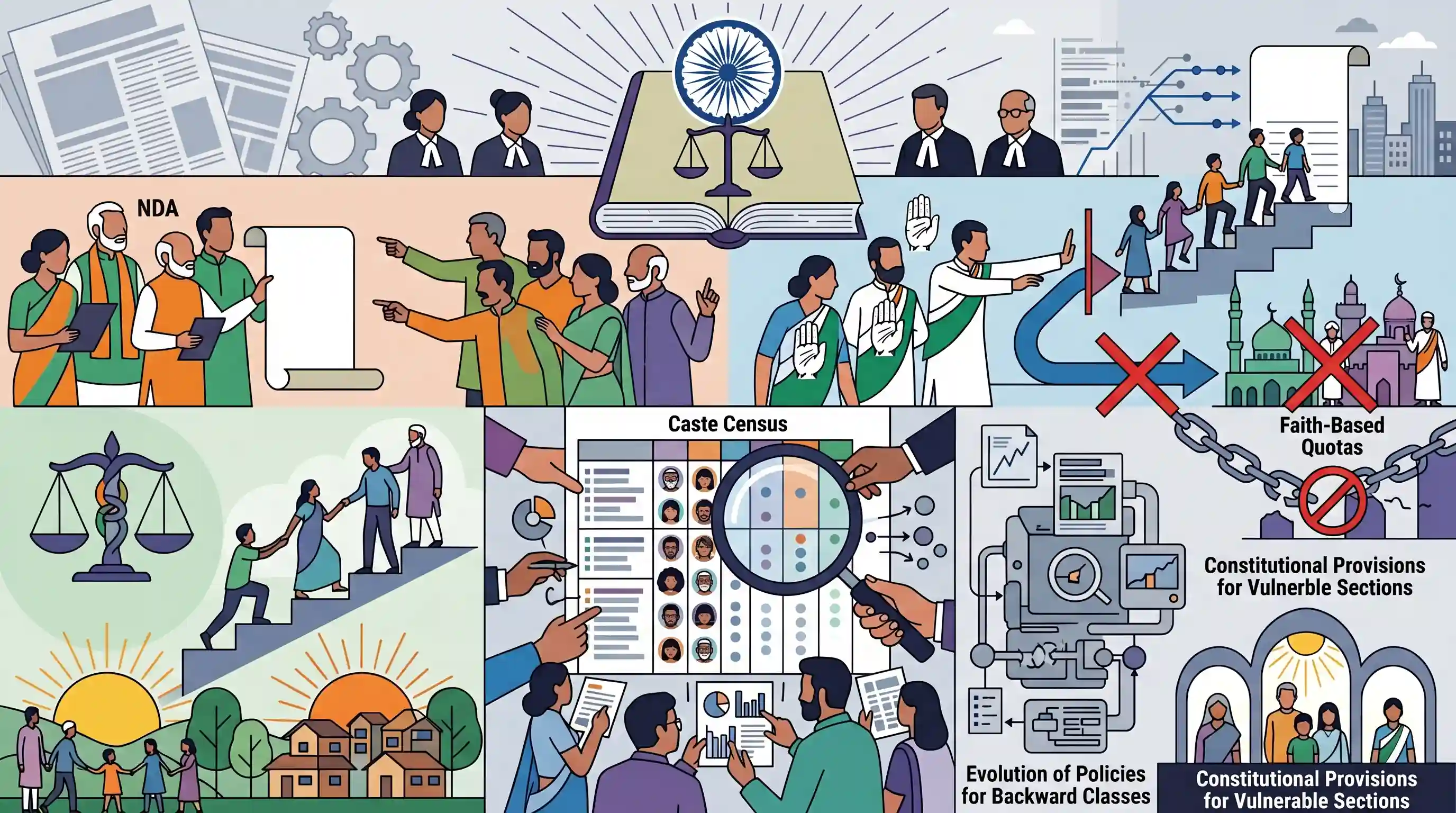
An NDA meeting resolution criticized the Congress party amid the ongoing debate over a nationwide caste census. The resolution claimed that Congress historically opposed the Mandal Commission's recommendations for OBC reservations while simultaneously supporting unconstitutional 'faith-based quotas' (religion-based reservations). This political maneuvering highlights the deeply contested nature of social justice policies, drawing attention to the constitutional framework governing reservations (Articles 15 and 16) and the historical evolution of policies aimed at socially and educationally backward classes.
Key Points
- The NDA passed a political resolution countering the opposition's demand for a nationwide caste census by targeting the Congress party's historical record on reservations.
- The resolution alleged that Congress opposed the implementation of the Mandal Commission recommendations, which introduced 27% reservation for Other Backward Classes (OBCs).
- The NDA further accused the Congress of backing a 'faith-based quota' (religion-based reservation), arguing this undermines the constitutional reservation framework meant for Dalits, Adivasis, and backward classes.
- The debate highlights constitutional provisions surrounding reservation, specifically Articles 15 and 16, which prohibit discrimination solely on religious grounds but allow special provisions for socially and educationally backward classes.
Important Terms
Caste Census

A systematic enumeration of individuals' caste identities alongside socio-economic data during a national census exercise. Last conducted comprehensively in 1931.
UPSC context
GS Paper I (Society) and II (Social Justice). Tests understanding of demographic data's role in targeted affirmative action.
Mandal Commission
The Second Backward Classes Commission (1979) chaired by B.P. Mandal. It identified 52% of India's population as OBCs and recommended 27% reservation in government jobs.
UPSC context
GS Paper II (Governance/Social Justice). Key for questions on the evolution of reservation policy in India.
Indra Sawhney Case (1992)
The 1992 Supreme Court judgment that upheld OBC reservations while establishing the 50% ceiling on total quotas and the 'creamy layer' exclusion principle.
UPSC context
GS Paper II (Polity). Essential for understanding constitutional limits and judicial oversight of reservation policies.
Faith-based Reservation
Affirmative action quotas based on religious identity. Courts generally hold that religion alone cannot be the sole basis for reservation under Articles 15 and 16.
UPSC context
GS Paper II (Polity/Secularism). Tests knowledge of constitutional non-discrimination vs. protective discrimination for backward groups.
Articles 15 and 16
Articles 15(4) and 16(4) empower the State to make special provisions (reservations) for the advancement of backward classes in education and public employment respectively.
UPSC context
GS Paper II (Fundamental Rights). Foundational knowledge for any discussion on equality and social justice.
Socially and Educationally Backward Classes (SEBC)
A constitutional category (identified under Article 340) of groups facing historical disadvantages. Backwardness must be determined by social and educational, rather than purely economic, criteria.
UPSC context
GS Paper II (Social Justice). Tests precision in identifying the legal basis for OBC classifications.
Prelims Trap
"The Constitution expressly prohibits citizens of religious minority communities from receiving reservation benefits under Article 16."
While Article 15(1) prohibits discrimination *solely* on religion, religious minorities are not barred from reservation if they qualify as Socially and Educationally Backward Classes (SEBCs).
Static Concepts Connected
What were the key principles established by the Indra Sawhney (1992) judgement?
- 50% Ceiling: Reservation should generally not exceed 50%, barring extraordinary situations in far-flung or remote areas.
- Creamy Layer: Advanced sections among OBCs must be excluded from reservation benefits to ensure social justice reaches the truly needy.
- No Religious Quota: Religion cannot be the sole basis for determining backwardness, but religious groups can be classified as backward based on socio-educational criteria.
- Promotions Barred: The court initially barred reservations in promotions, leading Parliament to enact the 77th Amendment (Article 16(4A)).
How does the SECC 2011 structurally differ from the regular Decennial Census?
- Statutory Backing: The regular Census is conducted under the Census Act of 1948, whereas the SECC was conducted via executive action across various ministries.
- Data Confidentiality: Census data is strictly confidential under the Census Act. SECC data is open for government departments to identify scheme beneficiaries.
- Scope of Enumeration: SECC mapped rural/urban economic vulnerabilities alongside caste, though caste data was never formally published due to data classification issues.
Cross-Topic Patterns
Caste Census + 2026 Delimitation Exercise
The push for a caste census intersects directly with the 2026 delimitation freeze expiration and the Nari Shakti Vandan Adhiniyam, setting the stage for a massive overhaul of India's electoral representation.
Sub-classification within reserved categories
Debates over OBC quotas and minority inclusion mirror recent Supreme Court Constitution Bench hearings on whether states can sub-classify SC/STs to ensure equitable distribution among the most marginalized.

Expect a Prelims 2026 question distinguishing Article 15(1) non-discrimination from minority inclusion under SEBC criteria (Indra Sawhney).
Linked PYQs · 3
Linked PYQs · 3
- 2022MainsGS2
Discuss the role of the National Commission for Backward Classes in the wake of its transformation from a statutory body to a constitutional body.
- 2018MainsGS2
Whether National Commission for Scheduled Castes (NCSC) can enforce the implementation of constitutional reservation for the Scheduled Castes in the religious minority institutions? Examine.
- 2023PrelimsGS1
Consider the following organizations/bodies in India: 1. The National Commission for Backward Classes 2. The National Human Rights Commission 3. The National Law Commission 4. The National Consumer Disputes Redressal Commission How many of the above are constitutional bodies?
