Caste Census Demands: Telangana Template and Reservation Caps
Source:Indian Express ↗
Why It Matters
The article underscores the ongoing political and legal contention surrounding India's affirmative action policies. The push to dismantle the 50% reservation cap and the necessity of a socio-economic caste census directly engage with core UPSC syllabus themes like social justice, constitutional provisions for vulnerable sections, and judicial precedents. It reflects the practical challenges and evolving strategies in delivering equitable representation to marginalized communities as envisioned by the Constitution.
Summary
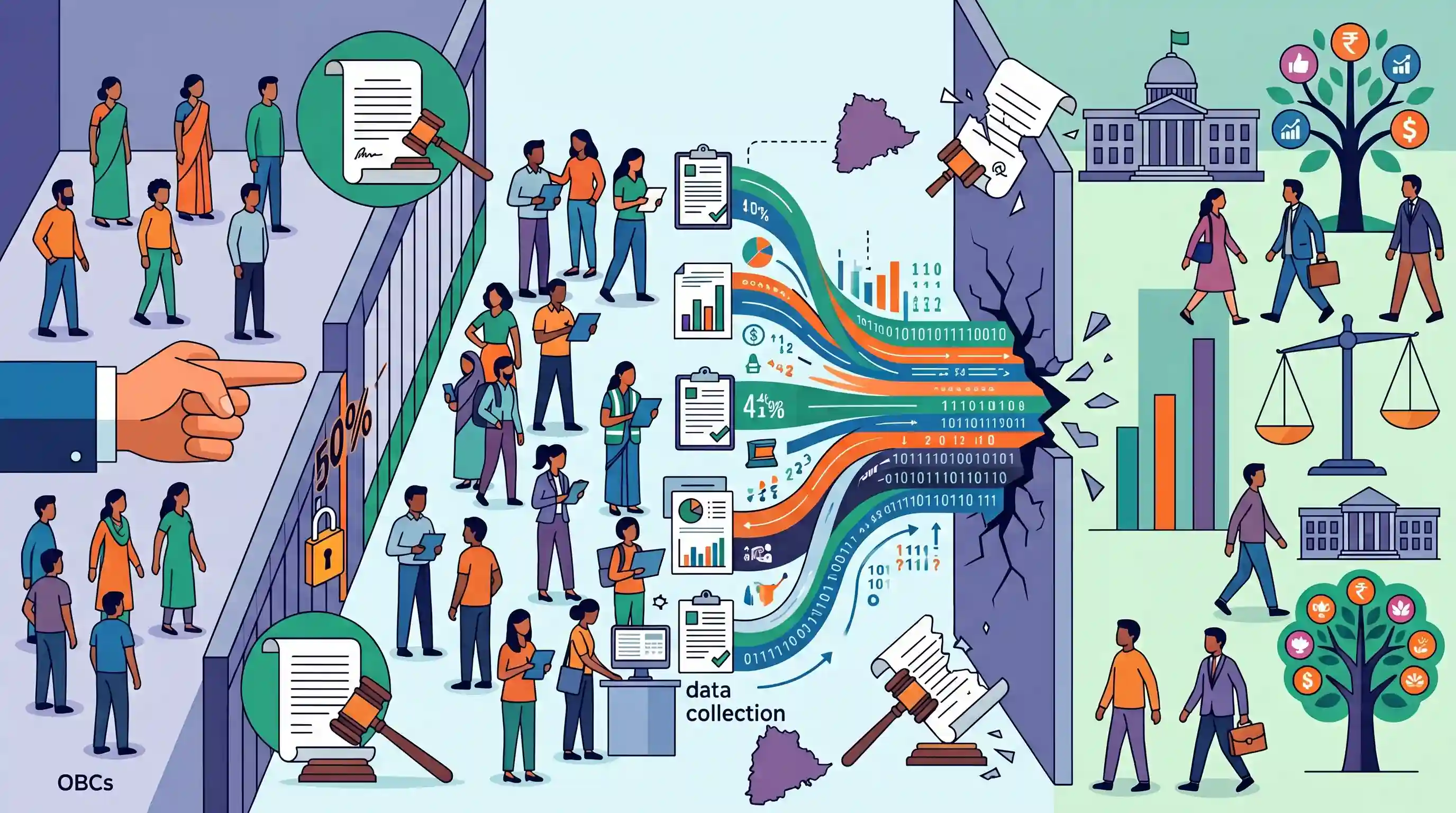
The Congress party's OBC department has strongly advocated for the adoption of the 'Telangana template' to conduct a comprehensive caste census. The political body is also demanding the removal of the 50% cap on reservations, which was established by the Supreme Court's Indra Sawhney judgment in 1992. Breaking this ceiling is increasingly viewed by political groups as essential for expanding affirmative action for Other Backward Classes (OBCs). The demand for a caste census is fundamentally tied to this objective, as quantifiable socio-economic and population data is legally mandated by the judiciary to justify exceeding the existing quota limits and ensuring proportionate representation.
Key Points
- The Congress OBC department is advocating for a nationwide Caste Census modeled on the recent 'Telangana template' to gather detailed socio-economic and educational data.
- A central demand is the removal of the 50% maximum cap on caste-based reservations to allow for proportionate representation.
- The 50% upper limit on reservations was established by the Supreme Court in the landmark 1992 Indra Sawhney vs. Union of India judgment.
- A caste census is viewed as a critical legal prerequisite, as the Supreme Court requires quantifiable empirical data to justify breaching the 50% quota limit.
- The political push underscores the evolving nature of caste mobilization and the ongoing debates over the scope of affirmative action and constitutional equity in India.
Important Terms
Indra Sawhney Judgment (1992)

Landmark 1992 Supreme Court verdict upholding 27% OBC reservation while capping total reservations at 50%. It introduced the 'creamy layer' concept to exclude affluent individuals from benefit eligibility.
UPSC context
GS II: Judiciary and Social Justice. Fundamental for understanding constitutional limits on affirmative action and the 'creamy layer' principle.
Socio-Economic Caste Census (SECC)
A demographic exercise to collect household socio-economic and caste data. It provides 'quantifiable data' required by courts to justify reservation quotas and ensure effective targeting of welfare schemes.
UPSC context
GS I: Indian Society; GS II: Governance. Crucial for discussing data-driven policymaking and updating 1931-based reservation metrics.
National Commission for Backward Classes (NCBC)
A constitutional body established under Article 338B via the 102nd Amendment (2018). It investigates safeguards for socially and educationally backward classes and advises on their welfare and development.
UPSC context
GS II: Constitutional Bodies. Key for questions on institutional protections for marginalized groups and identifying backward classes.
50% Reservation Ceiling
A judicial ceiling established in the Indra Sawhney case to ensure reservations remain an exception. It balances the right to equality (Article 16(1)) with social justice (Article 16(4)).
UPSC context
GS II: Fundamental Rights and Governance. A central theme in debates regarding quota expansion and judicial review of state laws.
Telangana Template (SEEEPC Survey)
A 2024 state-wide door-to-door survey collecting detailed data on caste, education, and income. It serves as a model for using localized data to justify proportional representation and welfare.
UPSC context
GS II: Federalism and Social Justice. Exemplifies state-led initiatives to provide empirical evidence for updating social justice frameworks.
Article 340
A constitutional provision empowering the President to appoint commissions to investigate the conditions of socially and educationally backward classes and recommend steps for their advancement.
UPSC context
GS II: Indian Constitution. Essential for understanding the legal origins of various backward class commissions and national reservation policies.
Prelims Trap
The 50% upper limit on reservations is a constitutional mandate prescribed under Article 16(4) of the Indian Constitution.
The 50% cap is a judicial construct from the 1992 Indra Sawhney judgment, not a constitutional provision. Furthermore, the 103rd Amendment (EWS) legally exceeded this limit.
Static Concepts Connected
What are the key principles established by the Indra Sawhney (1992) judgment?
- 50% Ceiling: Capped total reservations at 50%, stating affirmative action must not compromise the fundamental rule of equality.
- Creamy Layer: Introduced the 'creamy layer' exclusion for OBCs to ensure benefits reach the genuinely socio-economically backward individuals.
- No Promotions Quota: Ruled out reservations in promotions, a restriction Parliament later bypassed via the 77th Constitutional Amendment.
Which Constitutional provisions govern the welfare and identification of Backward Classes?
- Article 340: Empowers the President to appoint a commission to investigate the conditions of socially and educationally backward classes.
- Article 338B: Inserted via the 102nd Amendment, it granted constitutional status to the National Commission for Backward Classes (NCBC).
- Articles 15(4) & 16(4): Enable the State to make special provisions for the advancement and adequate representation of backward classes in education and public employment.
Cross-Topic Patterns
Caste Data Collection vs. Right to Privacy
Large-scale socio-economic surveys collecting granular household data test the boundaries of the right to privacy and the 'proportional state interest' doctrine outlined in the Justice Puttaswamy judgment.
EWS Quota and the 50% Ceiling Precedent
The Supreme Court's upholding of the 103rd Amendment (EWS quota) legally breached the 50% ceiling, providing judicial precedent and ammunition for states demanding proportionate OBC quotas.
OBC Sub-categorization (Justice Rohini Commission)
Accurate caste enumeration directly supports the Justice Rohini Commission's mandate to rationalise quotas, ensuring equitable distribution of reservation benefits among the most marginalised OBC sub-castes.

Caste census + Article 340 + 102nd Amendment (NCBC) + judicial criteria for breaching the 50% cap will likely form a 2026 Prelims question.
Linked PYQs · 4
Linked PYQs · 4
- 2024MainsGS1
Despite comprehensive policies for equity and social justice, underprivileged sections are not yet getting the full benefits of affirmative action envisaged by the Constitution. Comment.
- 2022MainsGS2
Discuss the role of the National Commission for Backward Classes in the wake of its transformation from a statutory body to a constitutional body.
- 2023PrelimsGS1
Consider the following organizations/bodies in India: 1. The National Commission for Backward Classes 2. The National Human Rights Commission 3. The National Law Commission 4. The National Consumer Disputes Redressal Commission How many of the above are constitutional bodies?
- 2018MainsGS1
Caste system is assuming new identities and associational forms. Hence, caste system cannot be eradicated in India." Comment.
